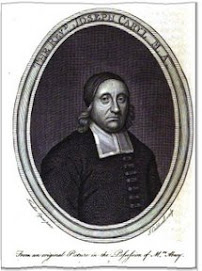
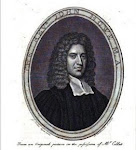
Mr Joseph Allen, the ejected minister of Taunton, was, on May 26th, 1663, committed to Ilchester jail for singing psalms in his own house, and preaching to his family, others being present. Here he continued a year, but upon his enlargement, returned again to his work, which he followed with unwearied diligence. But in the next year he was committed a second time to jail, with several other ministers, and forty private persons, where he contracted such distempers and weaknesses, as brought him to his grave before he was thirty-six years of age. He was an awakening, lively preacher, zealous and successful in his Master's work, and of a peaceable and quiet spirit.
Showing posts with label Devon. Show all posts
Showing posts with label Devon. Show all posts
Wednesday, 3 August 2011

Monday, 18 July 2011
Coleman Anecdote 03 Robert Collins
In the same county (of Devon) our attention may be directed to a Mr [Robert] Collins, who preached in his own house after his ejectment. But under the "Conventicle Act," one Lord's day in September, 1670, his house was surrounded with the officers and the vilest rabble of the town, who, not daring to break open the doors till they had obtained a warrant from a neighbouring justice, kept the congregation prisoners till night, when the warrant arrived. On forcing the doors, the gentlemen and the rabble treated both the minister and the people with great incivility. They wrote down the names of whom they pleased; took some into custody ; had warrants issued out for levying £20 on Mr Collins for preaching, £20 on the house, and 5s on each of the hearers, though they could produce no proof that there was any preaching or praying at all. After this followed breaking open of houses and shops, taking away goods and wares, forcing open gates, driving off cattle and exposing to sale for the raising of the fines.
On another occasion he was brought before a justice of the peace, who treated him and some others with great inhumanity, calling Mr Collins a minister of the devil, using other abusive and scurrilous language; and when Mr C offered to reply, threatening him with the jail, and interlacing his words with oaths and curses. On another occasion he and his wife went on horseback to attend a funeral, and a constable, by a warrant he obtained, seized them both. But at length his wife was set at liberty, and he was taken to the constable's house, and kept there under a guard, night and day, from Wednesday to Friday, when he was brought before the magistrate, and had the "Corporation Oath" tendered. On his refusing it, he was sent to the high jail, though a thousand pounds bail was offered, where he lay six months with the common prisoners, though while there he was considered to have heen the instrument of converting a poor prisoner that was executed. He was repeatedly persecuted for not attending divine service at church; also for living within five miles of the place where he had been minister; till he was at last constrained to leave his family and the kingdom and to withdraw to Holland, at the loss of several hundred pounds, and was obliged to sell a very handsome mansion-house, and a fine estate adjoining, to maintain himself and his family in their distracted condition. He was a grave and holy man. At his death he left £20 towards building a new meeting house.
Friday, 15 July 2011
Coleman Anecdote 02 Nosworthy
In the county of Devon we find a Mr Nosworthy meeting with many enemies and much opposition. One Mr Stowell distinguished himself in his furious zeal against him; and with _____ Bevan, Esq., came
into his meeting and required him to come down. He was advised by an attorney who was present to keep his place; but they threatened to pull him out of the pulpit, and at length obliged him to come down. The same person more than once disturbed his meeting afterwards; and one time, on a week-day, with drums and muskets, which so frightened Mrs Nosworthy that it was thought to occasion her death. In consequence of his having a service in his house, they convicted him for holding a conventicle, imposed upon him a fine of £20, and £20 upon the house. Yet he was a man whose learning and other ministerial qualifications were considerable. The neighbouring ministers paid great deference to his judgment, and often made him moderator in their debates. After his death, several of his enemies were troubled on account of the disturbances they had given him, and sent to his children, who were eminent for their piety, begging their prayers, and desiring forgiveness of the injury they had done their families.
Subscribe to:
Posts (Atom)