Showing posts with label Judge Jeffreys. Show all posts

Thursday, 7 September 2017

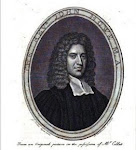
Bunhill Fields Thomas Rosewell 1630-1692

In his book on Bunhill Fields Alfred W Light tells that turning the back on Bunyan's tomb, and leaving the path to the left, the visitor will see, about five rows of stones ahead but nearer the railings, the now "double " headstone of Thomas Rosewell. On the original stone there was a Latin inscription, of which the translation is given as follows: — 
Here lieth the body of that celebrated divine, Thomas Rosewell, M.A. A man not more eminent for his learning than for his piety and modesty; a preacher distinguished for judgment, eloquence, and study ; a most diligent and skilful interpreter of the sacred volume. Who after many labours, and through the iniquities of the times, and many bitter sufferings, which for the sake of Christ be bore with the greatest fortitude, calmly departed this life at Rotherhithe, February 15th, in the 62nd year of his age, and of Christ, 1692.
There is now this inscription: — 
Thomas Rosewell, Nonconformist Minister, Rotherhithe. Died 1692. Tried for High Treason under the infamous Jefferies. See "State Trials, 1684.
Mr. Rosewell was born at Dunkerton, near Bath, on May 3rd, 1630, and his mother and father both died before he was ten years old. He and his sister had a considerable fortune bequeathed to them, but this was dissipated whilst living with an uncle during their minority. When about 16 years of age he began to sit under the ministry of Mr. Matthew Haviland, and to his preaching Rosewell always confessed that he owed his conversion. After spending some time under a tutor in London, he removed in March, 1674, to Pembroke College, Oxford, where he prosecuted his studies under Dr. Langley. He entered the ministry of the Church of England, and was presented to the rectory at Rhode in Somersetshire, in 1653, and in 1657 to Sutton Mandeville in Wilts. He was vicar here in 1662 when the Act of Uniformity came into force, and was one of the noble men who suffered ejectment then. He now became tutor to the son of Lady Hungerford, but in 1674 he was elected minister of the Presbyterian congregation meeting at Rotherhithe. In spite of much persecution he continued preaching, but he was tried for high treason in 1685. Daniel Neal gives an account of this in his History as follows: —
"Jefferies, now Lord Chief Justice of England, who was scandalously vicious, and drunk every day, besides a drunkenness of fury in his temper that looked like madness, was prepared for any dirty work the court should put him upon. September 23rd, Mr. Thomas Rosewell, the Dissenting minister at Rotherhithe, was imprisoned in the Gate House, Westminster, for high treason; and a Bill was found against him at the Quarter Sessions, upon which he was tried on November 8th at the King's Bench Bar, by a Surrey jury, before Lord Chief Justice Jefferies, and his brethren (viz.) Withins, Holloway, and Walcot. He was indicted for the following expressions in his sermon of September 14th:
"That the King could not cure the King's evil, but the priests and prophets by their prayers could heal the griefs of the people; that we had had two wicked Kings (meaning tke present King and his father), whom we can resemble to no other person but to the most wicked Jeroboam; and that if they (meaning his hearers), would stand to their principles, he did not doubt, but they should overcome their enemies (meaning the King), as in former times, with rams' horns, broken platters, and a stone in a sling.'
The witnesses were three infamous women, who swore to the words without the innuendos; but they were laden with the guilt of many perjuries already, and such of them as could be found afterwards, were convicted, and the chief of them pilloried before the Exchange. The trial lasted seven hours, and Mr. Rosewell behaved with all the decency and respect to the Court that could be expected, and made a defence that was applauded by most of the hearers. He said it was impossible the witnesses should remember, and be able to pronounce so long a period, when they could not so much as tell the text, nor anything else in the sermon, besides the words they had sworn. Several who heard the sermon and writ it in shorthand, declared they heard no such words. Mr. Rosewell offered his own notes to prove it, but no regard was had to them. The women could not prove (says Burnet), by any one circumstance, that they were at the meeting; or that any person saw them there on that day; the words they swore were so gross, that it was not to be imagined that any man in his wits would express himself so, before a mixed assembly: yet Jefferies urged the matter with his usual vehemence. He laid it for a foundation, that all preaching at conventicles was treasonable, and that this ought to dispose the jury to believe any evidence upon that head, so the jury brought him in guilty; upon which (says the bishop), there was a shameful rejoicing; and it was now thought, all conventicles must be suppressed, when such evidence could be received against such a defence. But when the words came to be examined by men learned in the law, they were found not to be treason by any Statute. So Mr. Rosewell moved in arrest of judgement, and though it was doubtful, whether the motion was proper on this foundation after the verdict, yet the King was so out of countenance at the accounts he heard of the witnesses, that he gave orders to yield to it; and in the end he was pardoned. The Court lost a great deal of reputation by this trial, for besides that Rosewell made a strong defence, he proved that he had always been a loyal man even in Cromwell's days, that he prayed constantly for the king in his family, and that in his sermons he often insisted upon the obligations to loyalty."
The manner of his escape was quite unusual. For once a Dissenter who had been condemned to death, and who was bitterly hated by Jefferies, did not suffer the full penalty of the law. Sir John Talbot, who had been present at the trial, went to the King, and speaking quite plainly, told him, "that he had seen the life of a gentleman and a scholar dependent on such evidence as he would not hang his dog on." He also said, "Sir, if your Majesty suffers this man to die, we are none of us safe in our houses." Just at this moment Jefferies, delighted with what he had done, burst into the room, and with much joyful pleasure told the King what a good deed he had accomplished, and what great service he had rendered to his Master. The surprise of Jefferies may be imagined when Charles II told him that Rosewell should not die, but that he must by some means make a way of escape. This was most unpalatable to Jefferies, who was simply thirsting for the blood of Rosewell, but a new trial was ordered, and Counsel was assigned the condemned man in order to plead the insufficiency of the indictment in arrest of judgment. There was an adjournment until the following term, and in the meantime the King granted Rosewell a pardon and he was discharged.
The prosecution of Rosewell was particularly unjust in that whilst a strong Puritan, he always had a very kindly feeling towards the Stuart family. While he was a schoolboy at Bath during the Civil War, the King's army seized the town, and the school was broken up. It was about this time that while he was taking a walk from home, he saw Charles I in a field, sitting at dinner under a tree with a few persons around him. This occurrence always disposed him to be loyal to the Royal Family, but it in no way influenced Jefferies in his decision.
His death took place on February 14th, 1692, in the 62nd year of his age, so that he outlived his trial about seven years.
Wikipedia article here.

Wednesday, 19 September 2012

Coleman Anecdote 20 Judge Jeffreys and Philip Henry

The conduct of Jeffreys to Philip Henry. 
Having presented several cases in which the conduct of the Chief Justice appears as little else than a compound of cruelty, injustice, and profaneness, it will be proper to record one instance in which he acted in a different manner, which shows some remaining influence of early education on such a mind as his.
Some time after the prosecution of Philip Henry, as related in a preceding page, Judge Jeffreys attended at the assizes for Flintshire, and it was remarked that he did not in private conversation appear to applaud what was done in this matter, as was expected. It was also said that he spoke with some respect of Mr. Henry, saying, "he knew him and his character well, and that he was a great friend of his mother's
" - Mrs. Jeffreys, of Acton, near Wrexham, a very pious, good woman - "and that sometimes, at his mother's request, Mr. Henry had examined him in his learning when he was a schoolboy, and had commended his proficiency." And it was much wondered at by many, that of all the times Sir George Jeffreys went that circuit, though it is well known what was his temper, and what the temper of those times, yet he never sought any occasion against Mr. Henry, nor took the occasions that were offered, nor countenanced any trouble that was intended him.
One particular circumstance may be recorded. There had been an agreement among several ministers to spend some time, either in secret or in their families, or both, between six and eight o'clock every Monday morning, in prayer, for the Church of God and for the land and nation, more fully and particularly than at other times, and to make that their special errand at a throne of grace, and to engage as many of their praying friends as ever they could to the observance of it. This had been communicated by Mr. Henry to.
 some of his friends in London, and he punctually observed it in his own practice. He also mentioned it to some of his acquaintances, who observed it in like manner.
It happened that Mr. Ambrose Lewis, a minister in Derbyshire, to whom he had communicated this, was so well pleased with it that he wrote a letter concerning it to a friend of his at a distance, which letter happened to fall into hands that perverted it, and made information upon it against the writer and receiver of the letter, who were bound over to the assizes; and great suspicions Sir George Jeffreys had that it was a branch of the Presbyterian plot, and rallied the parties accused severely.
At length it appeared, either by the letter or the confession of the parties, that they received the project from Mr. Henry, which it was greatly feared would bring him into trouble; but Sir George, to the admiration of many, let it fall, and never inquired further into it.
It appears that there are some men "whose ways so please the Lord, that he makes even their enemies to be at peace with them;" and there is nothing lost by trusting in God.

Monday, 16 April 2012

Coleman Anecdote 18 Alice Lisle

Alice Lisle, Her Trial and Execution
In Hampshire, John Hickes, a Nonconformist divine, and Richard Nelthorpe, a lawyer, who had been outlawed for his share in the Eye House Plot, had sought refuge at the house of Alice, widow of John Lisle. John Lisle had sat in the Long Parliament, and in the High Court of Justice; had been a Commissioner of the Great Seal, in the days of the Commonwealth; and had been created a Lord by Cromwell. The titles given by the Protector had not been recognised by any Government which had ruled England since the downfall of his house; but they appear to have been often used in conversation, even by Royalists. John Lisle's widow was, therefore, commonly known as the Lady Alice. She was related to many respectable, and to some noble families; and she was generally esteemed, even by the other gentry of her county, for it was well known to them that she had deeply regretted some violent acts in which her husband had borne a part; that she had shed bitter tears for Charles I; and that she protected and relieved many Cavaliers in their distress. The same womanly kindness which had led her to befriend the Royalists in their time of trouble, would not suffer her to refuse a meal and a hiding-place to the wretched men who now entreated her to protect them. She took them into her house; set meat and drink before them, and showed them where they might take rest. The next morning her dwelling was surrounded by soldiers. Strict search was made; Hickes was found concealed in a malt-house, and Nelthorpe in a chimney. If Lady Alice knew her guests to have been concerned in the insurrection in the west, she was undoubtedly guilty of what, in strictness, is a capital crime; "for the law of principal and accessory then was, and is to this day," remarks Macaulay, "in a state disgraceful to English jurisprudence." Odious as the law was, it was strained for the purpose of destroying Alice Lisle. She could not, according to the doctrine laid down by the highest authority, be convicted till after the conviction of the rebels whom she had harboured. She was, however, set to the bar before either Hickes or Nelthorpe had been tried. It was no easy matter in such a case to obtain a verdict for the Crown. The witnesses prevaricated. The jury, consisting of the principal gentlemen of Hampshire, shrank from the thought of sending a fellow-creature to the stake for conduct which seemed rather deserving of praise than of blame. Jeffreys was beside himself with fury. This was the first case of treason on the circuit, and there seemed to be a strong probability that his prey would escape him. He stormed, cursed, and swore, in language which no well-bred man would have used at a. race or a cock-fight. One witness, named Dunne, partly from concern for Lady Alice, and partly from fright at the threats and maledictions of the Chief Justice, entirely lost his head, and at last stood silent. "Oh how hard the truth is," said Jeffreys, "to come -out of a lying Presbyterian knave!" The witness, after a pause of some minutes, stammered a few unmeaning words. "Was there ever," exclaimed the judge, with an oath, "was there ever such a villain on the face of the -earth r1 Dost thou believe there is a God? Dost thou believe in hell fire? Of all the witnesses I ever met with, I never saw thy fellow." Still the poor man, scared out of his senses, remained mute. And again Jeffreys burst forth :— "I hope, gentlemen of the jury, that you take notice of the horrible carriage of this fellow. How can one help abhorring these men and their religion? A Turk is a saint to such a fellow as this. A Pagan would be ashamed of such villainy. O blessed Jesus! what a generation of vipers do we live among." "I cannot tell what to say, my lord," faltered Dunne. The judge again broke forth into a volley of oaths. "Was there ever," he cried, "such an impudent rascal? Hold a candle to him, that we may see his brazen face. You, gentlemen, that are counsel for the Crown, see that an information for perjury be preferred against this fellow." After the witnesses had been thus handled, the Lady Alice was called on for her defence. She began by saying, "That though she knew Hickes to be in trouble when she took him in, she did not know or suspect that he had been concerned in the rebellion. He was a divine, a man of peace. It had, therefore, never occurred to her that he could have borne arms against the Government; and she had supposed that he wished to conceal himself because warrants were out against him for field preaching." The Chief Justice began to storm. "There is not one of these lying, snivelling, canting Presbyterians, but, one way or another, have a hand in rebellion. Presbytery has all manner of villainy in it. Nothing but Presbytery could have made Dunne such a rogue. Show me a Presbyterian, and I'll show you a lying knave." He summed up in the same style, declaiming during an hour against Whigs and Dissenters, and reminding the jury that the prisoner's husband had borne a part in the death of Charles I., a fact which was not proved by any testimony, and which, if it had been proved, would have been utterly irrelevant to the issue. The jury retired, and remained long in consultation. The judge grew impatient. He could not conceive how, in so plain a case, they should ever have left the box. He sent a messenger to tell them, that if they did not instantly return, he would adjourn the court and lock them up all night. Thus put to the torture, they came, but came to say "that they doubted whether the charge had been made out." Jeffreys expostulated with them vehemently, and after another consultation, they gave a reluctant verdict of guilty. Our historians give different statements in reference to the conduct of the jury. Rapin says, " They found her not guilty three times." Burnet says, "They brought her in the second time not guilty, but, overcome with fear, they brought her in the third time guilty;" while Macaulay only gives the one statement of not guilty, or, "That they doubted whether the charge had been made out." On the following morning sentence was pronounced. Jeffreys gave directions that Alice Lisleshould be burned alive that afternoon! This excess of barbarity moved the pity and indignation of that class which was most devoted to the Crown. The clergy of Winchester Cathedral remonstrated with the Chief Justice, who, brutal as he was, was not mad enough to risk a quarrel on such a subject, with a body so much respected by the Tory party. He consented to put off the execution five days. During that time the friends of the prisoner besought James to show her mercy. Ladies of high rank interceded for her. Feversham, whose recent victory had increased his influence at Court, and who, it is said, had been bribed to take the compassionate side, spoke in her favour. Clarendon, the king's brother-in-law, pleaded her cause; but all was in vain. The utmost that could be obtained was, that her sentence should be commuted from burning to beheading. She was put to death on the scaffold in the market-place of Winchester, and she passed through it with serene courage. She was a woman of fine understanding, as well as exalted devotion and benevolence, and she behaved in the most heroic manner at the place of execution. The speech which, notwithstanding her advanced age, she delivered on the scaffold, is said to have commenced with a religious exordium, expressive of the patience and submission of her soul to the Divine will.

Tuesday, 27 March 2012

Coleman Anecdote 17b Baxter and Jeffreys

At the time of Baxter's trial and imprisonment, Matthew Henry was in London pursuing his studies .-at Gray's Inn. Whether he witnessed the public obloquy of his father's ancient and beloved friend does not appear; but he went to visit him in his prison, and in giving an account of this visit in a letter to his father, he says: "I found him in pretty comfortable circumstances, though a prisoner, in a private house near the prison, attended on by his own man and maid. He is in as good health as one can expect, and methinks looks better and speaks heartier than when I saw him last. The token you sent he would by no means be persuaded to accept of, and was almost angry when I pressed it from one outed (»'. e., cast out of the Church) as well as himself. He said he did not use to receive ; and I understand since his need is not great. We sat with him about an hour. . . . He gave us some good counsel to prepare for trials; and said the best preparation for them was a life of faith, and a constant course of self-denial. He thought it harder constantly to deny temptations to sensual lusts and pleasures, than to resist one single temptation to deny Christ for fear of suffering; the former requiring such constant watchfulness—however, after the former, the latter will be easier. He said, we who are young are apt to count upon great things, but we must not look for it; and much more to the same purpose. He said he thought dying by sickness usually much more painful and dreadful than dying a violent death: especially considering the extraordinary supports which those have who suffer for righteousness' sake." It is gratifying to find on record such a testimony to the comfort of the suffering saint in his confinement. I would now conduct our readers to another court, and lead them to behold another case, yet more affecting than that of Baxter, for here he will be called to see one of England's highly esteemed matrons, who had been connected with the Nonconformists, and who had now sheltered one of their ministers, called to stand before the same judge, and by him consigned to death.
Alice Lisle, Her Trial and Execution. In Hampshire, John Hickes, a Nonconformist divine, and Richard Nelthorpe, a lawyer, who had been outlawed for his share in the Eye House Plot, had sought refuge at the house of Alice, widow of John Lisle. John Lisle had sat in the Long Parliament, and in the High Court of Justice; had been a Commissioner of the Great Seal, in the days of the Commonwealth; and had been created a Lord by Cromwell. The titles given by the Protector had not been recognised by any Government which had ruled England since the downfall of his house; but they appear to have been often used in conversation, even by Royalists. John Lisle's widow was, therefore, commonly known as the Lady Alice. She was related to many respectable, and to some noble families; and she was generally esteemed, even by the other gentry of her county, for it was well known to them that she had deeply regretted some violent acts in which her husband had borne a part; that she had shed bitter tears for Charles I.; and that she protected and relieved many Cavaliers in their distress. The same womanly kindness which had led her to befriend the Royalists in their time of trouble, would not suffer her to refuse a meal and a hiding-place to the wretched men who now entreated her to protect them. She took them into her house; set meat and drink before them, and showed them where they might take rest. The next morning her dwelling was surrounded by soldiers. Strict search was made; Hickes was found concealed in a malt-house, and Nelthorpe in a chimney. If Lady Alice knew her guests to have been concerned in the insurrection in the west, she was undoubtedly guilty of what, in strictness, is a capital crime; "for the law of principal and accessory then was, |) and is to this day," remarks Macaulay, "in a state disgraceful to English jurisprudence." Odious as the law was, it was strained for the purpose of destroying Alice Lisle. She could not, according to the doctrine laid down by the highest authority, be convicted till after the conviction of the rebels whom she had harboured. She was, however, set to the bar before either Hickes or Nelthorpe had been tried. It was no easy matter in such a case to obtain a verdict for the Crown. The witnesses prevaricated. The jury, consisting of the principal gentlemen of Hampshire, shrank from the thought of sending a fellow-creature to the stake for conduct which seemed rather deserving of praise than of blame. Jeffreys was beside himself with fury. This was the first case of treason on the circuit, and there seemed to be a strong probability that his prey would escape him. He stormed, cursed, and swore, in language which no well-bred man would have used at a. race or a cock-fight. One witness, named Dunne, partly from concern for Lady Alice, and partly from fright at the threats and maledictions of the Chief Justice, entirely lost his head, and at last stood silent. "Oh how hard the truth is," said Jeffreys, "to come -out of a lying Presbyterian knave!" The witness, after a pause of some minutes, stammered a few unmeaning words.
"Was there ever," exclaimed the judge, with an oath, "was there ever such a villain on the face of the -earth r1 Dost thou believe there is a God? Dost thou believe in hell fire? Of all the witnesses I ever met with, I never saw thy fellow." Still the poor man, scared out of his senses, remained mute. And again Jeffreys burst forth :— "I hope, gentlemen of the jury, that you take notice of the horrible carriage of this fellow. How can one help abhorring these men and their religion? A Turk is a saint to such a fellow as this. A Pagan would be ashamed of such villainy. O blessed Jesus! what a generation of vipers do we live among." "I cannot tell what to say, my lord," faltered Dunne. The judge again broke forth into a volley of oaths. "Was there ever," he cried, "such an impudent rascal? Hold a candle to him, that we may see his brazen face. You, gentlemen, that are counsel for the Crown, see that an information for perjury be preferred against this fellow." After the witnesses had been thus handled, the Lady Alice was called on for her defence. She began by saying, "That though she knew Hickes to be in trouble when she took him in, she did not know or suspect that he had been concerned in the rebellion. He was a divine, a man of peace. It had, therefore, never occurred to her that he could have borne arms against the Government; and she had supposed that he wished to conceal himself because warrants were out against him for field preaching." The Chief Justice began to storm. "There is not one of these lying, snivelling, canting Presbyterians, but, one way or another, have a hand in rebellion. Presbytery has all manner of villainy in it. Nothing but Presbytery could have made Dunne such a rogue. Show me a Presbyterian, and I'll show you a lying knave." He summed up in the same style, declaiming during an hour against Whigs and Dissenters, and reminding the jury that the prisoner's husband had borne a part in the death of Charles I., a fact which was not proved by any testimony, and which, if it had been proved, would have been utterly irrelevant to the issue. The jury retired, and remained long in consultation. The judge grew impatient. He could not conceive how, in so plain a case, they should ever have left the box. He sent a messenger to tell them, that if they did not instantly return, he would adjourn the court and lock them up all night. Thus put to the torture, they came, but came to say "that they doubted whether the charge had been made out." Jeffreys expostulated with them vehemently, and after another consultation, they gave a reluctant verdict of guilty. Our historians give different statements in reference to the conduct of the jury. Rapin says, "They found her not guilty three times." Burnet says, "They brought her in the second time not guilty, but, overcome with fear, they brought her in the third time guilty;" while Macaulay only gives the one statement of not guilty, or, "That they doubted whether the charge had been made out." On the following morning sentence was pronounced. Jeffreys gave directions that Alice Lisle should be burned alive that afternoon! This excess of barbarity moved the pity and indignation of that class which was most devoted to the Crown. The clergy of Winchester Cathedral remonstrated with the Chief Justice, who, brutal as he was, was not mad enough to risk a quarrel on such a subject, with a body so much respected by the Tory party. He consented to put off the execution five days. During that time the friends of the prisoner besought James to show her mercy. Ladies of high rank interceded for her. Feversham, whose recent victory had increased his influence at Court, and who, it is said, had been bribed to take the compassionate side, spoke in her favour. Clarendon, the king's brother-in-law, pleaded her cause; but all was in vain. The utmost \ that could be obtained was, that her sentence should 'be commuted from burning to beheading. She was put to death on the scaffold in the market-place of Winchester, and she passed through it with serene courage. She was a woman of fine understanding, as well as exalted devotion and benevolence, and she behaved in the most heroic manner at the place of execution. The speech which, notwithstanding her advanced age, she delivered on the scaffold, is said to have commenced with a religious exordium, expressive of the patience and submission of her soul to the Divine will.

Coleman Anecdote 17a Baxter and Jeffreys

Baxter before Judge Jeffreys
The following remarkable scene—a scene which, in all its parts, tells most impressively to the honour of Baxter, and to the condemnation of Jeffreys—took place in the Court of King's Bench on May 30th, 1684. In a commentary on the New Testament, written by Baxter, he had complained with some bitterness of the persecutions which the Dissenters suffered; and the main charge was, that in some passages he had reflected on the prelates of the Church of England, and so was guilty of sedition. We will give our readers one of these passages, that they may judge of the nature of this charge. After explaining Matt. v. 19, he observes, "Are not those preachers and prelates, then, the least and basest that preach and tread down Christian love of all that dissent from any of their presumptions, and so preach down not the least but the great command?" "That men who, for not using the prayer-book," says Macaulay, "had been driven from their homes, stripped of their property, and locked up in dungeons, should' dare to utter a murmur, was then thought to be a high crime against the State and the Church." Roger Lestrange, the champion of the government and the oracle of the clergy, sounded the note of war in the "Observator." An information was filed; Baxter begged that he might be allowed some time to prepare for his defence. It was on the day on which Oates was pilloried in Palace Yard that the illustrious chief, the Puritan, oppressed by age and infirmity, came to Westminster Hall to make this request. Jeffreys burst into a storm of rage. "Not a minute," he cried, "to save his life. I can deal with saints as well as with sinners. There stands Oates on one side of the pillory, and if Baxter stood on the other, the two greatest rogues in the kingdom would stand together." "When the trial came on at Guildhall a crowd of those who loved and honoured Baxter filled the court. At his side stood Dr. William Bates, one of the most eminent Nonconformist divines. Two "Whig barristers of great note, Pollexfen and Wallop, appeared for the defence. Pollexfen had scarcely begun his address to the jury, when the Chief Justice broke forth, "Ah, Pollexfen! I know you well. I will set a mark upon you. You are a patron of the faction. This is an old rogue, a schismatical knave, a hypocritical villain. He hates the Liturgy. He would have nothing but long-winded cant without book." And then his lordship turned up his eyes, clasped his hands, and began to sing through his nose in imitation of what he supposed to be Baxter's style of praying, "Lord, we are thy people, thy peculiar people, thy dear people." Pollexfen gently reminded the court that his late Majesty had thought Baxter deserving of a bishopric. "And what ailed the old blockhead, then," cried Jeffreys, "that he did not take it?" His fury now rose almost to madness, he called Baxter a dog, and swore that it would be no more than justice to whip such a villain through the whole city.
Wallop interposed, but fared no better than his leader. "You are in all these dirty cases, Mr. Wallop," says the judge. "Gentlemen of the long robe ought to be ashamed to assist such factious knaves." The advocate made another attempt to obtain a hearing, but to no purpose. "If you do not know your duty," says Jeffreys, "I will teach you." Wallop sat down, and Baxter himself attempted to put in a word, but the Chief Justice drowned all expostulation in a burst of ribaldry and invective, mingled with scraps of Hudibras. "My lord," said the aged man, "I have been much blamed by Dissenters for speaking respectfully of bishops." "Baxter for bishops!" cried the judge, "that's a merry conceit indeed. I know what you mean by bishops—rascals like yourself; Kidderminster bishops, factious, snivelling Presbyterians." Again Baxter essayed to speak, and .again Jeffreys bellowed, "Richard, Richard, dost thou think we will let thee poison the court? Richard, thou art an old knave; thou hast written books enough to load a cart, and every book as full of sedition as an egg is full of meat. By the grace of God, I'll look after thee. I see a great many of your brotherhood waiting to see what will befall their mighty don." And then he continued, fixing his savage eye on Dr. Bates, "There's a doctor of the party at your elbow. But by the grace of God Almighty, I will crush you all."
Baxter held his peace, but one of the junior counsel for the defence made a last effort, and undertook to show that the words of which complaint was made would not bear the construction put on them by the information; with this view he began to read the context. In a moment he was roared down. "You shan't turn the court into a conventicle!" A noise of weeping was heard from some of those that surrounded Baxter. "Snivelling calves !" said the judge.
Witnesses to character were in attendance, and among them were several clergymen of the Established Church. But the Chief Justice would hear nothing. "Does your lordship think," said Baxter, "that any jury will convict a man on such a trial as this?" "I warrant you, Mr. Baxter," said Jeffreys; "don't trouble yourself about that." Jeffreys was right. The sheriffs were the tools of the Government; the juries were selected by the sheriffs from among the fiercest zealots of the Tory party, they conferred for a moment and returned a verdict of guilty.
"My lord," said Baxter, as he left the court, "there was once a Chief Justice who would have treated me very differently." He alluded to his learned and excellent friend Sir Matthew Hale. "There is not an honest man in England," answered Jeffreys, "but looks on thee as a knave."
The sentence was, for those times, it is observed, a lenient one. What passed in conference among the judges cannot be certainly known. It was believed among the Nonconformists, and is highly probable, that the Chief Justice was overruled by his three brethren. He proposed, it is said, that Baxter should be whipped through London at the cart's tail. The majority thought that an eminent divine, who a quarter of a century before had been offered a mitre, and was now in his seventieth year, would be sufficiently punished for a few sharp words with fine and imprisonment.
It is stated that Jeffreys thus summed up the matter to the jury: "'Tis notoriously known, that there has been a design to ruin the king and nation The old game has been renewed, and this has been the main incendiary. He's as modest now as can be, but the time was when no man was so ready at ' Bind your kings in chains, and your nobles in fetters of iron; and 'To your tents, O Israel.' Gentlemen, for God's sake, don't let us be gulled twice in an age."
He was sentenced to pay a fine of five hundred marks, and to lie in prison till it was paid, and bound to his good behaviour for seven years; and he continued in the court's prison in pain and languor for nearly two years; but at length the King changing his measures, he was pardoned. What a scene for a court of justice! and what a sentence after such a trial!

Monday, 18 July 2011

Judge Jeffries and the Bloody Assizes

Judge George Jeffries features in several of Coleman's anecdotes. Read about Jeffries here and the Bloody Assizes of 1685 where he presided here.