Showing posts with label Peregrine Philips. Show all posts

Tuesday, 14 February 2023

Ejected men in the ODNB 'O/P'

O
New England Urian Oakes c 1631–1681 returned to New England in 1671 to be head of the infant Harvard College.
Midlands preacher Henry O[a]sland 1625-1703
Lancashire born Samuel Ogden 1627/8–1697 who ‘thought the idolising the Common Prayer, and placing all religion in it, was a provocation to the good spirit of God’.
Derbyshire born John Oldfield 1626/7–1682 who wrote about his nonconformity and was later quoted by Unitarian Elizabeth Gaskell in Chapter 4 of her novel North and South. Oldfield wrote
When thou canst no longer continue in thy work without dishonour to God, discredit to religion, foregoing thy integrity, wounding conscience, spoiling thy peace, and hazarding the loss of thy salvation; in a word, when the conditions upon which thou must continue (if thou wilt continue) in thy employments are sinful, and unwarranted by the word of God, thou mayest, yea, thou must believe that God will turn thy very silence, suspension, deprivation, and laying aside, to His glory, and the advancement of the Gospel's interest.
P
Thomas Pakeman c 1614–1691
Anthony Palmer 1616-1679 of Bourton on the Water
Bolton born Robert Parke 1600-1668
London born Thomas Parson 1631- c 1668
Edward Pearse c 1633–1673
Lancashire born Henry Pendlebury 1626–1695
Samuel Petto c 1624–1711 who wrote on coveannt theology
Pembrokeshire born Peregrine Philips 1623–1691
Lavenham born Abraham Pinchbecke 1626-1681/2
London born John Poynter 1600–1684

Tuesday, 2 August 2022

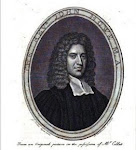
Peregrine Philips 1623-1691

PHILIPS was born at Amroth, Pembrokeshire, of which parish his father was vicar, in 1623. He was educated first at the grammar school, Haverfordwest, afterwards by Sir Edward Harley's private chaplain at Brampton-Bryan, Herefordshire, then by Dr William Thomas (afterwards Bishop of St. David's). He proceeded to Oxford, but the outbreak of the civil war soon put an end to his studies. He now took orders, acted for some time as curate to his uncle, Dr Collins, at Kidwelly, Carmarthenshire, and then received the rectory of Llangwm and Freystrop in his native county. His talents as a preacher in Welsh and English soon attracted the notice of the Puritan gentlemen of the district, who procured for him the livings of Monkton, St. Mary's, Pembroke, and Cosheston. He preached regularly every Sunday in his churches, and in 1648, at Cromwell's request, discoursed to the officers engaged in the siege of Pembroke. Throughout the Commonwealth period he held an influential position, being a member of the county committee which dealt with ‘scandalous’ ministers. He refused to conform in 1662, and so lost his livings. He settled at Dredgman Hill, a farm near Haverfordwest, let to him by his friend Sir Herbert Perrot of Harroldston, where he spent the rest of his life as a nonconformist preacher. During the reign of Charles II he was subject to much persecution, suffering imprisonment twice; nevertheless, he continued to preach at every opportunity, and his house was recorded as a congregationalist preaching station under the first Declaration of Indulgence (1672). The church he had formed in 1668 is mentioned in the list drawn up by Henry Maurice of Abergavenny in 1675. On the issue of the second Declaration of Indulgence (1687) Philips again took out a license for his own house and another in Haverfordwest, and preached in these until his death on 17 Sept. 1691. Though fearless and indefatigable in his work, he was reckoned a moderate man, and ‘took no small pleasure,’ says Calamy, ‘in reconciling differences.’