Thursday, 9 June 2011

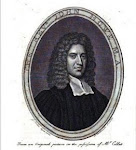
James Forbes

(From Wikipedia)
Forbes was born in or about 1629. He was educated at Aberdeen University, where he proceeded MA, being subsequently admitted ad eundem at Oxford. In 1654 he was sent to Gloucester Cathedral, where he preached ‘with great success, but to the apparent danger of shortening his life.’ At the Restoration he was speedily ejected from the cathedral, but he still continued at Gloucester, ‘ministering privately as he could.’ Struck by his talents, Robert Frampton, then dean, but afterwards bishop of Gloucester, ‘courted him to conformity in vain.’
In consequence of the "Yarranton Plot" or "Pakington Plot", he was committed to Chepstow Castle, where he was kept a long while. On regaining his liberty he returned to his pastoral charge; he was often imprisoned in Gloucester, on one occasion for a whole year; he was indicted under the Corporation Act, the penalty of which was imprisonment. He was also indicted under 23 James I, the penalty of which was £20 a month, and under 35 Elizabeth, of which the penalty was to abjure the realm or suffer death. At the same time, also, he was excommunicated, and the writ de excom. capiendo was out against him.
At the time of Monmouth's rebellion he retired to Enfield, Middlesex, and there continued in his ministry. He was later recalled to Gloucester, where he continued to labour until his death. Altogether, he exercised his ministry in Gloucester for 58 years, less one month. He died 31 May 1712, aged 83, and was buried under his own communion-table. His funeral sermon was preached by John Noble of Bristol. Edmund Calamy, who represents him as the model of a nonconformist divine, states that at his death he left gifts to charitable uses, including his library (now in Toronto).

Thursday, 19 May 2011

Hendon area

Francis Warham, the vicar ejected in 1662, was licensed as a Congregationalist in 1672, when he was living at Upper Hale. Richard Swift, ejected from Edgware in 1660, was imprisoned on several occasions for holding conventicles in his house, Jeanettes, at Mill Hill. The Independents who registered Samuel Everard's house at Childs Hill as a place of worship in 1672 may have been the dissenters who registered Mary Everett's house there in 1690.

From: 'Hendon: Protestant nonconformity', A History of the County of Middlesex: Volume 5: Hendon, Kingsbury, Great Stanmore, Little Stanmore, Edmonton Enfield, Monken Hadley, South Mimms, Tottenham (1976), pp. 39-43. See here.

Grandsons of the Ejected

Among the well known grandsons of ejeced ministers are

Philip Doddridge 1702-1751. His grandfather John Doddridge 1621-1689 was rector of Shepperton, Middlesex until 1662. 
John Wesley 1703-1791 (like his brothers) had ejected grandfathers on both sides. Both Dorset vicar John Westley 1636–1678 and Samuel Annesley c 1620-1696 of St Giles Cripplegate were grandfathers to the famous Methodist and Arminian. (John Westley's father Bartholomew Westley 1596–1680 was also ejected).
Henry Grove 1684–1738, an English nonconformist minister, theologian and dissenting tutor had a grandfather who was ejected from Pinhoe in Devon.


Tuesday, 26 April 2011

The Ejected (93 of them)

Articles are currently available on 93 people who were ejected on Wikipedia here.
A
Richard Adams (religious writer)
Thomas Adams (writer)
Joseph Alleine
Richard Alleine
Vincent Alsop
Isaac Ambrose
Samuel Annesley

B
William Bagshaw
Nathanael Ball
Matthew Barker
William Bates (minister)
Richard Baxter
Thomas Baylie
William Benn (divine)
James Bradshaw (1613-1685)
James Bradshaw (minister)
John Brinsley the younger
Thomas Brooks (Puritan)
John Bryan (minister)
Anthony Burges
Cornelius Burges
Ralph Button
Richard Byfield

C
Edmund Calamy the Elder
Joseph Caryl
Thomas Case
Daniel Cawdry
Stephen Charnock
Samuel Clarke (annotator)
Samuel Clarke (minister)
John Collinges
William Cooper (Puritan)
Zachary Crofton
Samuel Crossman

D
William Dell
Thomas Doolittle
Daniel Dyke

F
Giles Firmin
John Flavel
Thomas Ford (minister)
Richard Frankland (tutor)

G
Richard Gilpin
Thomas Gouge
William Greenhill
Obadiah Grew

H
Thomas Hall (minister)
Timothy Hall (bishop)
Samuel Hammond (minister)
Philip Henry (clergyman)
Oliver Heywood (minister)
Joseph Hill (lexicographer)
Leonard Hoar
Thomas Horton (Gresham College)
Charles Hotham (rector)
John Howe (Puritan)
John Humfrey

J
Arthur Jackson (minister)
James Janeway
William Jenkyn
Thomas Jollie

L
Henry Langley
Nicholas Lockyer

M
William Manning (Unitarian)
Thomas Manton
Walter Marshall (Puritan)
Adam Martindale
Edmund Staunton
Richard Mayo (minister)
Matthew Mead (minister)
Charles Morton (educator)

N
Henry Newcome
Matthew Newcomen

O
John Oxenbridge

P
William Pell (minister)

R
Edward Reyner
Thomas Rosewell
John Rowe (minister)

S
Lazarus Seaman
John Shawe
William Sherwin (minister)
William Spurstowe
Nathaniel Stephens (clergyman)

T
Francis Tallents

V
Ralph Venning
Nathaniel Vincent
Thomas Vincent

W
Thomas Watson (Puritan)
Bartholomew Westley
John Westley
Henry Wilkinson (canon)
Henry Wilkinson (dean)
Benjamin Woodbridge
Hezekiah Woodward

The Savoy Conference

(From Wikipedia)

The Savoy Conference of 1661 was a significant liturgical discussion that took place, after the Restoration of Charles II, in a supposed attempt to effect a reconciliation within the Church of England.
It was convened by Gilbert Sheldon, in his lodgings at the Savoy Hospital in London (where the Savoy Hotel now is) and was attended by commissioners: 12 Anglican bishops and 12 representative ministers of the Puritan and Presbyterian factions. Each side also had nine deputies (called assistants or coadjutors). The nominal chairman was Accepted Frewen, the Archbishop of York. The object was to revise the Book of Common Prayer. Richard Baxter for the Presbyterian side presented a new liturgy, but this was not accepted. In 1662 the Act of Uniformity followed and the Great Ejection.

Commissioners
The nominated commissioners and deputies were as follows:

Accepted Frewen, Archbishop of York
Gilbert Sheldon, Bishop of London
John Cosin, Bishop of Durham
John Warner, Bishop of Rochester
Henry King, Bishop of Chichester
Humphrey Henchman, Bishop of Salisbury
George Morley, Bishop of Worcester
Robert Sanderson, Bishop of Lincoln
Benjamin Laney, Bishop of Peterborough
Brian Walton, Bishop of Chester
Richard Sterne, Bishop of Carlisle
John Gauden, Bishop of Exeter

For the presbyterians (eventually ejectees marked *):
Edward Reynolds, Bishop of Norwich
Anthony Tuckney*
John Conant (Reynolds' son-in-law)
William Spurstow*
John Wallis
Thomas Manton*
Edmund Calamy*
Richard Baxter *
Arthur Jackson*
Thomas Case*
Samuel Clarke*
Matthew Newcomen*

Deputies
On the episcopal side:
John Earle, Dean of Westminster
Peter Heylin Sub-dean of Westminster.
John Hacket
John Barwick
Peter Gunning
John Pearson
Thomas Pierce
Anthony Sparrow
Herbert Thorndike

On the presbyterian side:
Thomas Horton (ejected but then conformed) 
Thomas Jacomb*
William Bates*
John Rawlinson*
William Cooper*
John Lightfoot
John Collinges*
Benjamin Woodbridge (ejected but then conformed and then became a nonconformist again)

There was to have been one more deputy on the presbyterian side, the former physician Roger Drake*. A clerical error caused his name to appear as "William Drake" in the official document, and he did not actually attend.

Friday, 8 April 2011

The Ejected of 1662 in Cumberland & Westmorland

The book The Ejected of 1662 in Cumberland & Westmorland can be consulted here on Google Books as a preview. Most though not all of the book can be seen there.

Tuesday, 5 April 2011

Pendlebury of Bury

In Bury, Lancashire, the Presbyerian Church of 1719 and the Independent Chapels, that in the 19th Cnetury were in New Road and in Henry Street (erected 1792 and 1807 respectively) are the outcrop of the ejection of 1662. The Rev Henry Pendlebury, MA was ejected from Holcombe Chapel, in Bury, in 1662. For over 25 years, Pendlebury continued to preach wherever he could in the district, in secret and illegally – in Richard Kay's barn, in the houses of Margaret Holt, Giles Unsworth and Abraham Wilkinson, and even in the open air. Eventually a Meeting house was built for him in Bass-lane, in the township of Walmersley. After his death the Presbyterian place of worship, called Dundee Chapel, on the opposite side of the brook to the Episcopal Chapel, whence Mr. Pendleton was ejected, was built for his successor; and in 1719 that part of the congregation who resided in Bury, erected a chapel in Silver Street.

Bere Regis Congregational, Dorset

In 1662 Philip Lamb, vicar of Bere Regis, was one of the puritan clergy to resign and can therefore be considered as the founder of the Congregational Church in the parish. There were 73 clergy known to have been ejected from the Church of England in Dorset. Lamb was one of those who resigned before being ejected.
He was apparently a zealous minister preaching at Winterborne Kingston, his second church, as well as at Bere Regis. From the age of 21 he laboured at Bere and Kingston, until his ejection, holding a service every day in the week at Bere at 6.00 am. In his farewell sermon he said, "l may not speak from God to you, yet I shall not cease to speak to God for you."
Lamb secured a large place in the affections of the people, and there was great grief when he was silenced. For some time he continued to preach privately, and undoubtedly it was under his guidance that the Congregational Church was formed.
Later he was forced to move to Morden, where doubtless he found refuge with a stout friend of non-conformity, Sir Walter Erle, who lived at Charborough Park. Later still he moved to Alton Pancras near Cerne Abbas.
In 1672 he was granted a licence to be ‘a Congregational Teacher' in East Morden. Later still a convenient meeting house in Winterborne Kingston, probably the residence of Richard Woolfreys, was provided for him, where the people flocked from all parts to hear him. Persecution drove him to flee to Clapham, London, where he died in 1689 at the age of 66. He was offered £600 a year, a princely salary in those days, if he would conform, but he was not tempted. He was a man of unaffected piety, cheerful temper and engaging personality.
Precise information is not available of the trials and persecutions of the Bere Regis dissenters, as records, if kept, have since been lost. It appears that six ministers preached here in rotation once a fortnight until a Mr Bulstrode settled there in 1670.

Broad Street Independent, Reading

The picture shows the former Broad Street Independent Chapel of 1707 in Reading,
now a branch of Waterstones. That all important 1662 date has been highlighted.

Thursday, 4 March 2010

Thomas Doolittle


Thomas Doolittle (1630-1707) was an English Puritan pastor of the 17th century. At his death, in 1707, at the age of 77, he had the distinction of being the last surviving pastor of the Great Ejection.

Born in Kidderminster, as a boy he heard Baxter preach "The Saints’ Everlasting Rest" (published 1653). The addresses led to Doolittle’s conversion and he would later call Baxter his “father in Christ.”
As an assistant to a county lawyer, he was required to work on the Sabbath adn so he left. Baxter encouraged him to enter the ministry. He studied at Pembroke Hall, Cambridge, earning a BA 1653 and MA 1656. His tutor was William Moses, later ejected from Pembroke.
Doolittle quickly earned a reputation as a great preacher. In 1653, he received Presbyterian ordination but committed himself to St Alfege, London Wall, where he until ejected in 1662. His ministry there had been eminently successful. In 1657, he had written to Baxter “God hath given me abundant encouragement in my work, by giving me favour in the hearts and affections of the people … and others in the city."