Wednesday, 31 October 2018

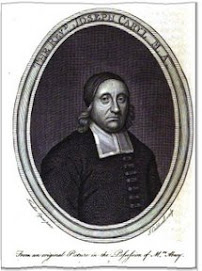
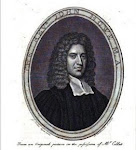
John Sames, Coggeshall


Dale continues his annals by talking about John Sames one of the ejected ministers, already mentioned by Dale earlier on. He quotes Palmer in a footnote saying of Sames
After the loss of his living he and some of his people went to Church, but others of them not being satisfied to do so, and the minister at the same time reproaching them in public for not being present in time of divine service, he desisted and set up a separate meeting, and died pastor of a gathered church there. He was a man of good learning and valuable ministerial abilities, but melancholy to an excess.
With that footnote he adds
1656, July 2.— (Born) Deborah, daughter of John and Anne Sames, vicar. "
1672, Dec. 16.— (Buried) Mr. John Sames."—Par. Reg.
1689, Nov. 29.— I first heard old Mrs. Sames was lately dead."— Bufton's Diary.

Dale continues
Most of those who formed the congregational church of which he was previously pastor left the Parish Church, and met together elsewhere, as circumstances permitted, and were ministered to by Mr Sames, Mr Lowry, [more on him later] and others. He died soon after the Indulgence was granted, and his funeral sermon was preached by Mr Lowry.
"The notes of ye sermon preached at ye funerall of Mr John Sames, by Mr. Lourey, Dec. 16,1672. "Text — Isaiah lvii. 1-2. We have been burying the greatest riches of the town, the jewel of the town; but we do not know whether ever we shall outlive the following storm of judgments, to regain such a pearl again. It is the great sin of a people, that when the righteous are removed by death they think they have done their last duty; but their last duty is to sit down and consider their loss, and what will be the sad consequences of such a dispensation We must not be troubled upon the personal account of this man, for he is gone to rest and peace, from all the troubles of this world. Death to him is gain. . . So that we are not to lay to heart his loss, but our own loss. Such as sat under his ministry and were refreshed by his doctrine, should mourn and lay it to heart; and the town should lay it to heart; for he was the salt as it were of the town, and the light of the town. He shined among you in his doctrine and conversation. Some men's death is but a cipher, and a hundred ciphers signify nothing; but the death of some is as a figure, and a figure of 1 and three ciphers stand for a thousand. He was a messenger of a thousand, and ought to be laid to heart more than the death of a hundred or thousand wicked persons. . . . . . Some men are not at all affected with such a dispensation as this. They may persecute the righteous when they are alive; but when they die, they lay them in their graves, and hide them in the dust, and forget them, and their hearts are hardened it may be against their widows or children. A righteous man is excellent; but they are willing to have him buried out of sight. They do not see that a righteous minister in a place is the greatest advantage: nor foresee that such a hedge or fence is taken away that the judgment of God may take hold of them.
"But yet there are gracious souls that do see the feet of the righteous servants of God to be beautiful: they open their hearts and their doors to them: they see God in such messengers, and when they are removed they see that it is an irreparable loss, except God make it up. God will take care of such a poor flock, though they be a flock of slaughter. And though their shepherd is gone, yet God will provide them another. Is there no more in the world? Yes: but you must go to God for one by prayer. Those that are sorrowful to see so many congregations without a soul-saving ministry, the Lord has made a promise to comfort them; as in the third of Zephany, 12-17 Now doubtless this friend which we have been burying was a righteous man. I could not only judge him to be righteous, but eminently righteous. He had a rich propriety in God and Christ, and he had a gospel spirit in his prayers and preaching. He was spiritual in his worship and spiritual in his conversation, and he had that wisdom from above that made him pure and peaceable, gentle and easy to be intreated: his wisdom did not carry him forth to strife, envy or contention. Again, he was of a plain spirit; he had a plain honest heart. And verily he was profitable to old, to young, to this company and that company, and he was communicative of any good he had. He did not handle the word of God in craftiness. He was patient: and of a free and public spirit. He was tender-hearted to his people, and to all; and he had a spirit of government in his family, and walked conscientiously. How careful was he! He ordered his family, and therefore was the more fit to order the church.
"Therefore our loss is great, now such a righteous man is taken away. You that are sinners have a great loss. He warned you of Hell, and of being drowned in the world. You that were his church have a great loss. He carried you in his warm bosom. Christ make it up to you. You young mm have had a great loss. He was kind to young men, and tender of their souls. The Lord make up our loss. And let us all endeavour to be righteous men and women; and then God will either take us from a day of trouble, or hide us in a day of trouble. And the Lord grant that we may be truly affected and humbled under this dispensation." — Bufton's MSS.

Coggeshall, Essex

St Peter ad vincula, Coggeshall, Essex
In his 19th century  Annals of Coggeshall the Congregationalist minister Bryan Dale has a chapter on Nonconformity which begins with a section on Ejected Ministers. He introduces it saying

Whenever laws were ordained contrary to conscience and the word of God, Nonconformity became a necessity for those who would obey God rather than man. It existed accordingly where the least scope was allowed for freedom of thought; and every attempt to bring the laws of the state into harmony with the individual conscience, and to silence its voice, alike failed.
During the twenty years which preceded 1662 there were placed in the parish churches men, of whom the least that can be said is that they were faithful pastors and able preachers. All of them were ultra-protestant in doctrine; many were in favor of Presbyterianism or a modified Episcopacy; and many were Independents. Charles II. was restored under most solemn engagements "that no man should be molested for his religion;" but as soon as the Restoration was effected all these were put aside.
First of all (1660) three hundred ministers were ejected from their livings to make room for the restoration of such as had been sequestered, and without regard to the character or competency of the latter. Then all the objections urged against the re-establishment of unmodified Episcopal authority and the Book of Common Prayer, were overruled, and an Act was passed, which required each minister who had not been ordained by Episcopal hands to be re-ordained, and to declare publicly his unfeigned assent and consent to all and everything contained in the Book of Common Prayer, as now set forth,* etc.; and on neglect or refusal pronouncing him ipso facto deprived of all his spiritual promotions. Unable, without disregarding the supreme claims of conscience, to comply with such requirements, above two thousand ministers** ceased to minister in the Established Church, from Bartholomew Day, 24th August, 1662. Another shade was thus added to the previous darkness of this day,*** by the privation and suffering into which these men were driven. The Conventicle Act was afterwards passed, forbidding more than five persons besides the family to meet for religious worship, under severest penalties. About this time the plague visited this country, and carried off great numbers of people in this neighbourhood. It does not appear to have been severe in this town, if it prevailed at all. At Braintree, on the contrary, 600 persons died within a short period; and in the vestry of that parish a memorial on parchment, containing the names of charitable contributors towards the distress, mentions
"The Inhabitants of Coggeshall — £35."
Several of the ejected ministers ventured into vacated pulpits, to preach to the excited people. The Five-Mile Act, however, forbade them to come within five miles of any place where they had previously ministered, or of any borough or corporate town. Great numbers of Nonconformists were fined and imprisoned; but meetings were secretly held. When the Conventicle Act was revived in 1669, enquiries were sent to every parish concerning such meetings; and the returns, partial and imperfect, are preserved at Lambeth.
"Coggeshall. Hard to be suppressed. (Ministers) Mr. Sammes. Mr. Lowry."
The next entry is:—
"Wethersfield. Mr. Cole, now in Chelmsford Goal."
In 1672 Charles II issued his Declaration of Indulgence, and above 3,000 licences for religious worship were taken out.
"License to John Sammes, to be a congregational teacher in the house of John Croe at Coggeshall.—1st May 1672."
"License to Thomas Lowry, to be a congregational teacher in his house at Coggeshall, in Essex."
"The house of Thomas Lowry in Coggeshall to be a Meeting House."
"The house of Matthew Ellistone at the Grange in Little Coggeshall to Matthew Ellistone.—13th May."
"William Grove, in his house at Coggeshall, licensed to he a congregational teacher.—May, 1672."
"Thomas Millaway, of Coggeshall, Essex, licensed to be a general congregational teacher.—22nd July, 1672."
The Nonconformists in this place were too numerous to meet in one spot. The Test and Corporation Acts immediately followed the Indulgence; afterwards came other persecutions. It does not appear, however, that in this town, beyond having their assemblies broken up, the Nonconformists suffered greatly; for the magistrates, and others upon whom the execution of the laws devolved, were themselves of the same mind as the offenders. The attempt of James II to bring back the country to Roman Catholicism, led to the Glorious Revolution of 1688, and the Act of Toleration: but the Act of Uniformity and other laws against Nonconformists were still continued.

* The alterations made were of the following nature:— The Book of Bell and the Dragon inserted in the Calendar — the words "rebellion and schism" in the Litany —" Priest" and "Deacon" substituted for "Minister" — Absolution ordered to be pronounced by the priest alone — kneeling at the Lord's supper — Charles styled "our most religious King." The Nonconformists, many of whom were in favor of a Liturgy, had many objections to the prescribed forms. Among other things they said, "We cannot in faith say that every child that is baptized is regenerated by God's holy spirit." "The words of the burial service cannot in truth be said of persons living and dying in open and notorious sins. These words may harden the wicked and are inconsistent with the largest rational charity."
** William Rastrick, in a MS. Index, (date 1734) in a library at Lynn, gives 2257 names.
*** The massacre of 10,000 French Protestants in 1572.

Friday, 6 April 2018

Richard Flavel


Richard Flavel was the father of the famous John Flavel and his brother Phineas, also a Gospel Minister. Described as "a painful and eminent minister" he first ministered at Bromsgrove, Worcestershire, then at Hasler in Gloucestershire before moving to Willersey, Gloucestershire, where he continued until 1660. At the Restoration he was put out of the church because it was a sequestered living, and the previous incumbent was still alive:
His main concern was to find a place of ministry. He is described as "a person of such extraordinary piety" that those who knew him said "they never heard one vain word drop from his mouth."
A little before 1662 and being near Totnes, Devon, he preached from Hosea 7:9 The Days of Visitation arc come, the Days of Recompence are come, Israel shall know it. His application was so close that it offended some and occasioned his being carried before some JPs but they could not reach him and so he was discharged.
He afterwards left the county and his son's house, where he had retired and went to London, where he continued in a faithful and acceptable discharge of his ministerial duties until the time of the plague in 1665 when he was arrested and imprisoned.
He was at the house of a Mr Blake in Covent Garden, where some were gathered for worship. While he was in prayer, a party of soldiers broke in on them with swords drawn, and demanded the arrest of the preacher, threatening some and flattering others in order to discover him, but in vain.
Some of them threw a coloured cloak over him, and in this disguise he was, together with his hearers, carried to Whitehall. They were all sent to Newgate prison, which was so disease ridden that Flavel and his wife became seriously ill.
Although they were bailed shortly after, they subsequently died. It is said that their son John was given an intimation of their death in a dream.

Tuesday, 3 October 2017

Lawrence on Thomas Goodwin

In his 2002 thesis Transmission and Transformation on Thomas Goodwin and the Puritan Project 1600-1704, TM Lawrence writes

Men who had been trained to preach and teach, men who had spent a lifetime developing the rhetorical tools necessary to persuade a nation to godliness, were by this act forbidden to do the very thing for which they lived. Adding injury to insult, the harsh sanctions of the Clarendon Code were soon enacted to enforce their silence. Cut off from both public life and public worship, Goodwin did not simply withdraw to the tranquil world of the pastor’s study. Rather, he was forced into the quietly furtive life of the nonconformist minister, managing his affairs in order to avoid confrontation with the authorities.

Thursday, 21 September 2017

Bunhill Fields William Jenkyn 1613-1685


WILLIAM JENKYN, MA
The massive stone tomb of William Jenkyn will readily catch the visitor's eye, as it lies only a little to the southeast of Thomas Goodwin's. The original inscription on this tomb was in Latin, but was replaced by an English one, now undecipherable, which was as follows: —
"Sacred to the remains of William Jenkyn, Minister of the Gospel, who during the heavy storms of the Church was imprisoned in Newgate. Died a martyr there in the 72nd year of his age and the 52nd of his Ministry, 1684."
This "martyr of Jesus" was born at Sudbury, Suffolk, in the year 1612, and was blessed with godly parents. That his father was a good man is clear, for he had already sacrificed all prospects of wealth and honour rather than yield obedience to laws, rites and doctrines which he deemed unscriptural. Indeed, so exceedingly enraged was his own father at his turning from the path which led to the highest positions in the Church of England, that he disinherited him. This cruel action of William Jenkyn's grand-father, however, had no effect, for his father became the minister at Sudbury, where God was pleased to smile upon his labours. The mother of Jenkyn was a grand-daughter of noble John Rogers, who was burned to death in the reign of that poor misguided but cruel daughter of Rome known as "Bloody Mary." When William was still quite young his father died, and his mother somewhat reluctantly agreed to trust him to the care of his paternal grandfather, who was willing to educate him and to train him as a gentleman. After the lad had been with his grandfather for a few years, fearing that the godless habits of those with whom he lived would have an ill effect upon him, his mother, like a wise woman, took "William under her own care, and with her second husband trained him up after a godly manner. In 1626 arrangements were made for him to go into residence at Cambridge, the College chosen being that of St. John's, and his tutor was Anthony Burgess, who found him an apt pupil. Indeed, he made such progress in his studies that his fame spread abroad, but best of all his mind was exercised concerning his spiritual standing. His walk, conversation, and conduct alike proclaimed him to be a godly character, and he was mercifully preserved from falling into those outward sins of dissipation and vice which ruin so many young men. Having taken his MA degree, he accepted a lectureship at St Nicholas Acon, London, but soon after moved to Hythe in Essex, where he preached to a small congregation.
A number of his friends, being desirous of sitting under his ministry, persuaded him in 1641 to return to the Metropolis, where he became vicar of Christ Church, Newgate, and afterwards he was also appointed lecturer of St. Anne's, Blackfriars. He laboured with much earnestness and success, but his political views brought him into trouble at the overthrow of the Monarchy. So thankful were the people at being freed from the hateful yoke of the Stuarts, that Parliament appointed special thanksgiving services, but Jenkyn, whilst a stalwart Puritan, refused to take part in these. As a consequence he was banished from London, suspended from his ministerial office, and his benefices were sequestrated. He removed to Billericay, in Essex, for some six months ; then returned to London, only to be sent to the Tower for taking some little part in a foolish plot. On the advice of friends he afterward petitioned Parliament for his release, although it was a difficult matter for those interested in him to obtain his signature to the document. It is pleasing to relate that it was resolved to pardon Jenkyn "both for life and estate," and he was thus free not only to return to his home, but also to his ministry. Showing a very magnanimous spirit he refused to eject the Mr. Feak who had been appointed to Christ Church, but an early morning lectureship was arranged, and a large subscription was raised for this purpose. He also recommenced his lectures at Blackfriars, and on the death of Dr. Gouge he was chosen rector. When afterwards Mr. Feak was dismissed by the Government, Jenkyn was reappointed by the Governors of Bartholomew's Hospital, and thus once again he became vicar of Christ Church. Each Lord's Day he preached morning and evening to large auditories, for in addition to his parishioners, people flocked from all parts to listen to this prince of preachers. He possessed very considerable abilities, and was called by Baxter, **that elegant and sententious preacher." When the deceived and foolish people made another Stuart, Charles the Second, King of England, Jenkyn's troubles began again.
On Tuesday, January 2nd, 1661, he was compelled to appear before a special council, where he " was reproved for not praying for the King." When afterwards the Uniformity and Oxford Acts in 1662 and 1665 were passed, Jenkyn could not take the oaths that were required; and once again he sacrificed his living, retiring to Langley in Hertfordshire, where he preached to a few friends in private. When the King issued a Declaration of Indulgence in 1671, he returned to London, and a chapel was erected for him in Jewin Street, where once again great numbers of people sat under his ministry. The Indulgence was not confirmed by Parliament, and was withdrawn ; but although not immediately, Jenkyn's sorest trial was fast approaching. As was only to be expected, Jenkyn declined to conform, and from that time he was '* in dangers oft," for although the King decreed, this man and hundreds of others refused to have their voices silenced, and continued to preach under the most adverse circumstances. Meetings were held in secrecy as often as possible until September 2nd, 1684, when he was apprehended by soldiers, who broke in upon the numerous company which had met for prayer. With the exception of Jenkyn, all the ministers, amongst whom were Reynolds and Flavel, escaped, the latter stating that it was a piece of foolish vanity on a lady's part, combined with an act of politeness by the famous preacher, that cost him his liberty. In the rush for safety Jenkyn stood aside to allow this lady to pass before him, and her long train only too effectually prevented his hastening down the stairs and reaching a place of safety. The officers were delighted at their capture, and treated the aged and venerable servant of God in as cruel and rude a manner as possible, whilst the two magistrates, who were mere tools of the Court, were exceedingly violent and unjust. According to the law, by the payment of £40, the offender could obtain his release, but these creatures set all order at defiance, and committed the preacher, now 71 years of age, to Newgate Prison, where most severe restrictions were imposed. What mattered it that this much loved and highly respected man had suffered greatly for the Royalist cause ? What cared his persecutors that the foul air and stench of Newgate would surely poison him ? What anxiety did the statement of Jenkyn's physician that "his life was in danger from close confinement " cause the evil king and his counsellors ? What effect had all the pleadings of his friends and petitions of his followers ? Answers to these questions are found in the regulations by which Jenkyn was bound. He was not allowed to pray with anyone—not even his daughter. He was never permitted to leave the prison, although full security was offered, and neither was he granted the ordinary rights of a prisoner. It is not to be wondered that his physical health soon began to fail, although as his natural strength decayed his spiritual powers seemed to increase. On one occasion he exclaimed to some of his friends, " What a vast difference is there between this and my first imprisonment ! Then I was full of doubts and fears, of grief and anguish; and well I might, for going out of God's way and my own calling to meddle with things that did not belong to me. But now being found in the way of my duty, in my Master's business, though I suffer even to bonds, yet I am comforted beyond measure. The Lord sheds His love abroad in my heart ; I feel it ; I have the assurance of it." Some of his loving hearers giving way to tears, he exclaimed, "Why weep ye for me? Christ lives; He is my Friend ; a Friend born for adversity; a Friend that never dies. Weep not for me, but weep for yourselves and for your children." On January 19th, 1684, after some four months' confinement, Jenkyn exchanged a prison cell for a heavenly mansion. In the former he suffered privation, persecution, hunger, thirst, and a thousand indignities, but in heaven all these things were done. The prison doors were kept securely fastened, but it is recorded of the Celestial City, " The gates of it shall not be shut at all by day ; for there shall be no night there."
For fifty years he had been a minister of the Gospel upon the earth, faithfully rebuking sin and setting forth Christ as the one hope of a sinner and the only way to the Father, but now he "sees Him as He is," and is joining in the song of the redeemed from among men.
It was not long ere the news of his death reached the court, and one courtier was bold enough to say to the King, "May it please your majesty, Jenkyn has got his liberty." With surprise the monarch replied, "Aye, who gave it to him ?" "A greater than your Majesty, the King of kings," was the explanation, and even so callous and perfidious a man was for once silent.
To Bunhill Fields the mortal remains of Jenkyn were taken, "his corpse being attended by at least one hundred and fifty coaches," and were there laid to rest. He was undoubtedly a martyr, for in Newgate, as he stated, "a man might be as effectually murdered as at Tyburn;" and his daughter boldly gave mourning rings with the inscription, "Mr. William Jenkyn murdered in Newgate." As a politician Jenkyn is not easily understood, for he seemed to change his views quickly and often, but this compared with eternal matters is of small moment.
His great work is an exposition upon the Epistle of Jude, which was preached in Christ Church. A revised and corrected edition was published in 1839, the editor being Mr. James Sherman, who was then the minister of the Surrey Chapel.
The extract given is from Jenkyn's sermon on the afternoon of August 17th, 1662, before he was ejected. The text was Exodus iii. 2-5.
"Lastly, to name no more, labour to preserve the holiness of God's true institutions, those things which are of divine consecration. What is human consecration without divine institution? The sabbath day is of divine institution, labour to keep it holy ; this is a holy day indeed, and this labour to keep your families from profaning' of ; but for other holy days, and holy things, they are much alike for holiness; the Lord's day is a holy day indeed, and for shame do not let your children gad abroad on this day. Truly I do verily believe, that though here be a great company of people in the congregation, yet they are but a handful in comparison of what are drinking in ale-houses, and walking in the fields, that one can hardly get home to their house for the crowd of the people that are going thither. For shame let not this be told in Gath, nor published in Askelon. What ! shall we stand up for the holiness of places, and yet oppose the holiness of the Lord's day, which God hath enjoined and instituted ? Oh! that the magistrates of London - oh! that England's king - oh! that England's Parliament would do something for the reformation of this, to oppose wickedness and profaneness which will otherwise bring upon us the judgements of Sodom and Gomorrah, and make us guilty and worthy of a thousand punishments. And labour by prayer in your families to overcome that flood of profaneness, which you cannot by your strength prevent. And then for the Lord's message and Word, that is a holy thing, and therefore love His messengers : the messengers of God delivering His message with fear and reverence, you are to hear them with the same fear, reverence, and resolution to be holy, as if Christ were present. And for the Word of God, it is not enough for you to have a choice sentence written upon the walls of your churches, but let God's law be written in your hearts and consciences, and practised in your lives, that all the world may see that you live as men dedicated to the true God, in all the duties of His ways and obedience. Many of these things might have been enlarged. What I have given you with the right hand, I pray you Christians, do not take with the left ; for if you do, you will make yourselves guilty of a double sin. First, because you do not obey the truth you hear. And secondly, for putting a wrong construction upon it. But I have better hopes of you, my beloved hearers, and hope that the Lord will be better unto your souls than His ministers, than His Word, or any thing else can be. God bless you and His ordinances, and discover His mind and will at this time to you."

Friday, 15 September 2017

Bunhill Fields Thankful Owen 1620-1681


(Same Tomb as Goodwin.)
Translation of Latin Inscription.
Thankful Owen, STB. Here mingles his sacred dust with that of Goodwin; to whom in life he was most dear. He scarce survived an hour the finishing of a Preface which he had been writing to that great work of Goodwin's on the Epistle to the Ephesians, the publication of which had fallen to his care. Dying with the same calmness with which he had lived, without a groan, save of the heart to Christ, on the 1st April, 1681, in the 63rd year of his age.
Thankful Owen was born, according to one account, at Taplow in Buckinghamshire, but another authority states that he was born in London. While quite a youth he had a remarkable preservation from drowning, for as he was swimming near Oxford he sank twice under the water. He received his education chiefly at Exeter College, Oxford, where his tutor was a Puritan. He became a man of much learning, and was greatly admired for the easy fluency of his language and compositions, and for the quite exceptional purity of his Latin style. He joined the Independent Church, afterwards becoming one of their preachers, and he was also chosen Proctor of the University in 1650, whilst in the same year he became President of St. John's College.
At the Restoration he was ejected by the Commissioners and, like Goodwin, removed to London. Here he lived very quietly, preaching as often as he could and steadfastly maintaining his nonconformity. On the death of Goodwin he was chosen to succeed him, but was only pastor for a fortnight, as he died quite suddenly at his house in Hatton Garden. His last labour was, as stated in the Inscription, to write a Preface for Goodwin's work on the Ephesians, and he had almost finished a work of his own, entitled "Imago Imagins" which was designed to show that Rome Papal was simply an imitation of Rome Pagan. Dr. John Owen said of Thankful Owen that he had not left his fellow behind him for learning, religion, and good humour.

Thursday, 14 September 2017

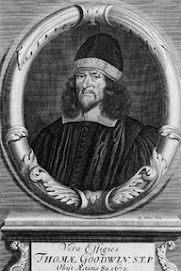
Bunhill Fields Thomas Goodwin 1600-1679


The tomb of Thomas Goodwin ... lies slightly to the south-east of Wavel's. During a terrific thunderstorm a flash of lightning split the top, and all that can now be deciphered is, "Thomas Goodwin, D.D."

Inscription
Here lies the body of the Rev. Thomas Goodwin, D.D., born at Rolesby, in the county of Norfolk. He had a large and familiar acquaintance with ancient, and above all, with ecclesiastical history. He was exceeded by none in the knowledge of the Holy Scriptures. He was at once blessed with a rich invention, and a solid and exact judgement. He carefully compared together the different parts of holy writ, and with a marvellous felicity discovered the latent sense of the Divine Spirit who indited them. None ever entered deeper into the mysteries of the gospel, or more clearly unfolded them for the benefit of others. The matter, form, discipline, and all that relates to the constitution of a true Cliurch of Christ, he traced out with an uncommon sagacity, if he was not rather the first Divine who thoroughly investigated them. He was eminently qualified, by the light of sacred truth, to pacify troubled consciences, to dispel the clouds of mistake, and to remove needless scruples from perplexed and bewildered minds. In knowledge, wisdom, and eloquence, he was a truly Christian pastor. In his private discourses, as well as in his public ministry, he edified numbers of souls, whom he had first won by Christ ; till having finished his appointed course both of service and sufferings, in the cause of his Divine Master, he gently fell asleep in Jesus. His writings already published, and what are now preparing for publication (the noblest monuments of this great muse's praise), will diffuse his name in a more fragrant odour than that of the richest perfume, to flourish in those far distant ages, when this marble, inscribed with his just honour, shall have dropt into dust. He died February 23, 1679, in the 80th year of his age.

Dr. Thomas Goodwin, one of the most eminent of the Puritan Divines, was born on October 5th, 1600. His parents, wishing him to be devoted to the ministry, had him educated in a careful and thorough manner, and being blessed with good natural abilities he so improved by diligent study as to become noted even at the early age of thirteen. He had strong impressions of religion upon his mind from the time he was six years old, but when at Christ College, Cambridge, to which he was sent in 1613, he was much engrossed in ambitious designs, and his whole desire was to obtain high offices and the good word of man. When nineteen years of age he removed to Katherine Hall, where his tutor was the famous Puritan, Dr. Sibbes. " On Monday, the 2nd of October, 1620, in the afternoon," while going from Katherine Hall to enjoy himself with his former friends of Christ College, he heard a bell toll for a funeral, and one of his companions, saying there was to be a sermon, pressed him to hear it. The preacher was Dr. Bambridge, who was accounted a witty man, and though his remarks, based on Luke xix. 41, 42, were quite ordinary on this occasion, they made an impression upon the mind of Goodwin. Instead of going on with his companions he returned to his college, having a most powerful sense of sin and a dread of its consequences. It pleased God in a little time gently to speak peace to his soul, and he now saw very clearly how vague and empty had been his previous profession. He had a very real yet peculiar evidence of a true conversion, for he was led to search out the sins which he had loved most, and was by grace enabled to gain the victory over them.
In 1628 he was appointed lecturer at Trinity Church, Cambridge, in spite of the opposition of the Bishop, but in 1634, his conscience being disturbed with the terms of Conformity, he resigned his preferment and left the University.
When referring to this memorable event in after years Goodwin said:
"I freely renounced for Christ, when God converted me, all those designs of pride, and vain-glory, and advancement of myself, upon which my heart was so strongly set that no persuasions of men, nor any worldly considerations, could have diverted me from the pursuit of them. No, it was the power of God alone that prevailed with me to do it. It was He alone that made me willing to live in the meanest and most afflicted condition, so that I might serve Him in all godly sincerity. I cheerfully parted with all for Christ, and He hath made me abundant compensation, not only in the comforts and joys of His love, which are beyond comparison above all other things, but even in this world. What love and esteem I have had among good men, He gave me. He alone made my ministry in the gospel acceptable, and blessed it with success, to the conversion and spiritual good and comfort of many souls."
Goodwin was now a marked man, and Archbishop Laud persecuting him, he left England and went to Holland in 1689. Here he enjoyed liberty of conscience, and became pastor of the English Church at Arnheim. He, however, returned to England during the Long Parliament, and became minister of an Independent Congregation meeting in Thames Street. Being chosen a member of the Assembly of Divines, which met at Westminster in 1643, he took a leading part in the deliberations, and won high esteem by his ability, modesty and meekness. He afterwards published his notes of these transactions, and was himself one of the Dissenting ministers.
His first marriage took place in 1638, his second in 1649, and he was very happy in both. The great Protector, who held him in high favour, appointed him in 1654 to the Presidency of Magdalen College, Oxford. He formed a church in this university town, and his members numbered amongst others, Thankful Owen, Theophilus Gale and Stephen Charnock. Soon after the Restoration he retired from the college and removed once more to London, many of his fellow members and friends following him. Another Independent Church was formed in Fetter Lane, and he preached here until his death.
During the Great Fire of 1666 he lost a large portion of his library, and he felt this blow to be a very severe one. He, however, expressed his thankfulness that his works of divinity were for the most part saved, and that those lost were in the main books of human knowledge. He continued to preach in spite of the Conventicle and Five Mile Acts, and was for the most part unmolested. Except when preaching, he lived a very retired life, dividing his time between prayer, reading and meditation. He had his favourite authors, such as Augustine and Calvin, but his son says,
"The Scriptures were what he most studied. ... The love and free grace of God, the excellencies and glories of our Lord Jesus Christ, were the truths in which his mind soared with the greatest delight."
The last scene of all was also described by his son as follows : — 

"In February, 1679, a fever seized him, which in a few days put an end to his life. In all the violence of it, he discoursed with that strength of faith and assurance of Christ's love, with that holy admiration of free grace, with that joy in believing, and such thanksgivings and praises, as he extremely moved and affected all that heard him. That excellent man, Mr. Collins, praying earnestly for him, offered up this petition, ' That God would return into his bosom all those comforts which he had by his ministry of free grace poured into so many distressed souls.' My dear father felt this prayer answered in the abundant comforts and joys with which he was filled. He rejoiced in the thought that he was dying, and going to have a full and uninterrupted communion with God. 'I am going,' said he, ' to the Three Persons with whom I have had communion: They have taken me; I did not take Them. I shall be changed in the twinkling of an eye; all my lusts and corruptions I shall be rid of, which I could not be here ; those croaking toads will fall oft' in a moment.' And mentioning those great examples of faith, Heb. xi., 'All these,' said he, 'died in faith. I could not have imagined that I should ever have had such a measure of faith in this hour ; no, I could never have imagined it. My bow abides in strength. Is Christ divided ? No, I have the whole of His righteousness ; I am found in Him, not in mine own righteousness, which is of the law, but in the righteousness which is of God, which is by faith of Jesus Christ, who loved me and gave Himself for me. Christ cannot love me better than He doth : I think I cannot love Christ better than I do ; I am swallowed up in God.' " Directing his speech to his two sons, he exhorted them to value the privilege of the covenant. 'It hath taken hold on me,' said he; 'my mother was a holy woman ; she spake nothing diminishing of it. It is a privilege cannot be valued enough, nor purchased with a great sum of money,' alluding to the words of the chief captain to Paul, Acts xxii. 28. Then he exhorted them to be careful that they did nothing to provoke God to reject them. 'Now,' said he, 'I shall be ever with the Lord.' With this assurance of faith and fullness of joy, his soul left the world, and went to see and enjoy the reality of that blessed state of glory, which in a discourse on that subject he had so well demonstrated. He died February, 1679, and in the eightieth year of his age."

Thursday, 7 September 2017

Bunhill Fields Richard Wavel 1633-1705

Light tells us that a few rows eastward the previous graves he describes, in about the centre of this section of the ground, is the small, fast-decaying headstone of Richard Wavel, BA The words are practically obliterated, but the stone will not be very difficult to identify.
Inscription: This adjourns to the family vault of the late Rev. RlCHARD WAVEL.
Here is the resting-place of one of the victims of the Act of Uniformity. He was born in the Isle of Wight on April 3rd, 1633, and after he had taken bis degree of BA he studied Divinity under the tuition of the Rev. W. Reyner, at Egham, in Surrey. He afterwards married Mr. Reyner's step-daughter, and constantly preached in the church at Egham. When the Act of Uniformity came into force he was compelled by his conscience to sever his connection with the Established Church, although many tempting offers of good livings were made to him. For a time he preached privately at Egham, in his own house, but was compelled to cease, as stern measures were taken against him. He afterwards became minister at Pinners Hall, and on doing so, ''told his people that he would venture his person if they would venture their purses; which they did, and they were put to no small expense by it." It is recorded that "his preaching was plain, and tended very much to exalt Christ, and the grace of God in him; and yet it was his dying advice to his church that they would choose one to succeed him of whom they should have some ground to hope that he would preach Christ crucified more than he had done. He excelled in prayer, more especially upon particular occasions, to which he would apply Scripture expressions with great propriety. It was a most frequent petition in his prayer, which he would express with a warmth and relish that was very remarkable, 'Father, glorify Thy name; Father, glorify Thy Son.' During the time of his last illness, for a fortnight before his death, he enjoyed a continued serenity of mind, expressing to those about him his desire to depart, and rejoicing that his work was finished. To a minister who visited him, telling him that he had suffered much for his Master, Christ, his answer was, 'He owes me nothing.' As he sat in his chair, he lifted up his hands and blessed his children; and as he was going to bed died in his chair, December 19th, 1705, in the 72nd year of his age."

Bunhill Fields Theophilus Gale 1628-1678


Light says that Gale's grave is a little nearer the path than Rowe's tomb, and on the low headstone there is to be seen the inscription: —
THEOPHILUS Gale. Born 1628. Died 1678.
Mr. Theophilus Gale was the son of Dr. Thomas Gale, Prebendary of Exeter. He was born in 1628, and in 1650 he was unanimously chosen Fellow of his College, in preference to many others who were his seniors. He frequently preached at the University, and also enjoyed a considerable reputation as a tutor - Bishop Hopkins, who always paid him very great respect, being one of his pupils. During the Commonwealth, in 1657, he was called to the Cathedral at Winchester, where he remained as a preacher till the Restoration, when he was ejected.
As he also lost his Fellowship, he went to France in September, 1662, as the tutor to the two sons of Lord Wharton, and stayed for two years at Caen. He left his pupils there and returned to England, reaching the Metropolis just as it was being devastated by the Great Fire. He was much alarmed and distressed when told that the house was burned in which he had left his MSS, amongst these being his famous work, ''The Court of the Gentiles." These MSS represented the labour of twenty years, but after he had given up all hope, he received the welcome news that certain of his goods had been preserved. He was told that amongst the things saved was a desk, which a friend who, placing no value upon it, had intended leaving behind, but having just enough room, he placed it upon the cart to make up the load. In this desk were his much loved papers, and Gale was thus enabled to complete his work. Upon Mr. John Rowe's death he was chosen as joint pastor with Mr. Lee, and it is recorded that he was "a man of great reading, and an exact philologist, and philosophist, and a learned and industrious person."
He died of consumption in 1678, when only 49 years of age, leaving all his estate in the charge of Nonconformist ministers for the purpose of educating poor Dissenters.
Wikipedia
Gale was born at Kingsteignton, Devon, the son of Bridget Gale (née Walrond) and Theophilus Gale DD (d. 1639), vicar of Kingsteignton and prebendary of Exeter Cathedral). Gale was educated by a private tutor, before attending grammar school, and being admitted to the University of Oxford, entered Magdalen Hall in 1647 as a commoner. Magdalen Hall was shortly to be the home of nonconforming students: William Conway, John Cudmore, Joseph Maisters and, according to Edmund Calamy, a 'Mr. Sprint'. In August 1648 Henry Wilkinson was appointed as Principal; he was a major figure in Civil War and Protectorate Oxford, lecturing at Carfax Church between 10 October 1642 and 16 June 1662.
Gale became a demy (funded scholar) of Magdalen College following the Parliamentary Visitation of 1648. Here he took his BA in 1649, becoming a Fellow and Tutor of Magdalen the following year and being awarded MA in 1652. He was then appointed lecturer in Logic (1652) and was later to become a Junior Dean of Arts (1657) and a Senior Dean of Arts (1658). One of his tutorial pupils was Ezekiel Hopkins. In 1657 he had also been appointed a preacher at Winchester Cathedral, alongside such luminaries as Humphrey Ellis, perhaps Faithful Teate (although this is difficult to substantiate) and George Lawrence (Chaplain of St. Cross Hospital). Magdalen itself was home to some of the most influential radical theologians of the day, including Thomas Goodwin (President), Henry Hickman (Fellow), Zachary Mayne (Fellow) and John Gipps (Chaplain). Gale's Congregationalism made him a natural ally of Goodwin, and may also have led to an association with John Owen, Vice-Chancellor of Oxford and President of Christ Church for much of this period.
Under the Act for Restoration of Ministers (1660) many Puritans and other radicals lost their jobs. Gale lost his place at Winchester Cathedral, and also was forced to resign his Fellowship at Magdalen. The Act of Uniformity (1662) required subscription on oath to the articles of the newly restored Church of England and a faithful following of the newly revised Book of Common Prayer (1662) in services for all clergy and teachers. These stipulations permanently barred Gale from University teaching, government employment and the Church of England Ministry.
Gale was fortunate in his contacts. Philip Wharton had been a supporter of Parliament in the Civil War and had built up a network of ministerial friends, including John Owen, Thomas Manton, William Bates and John Howe. Wharton, a lay member of the Westminster Assembly in the 1650s, continued an influential dissenting Member of Parliament for Buckinghamshire through the Restoration period. He had connections in the United Provinces and France. In 1662 he offered Gale £40 a year as tutor to his sons, a position which enabled Gale to travel to the French Huguenot College at Caen and meet other scholars including Samuel Bochart. Gale's strictness as a teacher offended his patron and he was dismissed in July 1664. After taking the opportunity to travel for a few months, he returned to England in early 1665 and was back at Wharton's Quainton estate before the end of the year. The latter portion of his life Gale passed in London as assistant to John Rowe, an Independent minister who had charge of a church in Holborn, active in the lull of efforts against conventicles after the Great Fire. Gale settled at Newington Green and took pupils: John Ashwood of Peckham, and the two sons of John Rowe, Thomas (who succeeded Gale as minister) and Benoni. Gale succeeded Rowe in 1677, and died in the following year. He is buried in Bunhill Fields burial ground, where his headstone is believed to be the earliest surviving monument.
Gale worked in the 1660s on manuscripts for a large-scale and erudite theoretical work of intellectual history; a hint in Grotius's De Veritate (i. 16) gave him the idea of the derivation of all ancient learning and philosophy from the Hebrew scriptures. He therefore traced European languages to the Hebrew language, and all the theologies, sciences, politics, and literature of pagan antiquity to a Hebrew tradition. In a similar way he dealt with the origin of all philosophies. He also accounted for the errors of pagan philosophy and Catholic divinity by the theory of corruption by successive apostasies from a divine original. Constructively he proposed a reformed Platonism, and tried to rescue the Calvinistic doctrine of predetermination from difficulties. Work left in store escaped the Great Fire of London in 1666. Gale's major work, The Court of the Gentiles, taking its name from the Court of the Gentiles in the Second Temple, appeared in parts in 1669, 1671 and 1676. It takes the form of a storehouse of miscellaneous philosophical learning. It resembles the Intellectual System of Ralph Cudworth, though many regarded it as inferior.
Gale's endeavour (based on a hint of Grotius) was to provide evidence that the foundation of European Christian philosophy is a distorted reproduction of Biblical truths. Just as Cudworth referred the Democritean doctrine of atoms to Moses as the original author, so Gale tries to show that the various systems of Greek thought may be traced back to Middle Eastern and South Asian sources. The Court of the Gentiles was attacked by the church and referred to as being chaotic and unsystematic. Biblical scholars claimed it lacked discrimination. Each of the four books is broken into multiple sections and the information organised into dozens of chapters. Most pages have dozens of references to previous authors, a flow of references woven into the text rather than being presented in footnotes.
Works
1669: The True Idea of Jansenisme, London
1669: The Court of the Gentiles, Oxford, 1669, 1670, 1671, 1672
1671: The Life and Death of Thomas Tregosse Late Minister of the Gospel, at Milar and Mabe in Cornwal [sic], London
1671 Theophilie: or A Discourse of the Saints Amitie with God in Christ, London
1672: The Anatomie of Infidelitie, London 1673: The Life and Death of Mr. John Rowe of Crediton in Devon, London 1673: Idea Theologiae, London
1673: A Discourse of Christ's Coming, London
1676: Philosophia Generalis, London
1676: The Court of the Gentiles. Part II., London
1677: The Court of the Gentiles. Part III., London
1677: The Court of the Gentiles. Part IV., London, 1677, 1678, 1682
1678: Dedication to William Strong's A Discourse of the Two Covenants, London
1679: Christ's Tears for Jerusalems Unbelief and Ruine, London
Ars Sciendi (1681) by T. G. is now attributed to Thomas Gowan.

Bunhill Fields John, Thomas And Benoni Rowe

Light tells us that near Rosewell's tomb is another.
The original inscriptions were as follows: — 
Here lies the body of John Rowe, some time preacher in the Abbey of Westminster, who died October 12th, in the 52nd year of his age. Anno, 1677. Under this stone is the body of Mr. THOMAS ROWE, the eldest son of Mr. John Rowe; late minister of the Gospel in London. He departed this life the 18th day of August, in the year of our Lord 1705, in the 49th year of his age. Here also lies the body of Mr. Benoni Rowe, minister of the Gospel in London, who departed this life the 30th day of March, in the year of our Lord 1706, in the 49th year of his age. (The present stone was erected by Walter W. Law, Esq., of Briar Cliffe Manor, New York, on the 11th February, 1910.)
John Rowe 1626-1677
Mr. John Rowe was born in the year 1626 at Crediton in Devonshire, and after spending some time at Cambridge he removed to Oxford in 1648. He was appointed to a Fellowship in Corpus Christi College, and became a lecturer at Witney in Oxfordshire, but afterwards was engaged in the work of the ministry at Tiverton. In 1654 Mr. Rowe was appointed to succeed William Strong as minister of the Independent Church, which met in Westminster Abbey during the Commonwealth. His congregation was quite a remarkable one, as numbers of the leading Puritans were constant attendants upon his ministry. On the 14th March, 1659, he was appointed by Act of Parliament one of the Approvers of Ministers, but at the Restoration in 1660 he was ejected from his pastorate at Westminster Abbey. After the Act of Uniformity he preached privately as often as he could, with his old. people gathered round him. He was noted for his great gravity and piety, whilst "his sermons were judicious and well studied, fit for the audiences of men of the best quality in those days." It is interesting to notice, too, the words with which he closed his last sermon: "We should not desire to continue longer in this world than to glorify God, to finish our work, and to be ready to say, 'Farewell, Time; welcome, blessed Eternity; even so, come. Lord Jesus.'" One of his other expressions when preaching this sermon was, "that he knew no other bottom whereon to lay the stress of his salvation, than the incarnation and atonement of the Son of God."
Wikipedia confirms his Crediton birth and says he was at Emmanuel College, Cambridge and Oxford, where he attended New Inn Hall. It mentions his 1653 book Tragi-comoedia. It took an incident in his parish of Witney as a judgement on those attending dramatic productions. The floor of an upper room of The White Hart Inn collapsed during a performance by travelling players of Mucedorus. It notes that in October 1656 he preached to Parliament, then giving thanks for a naval victory in the Caribbean. In 1659 at the State Funeral of John Bradshaw, the President of the Court that had condemned Charles I, he gave the eulogy. Also that he established a church in Holborn, London, where he was assisted by Theophilus Gale.
Thomas Rowe 1657–1705
Mr. Thomas Rowe was chiefly noted for the number of distinguished pupils who attended his Academy, amongst them being Daniel Neal, the author of "The History of the Puritans," Doctor Isaac Watts and Mr. Samuel Say, all of whom are buried in Bunhill. Thomas Rowe was the son of John Rowe, and was born about the year 1657. He had quite a remarkable mind, and having a great desire for knowledge he soon became one of the best instructed men of his times. Soon after his father's death he accepted the oversight of the congregation which was then removed to Girdler's Hall, Basinghall Street. His predecessor as a teacher was none other than Theophilus Gale, whose body is resting so close to his own. Dr. Watts was not only a pupil, but also a member of his church. The Revolution of 1688 naturally made a great difference to Mr. Rowe, and considerable prosperity attended his latter days, but his end was very sudden. He was riding through the City when he was seized with a fit, and falling from his horse near the Monument immediately expired. This took place on the 18th August, 1705, when he was only in his 49th year.
Wikipedia makes clear that he succeeded Gale, both as pastor of the independent church in Holborn and as tutor in the academy at Newington Green adn says it was he who moved his congregation to a meeting-house at Girdlers' Hall, Basinghall Street, and took his academy successively to Clapham and, about 1687, to Little Britain. It is as a tutor, especially in philosophy, that he made his mark as an early adopter of new ideas. He was the first to desert the traditional textbooks, introducing his pupils, about 1680, to what was known as ‘free philosophy.’ Rowe was a Cartesian at a time when the Aristotelian philosophy was still dominant in the older schools of learning; but while in physics he adhered to Descartes against the rising influence of Isaac Newton, he also became one of the earliest exponents of John Locke. Students included John Evans, D.D., Henry Grove, Josiah Hort, John Hughes the poet, Jeremiah Hunt, D.D., Daniel Neal, and Isaac Watts. Rowe was a Calvinist in theology, but few of his pupils adhered to the same system without some modification. In 1699 he became one of the Tuesday lecturers at Pinners' Hall. He died suddenly on 18 August 1705.
Benoni Rowe 1658-1706
Benoni Rowe was also son to John Rowe, and was the younger brother of Thomas Rowe. The date of his birth was about 1668, and the early days of his ministry began when Dissenters were under a dark cloud. Through the reigns of Charles II and James II he was sorely persecuted, and his services were often disturbed. After the Prince of Orange ascended the throne Benoni Rowe moved to Epsom, and stayed there about a year, when he accepted an invitation to become the pastor of the Independent Church in Fetter Lane. Amongst other memorable services in which he took part was that of the ordination of Isaac Watts, at which his brother Thomas preached a sermon from the text, "I will give you pastors according to Mine heart, which shall feed you with knowledge and understanding" (Jer. iii. 15). He died just about seven months after Thomas, and was buried in the same vault, where their father's body had been placed some years previously.
Wikipedia makes Benoni brother-in-law to Thomas, husband to his sister Sarah. Born in London, and educated for the ministry, his first known settlement was at Epsom, Surrey, about 1689. He succeeded Stephen Lobb in 1699 as pastor of the independent church in Fetter Lane and died on 30 March 1706. He left two sons: Thomas (1687–1715), husband of Elizabeth Rowe; and Theophilus.