Thursday, 20 September 2012

Radio broadcast due

You may be interested to know that I did an interview about the new book on 1662 recently and it is scheduled to be broadcast next Thursday, Sept. 27 at 2:30am; 12:30pm and 9:30pm PDT (BST is 8 hours ahead) on "His People" over the Pilgrim Radio Network and at pilgrimradio.com here.

Wednesday, 19 September 2012

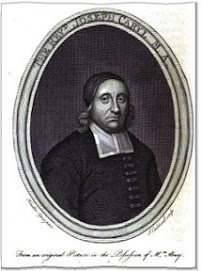
Coleman Anecdote 20 Judge Jeffreys and Philip Henry

The conduct of Jeffreys to Philip Henry. 
Having presented several cases in which the conduct of the Chief Justice appears as little else than a compound of cruelty, injustice, and profaneness, it will be proper to record one instance in which he acted in a different manner, which shows some remaining influence of early education on such a mind as his.
Some time after the prosecution of Philip Henry, as related in a preceding page, Judge Jeffreys attended at the assizes for Flintshire, and it was remarked that he did not in private conversation appear to applaud what was done in this matter, as was expected. It was also said that he spoke with some respect of Mr. Henry, saying, "he knew him and his character well, and that he was a great friend of his mother's
" - Mrs. Jeffreys, of Acton, near Wrexham, a very pious, good woman - "and that sometimes, at his mother's request, Mr. Henry had examined him in his learning when he was a schoolboy, and had commended his proficiency." And it was much wondered at by many, that of all the times Sir George Jeffreys went that circuit, though it is well known what was his temper, and what the temper of those times, yet he never sought any occasion against Mr. Henry, nor took the occasions that were offered, nor countenanced any trouble that was intended him.
One particular circumstance may be recorded. There had been an agreement among several ministers to spend some time, either in secret or in their families, or both, between six and eight o'clock every Monday morning, in prayer, for the Church of God and for the land and nation, more fully and particularly than at other times, and to make that their special errand at a throne of grace, and to engage as many of their praying friends as ever they could to the observance of it. This had been communicated by Mr. Henry to.
 some of his friends in London, and he punctually observed it in his own practice. He also mentioned it to some of his acquaintances, who observed it in like manner.
It happened that Mr. Ambrose Lewis, a minister in Derbyshire, to whom he had communicated this, was so well pleased with it that he wrote a letter concerning it to a friend of his at a distance, which letter happened to fall into hands that perverted it, and made information upon it against the writer and receiver of the letter, who were bound over to the assizes; and great suspicions Sir George Jeffreys had that it was a branch of the Presbyterian plot, and rallied the parties accused severely.
At length it appeared, either by the letter or the confession of the parties, that they received the project from Mr. Henry, which it was greatly feared would bring him into trouble; but Sir George, to the admiration of many, let it fall, and never inquired further into it.
It appears that there are some men "whose ways so please the Lord, that he makes even their enemies to be at peace with them;" and there is nothing lost by trusting in God.

Edward Bowles 1613-1662

This is from the ODNB 1900
BOWLES, EDWARD (1613-1662), presbyterian minister, was born in February 1613 at Sutton, Bedfordshire. His father, Oliver Bowles, B.D., minister of Sutton, was one of the oldest members of the Westminster Assembly, and author of:
  • 'Zeale for God's House quickned: a Fast Sermon before the Assembly of the Lords, Commons, and Divines,' 1643, 4to.
  • 'De Pastore Evangelico,' 1649, 4to; 1655 and 1659, 16mo (published by his son, and dedicated to the Earl of Manchester).
  • Bowles was educated at Catherine Hall, Cambridge, under Sibbes and Brownrigge. He was chaplain to the second Earl of Manchester, and after the surrender of York, 15 July 1644, was appointed one of the four parliamentary ministers in that city, officiating alternately at the minster and Allhallows-on-the-Pavement. On 10 June 1645 the House of Commons voted him 100l.as one of the ministers in the army. His preaching is said to have been extremely popular, even with hearers not of his own party. Among the presbyterians of the city and district he was the recognised leader; nay, it is said that, without being a forward man, 'he ruled all York.' On 29 Dec. 1657 he wrote to Secretary Thurloe, urging the suppression of preachers who advocated the observance of Christmas. Matthew Pool, the commentator, thought more of his judgment than of any other man's. He was a man of some humour. In 1660 he was active in the restoration of the monarchy, accompanying Fairfax to Breda, and incurring some odium with his friends for over-zeal. He did not, however, flinch from his presbyterianism, though report said that the deanery of York was offered to him. Bradbury relates that Bowles, on leaving London after the Restoration, said to Albemarle, 'My lord, I have buried the good old cause, and I am now going to bury myself.' Excluded from the minster, he continued to preach at Allhallows, and subsequently at St. Martin's, besides conducting a Thursday lecture at St. Peter's. The parishioners of Leeds petitioned the king in April 1661 for his appointment to that vicarage, but it was given to John Lake (afterwards bishop of Chichester). Efforts were made (Calamy says by Tillotson and Stillingfleet) to induce him to conform ; but when asked in his last illness what he disliked in conformity, he replied 'The whole.' Calamy reckons him among the silenced ministers, but he died just before the act came into force, and was buried on 23 Aug. 1662. His wife, who predeceased him, was a grand-daughter of Matthew Hutton, archbishop of York, and widow of John Robynson of Dighton. Bowles's portrait (which has been photographed) was in 1869 the property of Leonard Hartley of Middleton Tyas, a collateral descendant. He published:
  • 'The Mystery of Iniquity yet working,' &c., 1643, 4to (he means popery).
  • 'Manifest Truth,' 1646, 4to (a narrative of the proceedings of the Scotch army, and vindication of the parliament, in reply to a tract called 'Truths Manifest').
  • 'Good Counsell for Evil Times,' 1648, 4to (sermon [Eph. v. 15, 16] at St. Paul's, before the Lord Mayor of London).
  • 'The Dutie and Danger of Swearing,' 1655 (sermon at York).
  • 'A Plain and Short Catechism' (anon), 8th edit. 1676, 8vo (reprinted in Calamy's 'Continuation' and in James's 'History').
  • The will, dated 9 July 1707, codicil 21 Aug. 1710, of the presbyterian Dame Sarah Hewley (born 1627, died 23 Aug. 1710), widow of Sir John Hewley, knt. (died 1697), left a large estate to found several trusts for almshouses, preachers, and students ; a condition of admission to the almshouses being the repeating of Mr. Edward Bowles's catechism. The trust having descended to anti-trinitarian hands, a suit was begun on 18 June 1830, which ended in the removal of the trustees by a judgment of the House of Lords given on 5 Aug. 1842. Much use was made on both sides of the doctrinal statements and omissions in the catechism. This suit was the immediate occasion of the passing of the Dissenters' Chapels Act, 1844.

    Bishoprics and Deaneries

    Apparently the offers of bishoprics and deaneries to Presbyterians were as follows, Edward Reynolds being the only one to take up the offer:

    Bishoprics
    Norwich Edward Reynolds
    Hereford Richard Baxter
    Lichfield and Coventry Edmund Calamy

    Deaneries
    Rochester Thomas Manton
    Lichfield William Bates
    York Edward Bowles

    Thursday, 6 September 2012

    The new book

    The Book is out

    The book is now out. It is 165 pages in length and is retailing at the moment at the bargain price of £7.64. Evangelical Press have done us proud. Do get your copy asap. 

    Spirituality in Adversity

    Raymond Brown's new book Spirituality in Adversity. English Nonconformity in a Period of Repression, 1660-1689 is now out from Paternoster.
    Paternoster say
    Spirituality in Adversity demonstrates through a specific historical period of persecution the fortitude and faith of evangelical men and women as they face unspeakable hardship in the name of Christ. This exhaustive masterpiece traces the period of the repression in the seventeenth century, analysing the persecution and its aftermath. The unique feature of this scholarly and very readable work is that it examines the way those persecuted responded to hardship their faith, their worship, their perseverance. With marvellous warmth Raymond Brown shows us the spirituality of these men and women a spirituality centred on Jesus Christ and the Father s love, even in such times. ...
    This is is a remarkable book by any standards - scholarly and pastoral, meticulous and heart-warming. A significant masterpiece on the faith, worship, perseverance of remarkable men and women.
    The unique feature of this scholarly and very readable work is that it examines the way those persecuted responded to hardship: their faith, their worship, their perseverance. With marvellous warmth Raymond Brown shows us the spirituality of these men and women- spirituality centred on Jesus Christ and the Father's love, even in such times.
    They add these quotes:
    "Brown dives into the writings of those persecuted and demonstrates the rich theology that could only be written with such depth by those who lived in suffering and found God faithful and satisfying. I highly recommend this book to scholars as well as common sufferers looking for solace in God."
    Larry Siekawitch, pastor and author of Balancing Head and Heart in Seventeenth Century Puritanism
    "At a time when Evangelicals interested in the study of spirituality often overlook the immense resources of their own antecedents, I hope that this book will help to redress the balance."
    Timothy Grass, church historian, author and associate editor for the Ecclesiastical History Society                           
    "Raymond Brown's research - the fruit of a lifetime of study - reveals how suffering forged a deep spirituality." Derek Tidball
    See here and here
    Details

  • Paperback: 375 pages
  • Publisher: Authentic Media (13 July 2012)
  • Language: English
  • ISBN-10: 1842277855
  • ISBN-13: 978-1842277850
  • Friday, 31 August 2012

    Trueman on why Owen is not better known

    The name of John Owen (1616-1683) is little known today even in theological circles outside of very conservative evangelical churches and the narrow and highly specialized field of early modern intellectual history. This is This is unfortunate, for Owen was without doubt the most significant theological intellect in England in the third quarter of the seventeenth century and one of the two or three most impressive Protestant theologians in Europe at the time. It was his misfortune, however, to be on the losing side: for Owen was a Puritan and allied to the Indepenedent party in the struggles which tore England apart in the 1640s and 1650s; as such, as such he was one of history's losers; and, as history is generally written by those who win, Owen was swiftly and decisively written out of the intellectual history of England in the aftermath of the Great Ejection of 1662 when non-conformists were not simply expelled from the Church of England, but excluded from the establishment, political, cultural, and intellectual, with all of the later impotence with regard to influence and the writing of history which that implies. ...
    (From the intro to his John Owen: reformed Catholic, Renaissance man)

    Wednesday, 29 August 2012

    Treading the grain link

    See link here

    Third Way Link

    I found this here

    On this 350th anniversary of the Great Ejection, when the Puritans were ejected from the Church of England, I pulled down a volume of Thomas Manton, the ejected rector of St. Paul’s, Covent Garden.
    Of his influence, the First Bishop of Liverpool J.C. Ryle wrote, “If ever there was an English divine who must be classed as a Puritan, that man is Manton…his works, like the Pilgrim’s Progress deserve the attention of all true Christians…As an expositor of Scripture I regard Manton with unmingled admiration. Here, at any rate, he is facile princeps [easily first] among the divines of the Puritan school… In days like these [Ryle wrote in 1870], I am thankful that the publishers of Manton’s Works have boldly come forward to offer real literary gold to the reading public.”
    Dr William Bates preached his funeral sermon. I found it in volume 22. When we read how he described his departed friend, we understand why Ryle wrote what he did and how it was reported that Bates would weep whenever he spoke of Manton for some years after his friend’s death. At the same time, the description below provides us with a powerful depiction of a true preacher and true preaching.
    His name is worthy of precious and eternal memory. God had furnished him with a rare union of those parts which are requisite to form an eminent minister of his word. A clear judgment, a rich fancy, a strong memory, and happy elocution met in him; and were excellently improved by his diligent study. In preaching the word he was of conspicuous eminence; and none could detract from him, but from ignorance or envy. He was endowed with an extraordinary knowledge of the scripture; and in his preaching, gave such perspicuous accounts of the order and dependence of divine truths, and with that felicity applied the scripture to confirm them, that every subject, by his management, was cultivated and improved. His discourses were so clear and convincing, that none, without offering violence to conscience, could resist their evidence; and from hence they were effectual, not only to inspire a sudden flame, and raise a short commotion in the affections, but to make a lasting change in the life.
    His doctrine was uncorrupt and pure; the truth according to godliness. He was far from the guilty, vile intention to prostitute the sacred ordinances for acquiring any private secular advantage; neither did he entertain his hearers with impertinent subtleties, empty notions, intricate disputes, dry and barren, without productive virtue; but as one who always had in his eye the great end of his ministry, the glory of God, and the salvation of men. His sermons were directed to open their eyes, that they might see their wretched condition as sinners, to hasten their flight from the wrath to come, and make them humbly, and thankfully, and entirely receive Christ as their Prince and all-sufficient Saviour; and to build up the converted in their holy faith, and more excellent love, which is the “fulfilling of the law:” in short, to make true Christians eminent in knowledge and universal obedience.
    And as the matter of his sermons was designed for the good of souls, so his way of expression was proper for that end. His style was not exquisitely studied, not consisting of harmonious periods, but far distant from vulgar meanness. His expression was natural and free, clear and eloquent, quick and powerful; without any spice of folly; and always suitable to the simplicity and majesty of divine truth. His sermons afforded substantial food with delight, so that a fastidious mind could not disrelish them. He abhorred a vain ostentation of wit in handling sacred truths, so venerable and grave, and of eternal consequence. His fervour and earnestness in preaching was such as might soften and make pliant the most stubborn and obstinate spirit. I am not speaking of one whose talent was only voice, who laboured in the pulpit as if the end of preaching were the exercise of the body, and not for the profit of souls.
    But this man of God was inflamed with holy zeal, and from thence such expressions broke forth as were capable of procuring attention and consent in his hearers. He spake as one who had a living faith within him of divine truth. From this union of zeal with his knowledge, he was excellently qualified to convince and convert souls. His unparalleled assiduity in preaching declared him very sensible of those dear and strong obligations which lie upon ministers to be very diligent in that blessed work. This faithful minister abounded in the work of the Lord; and, which is truly admirable, though so frequent in preaching, yet was always superior to others, and equal to himself, He was no fomentor of faction, but studious of the public tranquillity; he knew what a blessing peace is, and wisely foresaw the pernicious consequences which attend divisions.
    Consider him as a Christian, his life was answerable to his doctrine. This servant of God was like a fruitful tree, which produces in the branches what it contains in the root. His inward grace was made visible in a conversation becoming the gospel. His resolute contempt of the world secured him from being wrought upon by those motives which tempt low spirits from their duty. He would not rashly throw himself into troubles, nor, spreta conscientia [disdaining conscience], avoid them. His generous constancy of mind in resisting the current of popular humour, declared his loyalty to his divine Master. His charity was eminent in procuring supplies for others, when in mean circumstances himself. But he had great experience of God’s fatherly provision, to which his filial confidence was correspondent.
    I shall finish my character of him by observing his humility. He was deeply affected with the sense of his frailty and unworthiness. He considered the infinite purity of God, and the perfection of his law, the rule of duty; and by that humbling light discovered his manifold defects. He expressed his thoughts to me a little before his death. “If the holy prophets were under strong impressions of fear upon extraordinary discoveries of the divine presence, how shall we poor creatures appear before the holy and dreadful Majesty? It is infinitely terrible to appear before God, the Judge of all, without the protection of the blood of sprinkling, which speaketh better things than that of Abel.” This alone relieved him, and supported his hopes. Though his labours were abundant, yet he knew that the work of God, passing through our hands is so blemished, that without appealing to pardoning mercy and grace, we cannot stand in judgment.
    1662 may have been a significant year for the Book of Common Prayer. It was not, however, a good year for those to whom the gospel and a good conscience were more precious than the institutional church. May God grant to his church more such men and ministers today!