Showing posts with label Richard Baxter. Show all posts

Monday, 23 March 2020

Appleby on the Nonconformists and the Plague 1665 Part 1

From David J Appleby's essay in The Great Ejectment of 1662: Its Antecedents, Aftermath, and Ecumenical Significance editor Alan P F Sell

In 1665 plague crossed the Channel, bringing perhaps the worst visitation since the Black Death of 1348. Over the next two years it spread across England and Wales, mainly through the cloth trade routes. As London citizens began to die in droves, the wealthy and well connected fled. King and Parliament removed to Oxford, leaving George Monck, Duke of Albemarle and his army in charge of London. England was by now at war with the Dutch and, with the economic and political life of the capital seriously disrupted, the authorities were understandably more nervous than usual. The traditional ties between English religious dissenters and the Netherlands gave rise to suspicions of treasonable collaboration, and Albemarle kept his soldiers busy rounding up both Quakers and more conventional Nonconformists. Many of these unfortunate individuals subsequently died of plague in the unhealthy environs of London's prisons; including Richard Flavell, a minister who had come to London after having been ejected from his Gloucestershire living, only to perish in Newgate. Hundreds of arrests were also made in the provinces. Charles appointed his brother, James. Duke of York to supervise operations in the areas so recently affected by the Northern Rising. Predictably, little effort was made to distinguish been radicals and moderates, with the result that peaceable Presbyterian ministers such as Philip Henry found themselves caught in the net.
Whatever else he may have been, Gilbert Sheldon was no coward. He remained working in Lambeth throughout the epidemic. Similarly, at least nineteen Anglican clergy stayed to comfort their London congregations, and eleven of them paid for this devotion with their lives. Several of their colleagues, however, deserted their parishes in panic. Nonconformist clergy who had remained in the city promptly climbed into the empty pulpits, or held prayer meetings in private houses to bring spiritual solace to people by now desperately afraid that judgement day was approaching. Calamy records the names of fourteen such ministers who preached in London during these troubled times, the best known being Thomas Vincent, formerly of St. Mary Magdalen, Milk Street. Several more ministers are known to have been living in London and may also have participated in the work. A number of others, Richard Baxter among them, moved out of the city, taking the plague with them in some cases. Relatively little work has been done to investigate the conduct of Nonconformist clergy (and 
their episcopalian counterparts, for that matter) in provincial areas affected by the Great Plague, although it has been suggested that matters in the grievously afflicted cloth-working town of Colchester in Essex followed a similar course to London. The former Colchester minister Owen Stockton may well have engaged in pastoral work in the plague-ridden town, for example, and Obadiah Grew certainly did so in Coventry. ....

Wednesday, 18 December 2013

Coleman Interposition 9

A Persecuting Magistrate Outwitted
The following circumstances, handed down by tradition, characteristic of the times, are related as having taken place when Mr Baxter was residing, for a time in the city of Coventry. Several of the ministers ejected by the Act of Uniformity, who resided in this city, united with Mr Baxter in establishing a lecture in a private house, on a neighbouring common, near the village of Berkswell. The time of worship was, generally, a very early hour. Mr Baxter left Coventry in the evening, intending to preach the lecture in the morning. The night being dark, he lost his way, and after wandering about a considerable time, he came to a gentleman's house, where he asked for direction. The servant who came to the door informed his master that a person of very respectable appearance had lost his way. The gentleman told the servant to invite him in. Mr Baxter readily complied, and met with a very hospitable reception. His conversation was such as to give his host an exalted idea of his good sense and extensive information.
The gentleman wishing to know the quality of his guest, said, after supper, "As most persons have some employment or profession in life, I have no doubt, sir, that you have yours." Mr Baxter replied with a smile, "Yes, sir, I am a man-catcher." "A man-catcher," said the gentleman, "are you? I am very glad to hear you say so, for you are the very person I want. I am a justice of the peace in this district, and am commissioned to secure the person of Dick Baxter, who is expected to preach at a conventicle in this neighbourhood, early to-morrow morning; you shall go with me, and, I doubt not, we shall easily apprehend the rogue."
Mr Baxter very prudently consented to accompany him. Accordingly the gentleman, on the following morning, took Mr Baxter in his carriage to the place where the meeting was to be held. When they arrived at the spot, they saw a considerable number of people hovering about, for, seeing the carriage of the justice, and, suspecting his intentions, they were afraid to enter the house. The justice, observing this, said to Mr Baxter, "I am afraid they have obtained some information of my design. Baxter has probably been apprised of it, and, therefore, will not fulfil his engagement, for you see the people will not go into the house. I think, if we extend our ride a little further, our departure may encourage them to assemble, and on our return we may fulfil our commission." "When they returned they found their efforts useless, for the people still appeared unwilling to assemble. The magistrate, thinking he should be disappointed of the object he had in view, observed to his companion, "that as the people were very much disaffected to the Government, he would be much obliged to him to address them on the subject of loyalty and good behaviour." Mr Baxter replied "that perhaps this would not be deemed sufficient, for as a religious service was the object for which they were met together, they would not be satisfied with advice of that nature; but if the magistrate would begin with prayer, he would then endeavour to say something to them." The gentleman replied, putting his hand to his pocket, "Indeed, sir, I have not got my Prayer-book with me, or I would readily comply with your proposal. However, I am persuaded that a person of your appearance and respectability would be able to pray with them as well as talk to them. I beg, therefore, that you will be so good as to begin with prayer."
This being agreed to, they alighted from the carriage, and entered the house, and the people, hesitating no longer, immediately followed them.
Mr Baxter then commenced the service by prayer, and prayed with that seriousness and fervour for which he was so eminent. The magistrate standing by was soon melted into tears. The good divine then preached in his accustomed lively and zealous manner. When he had concluded, he turned to the justice and said, "I am the very Dick Baxter of whom you are in pursuit. I am entirely at your disposal." The magistrate, however, had felt so much during the service, and saw things in so different a light, that he entirely laid aside all his enmity to the Nonconformists, and ever afterwards became their sincere friend and advocate, and it is believed also a decided Christian.

Wednesday, 19 September 2012

Bishoprics and Deaneries

Apparently the offers of bishoprics and deaneries to Presbyterians were as follows, Edward Reynolds being the only one to take up the offer:

Bishoprics
Norwich Edward Reynolds
Hereford Richard Baxter
Lichfield and Coventry Edmund Calamy

Deaneries
Rochester Thomas Manton
Lichfield William Bates
York Edward Bowles

Tuesday, 27 March 2012

Coleman Anecdote 17b Baxter and Jeffreys

At the time of Baxter's trial and imprisonment, Matthew Henry was in London pursuing his studies .-at Gray's Inn. Whether he witnessed the public obloquy of his father's ancient and beloved friend does not appear; but he went to visit him in his prison, and in giving an account of this visit in a letter to his father, he says: "I found him in pretty comfortable circumstances, though a prisoner, in a private house near the prison, attended on by his own man and maid. He is in as good health as one can expect, and methinks looks better and speaks heartier than when I saw him last. The token you sent he would by no means be persuaded to accept of, and was almost angry when I pressed it from one outed (»'. e., cast out of the Church) as well as himself. He said he did not use to receive ; and I understand since his need is not great. We sat with him about an hour. . . . He gave us some good counsel to prepare for trials; and said the best preparation for them was a life of faith, and a constant course of self-denial. He thought it harder constantly to deny temptations to sensual lusts and pleasures, than to resist one single temptation to deny Christ for fear of suffering; the former requiring such constant watchfulness—however, after the former, the latter will be easier. He said, we who are young are apt to count upon great things, but we must not look for it; and much more to the same purpose. He said he thought dying by sickness usually much more painful and dreadful than dying a violent death: especially considering the extraordinary supports which those have who suffer for righteousness' sake." It is gratifying to find on record such a testimony to the comfort of the suffering saint in his confinement. I would now conduct our readers to another court, and lead them to behold another case, yet more affecting than that of Baxter, for here he will be called to see one of England's highly esteemed matrons, who had been connected with the Nonconformists, and who had now sheltered one of their ministers, called to stand before the same judge, and by him consigned to death.
Alice Lisle, Her Trial and Execution. In Hampshire, John Hickes, a Nonconformist divine, and Richard Nelthorpe, a lawyer, who had been outlawed for his share in the Eye House Plot, had sought refuge at the house of Alice, widow of John Lisle. John Lisle had sat in the Long Parliament, and in the High Court of Justice; had been a Commissioner of the Great Seal, in the days of the Commonwealth; and had been created a Lord by Cromwell. The titles given by the Protector had not been recognised by any Government which had ruled England since the downfall of his house; but they appear to have been often used in conversation, even by Royalists. John Lisle's widow was, therefore, commonly known as the Lady Alice. She was related to many respectable, and to some noble families; and she was generally esteemed, even by the other gentry of her county, for it was well known to them that she had deeply regretted some violent acts in which her husband had borne a part; that she had shed bitter tears for Charles I.; and that she protected and relieved many Cavaliers in their distress. The same womanly kindness which had led her to befriend the Royalists in their time of trouble, would not suffer her to refuse a meal and a hiding-place to the wretched men who now entreated her to protect them. She took them into her house; set meat and drink before them, and showed them where they might take rest. The next morning her dwelling was surrounded by soldiers. Strict search was made; Hickes was found concealed in a malt-house, and Nelthorpe in a chimney. If Lady Alice knew her guests to have been concerned in the insurrection in the west, she was undoubtedly guilty of what, in strictness, is a capital crime; "for the law of principal and accessory then was, |) and is to this day," remarks Macaulay, "in a state disgraceful to English jurisprudence." Odious as the law was, it was strained for the purpose of destroying Alice Lisle. She could not, according to the doctrine laid down by the highest authority, be convicted till after the conviction of the rebels whom she had harboured. She was, however, set to the bar before either Hickes or Nelthorpe had been tried. It was no easy matter in such a case to obtain a verdict for the Crown. The witnesses prevaricated. The jury, consisting of the principal gentlemen of Hampshire, shrank from the thought of sending a fellow-creature to the stake for conduct which seemed rather deserving of praise than of blame. Jeffreys was beside himself with fury. This was the first case of treason on the circuit, and there seemed to be a strong probability that his prey would escape him. He stormed, cursed, and swore, in language which no well-bred man would have used at a. race or a cock-fight. One witness, named Dunne, partly from concern for Lady Alice, and partly from fright at the threats and maledictions of the Chief Justice, entirely lost his head, and at last stood silent. "Oh how hard the truth is," said Jeffreys, "to come -out of a lying Presbyterian knave!" The witness, after a pause of some minutes, stammered a few unmeaning words.
"Was there ever," exclaimed the judge, with an oath, "was there ever such a villain on the face of the -earth r1 Dost thou believe there is a God? Dost thou believe in hell fire? Of all the witnesses I ever met with, I never saw thy fellow." Still the poor man, scared out of his senses, remained mute. And again Jeffreys burst forth :— "I hope, gentlemen of the jury, that you take notice of the horrible carriage of this fellow. How can one help abhorring these men and their religion? A Turk is a saint to such a fellow as this. A Pagan would be ashamed of such villainy. O blessed Jesus! what a generation of vipers do we live among." "I cannot tell what to say, my lord," faltered Dunne. The judge again broke forth into a volley of oaths. "Was there ever," he cried, "such an impudent rascal? Hold a candle to him, that we may see his brazen face. You, gentlemen, that are counsel for the Crown, see that an information for perjury be preferred against this fellow." After the witnesses had been thus handled, the Lady Alice was called on for her defence. She began by saying, "That though she knew Hickes to be in trouble when she took him in, she did not know or suspect that he had been concerned in the rebellion. He was a divine, a man of peace. It had, therefore, never occurred to her that he could have borne arms against the Government; and she had supposed that he wished to conceal himself because warrants were out against him for field preaching." The Chief Justice began to storm. "There is not one of these lying, snivelling, canting Presbyterians, but, one way or another, have a hand in rebellion. Presbytery has all manner of villainy in it. Nothing but Presbytery could have made Dunne such a rogue. Show me a Presbyterian, and I'll show you a lying knave." He summed up in the same style, declaiming during an hour against Whigs and Dissenters, and reminding the jury that the prisoner's husband had borne a part in the death of Charles I., a fact which was not proved by any testimony, and which, if it had been proved, would have been utterly irrelevant to the issue. The jury retired, and remained long in consultation. The judge grew impatient. He could not conceive how, in so plain a case, they should ever have left the box. He sent a messenger to tell them, that if they did not instantly return, he would adjourn the court and lock them up all night. Thus put to the torture, they came, but came to say "that they doubted whether the charge had been made out." Jeffreys expostulated with them vehemently, and after another consultation, they gave a reluctant verdict of guilty. Our historians give different statements in reference to the conduct of the jury. Rapin says, "They found her not guilty three times." Burnet says, "They brought her in the second time not guilty, but, overcome with fear, they brought her in the third time guilty;" while Macaulay only gives the one statement of not guilty, or, "That they doubted whether the charge had been made out." On the following morning sentence was pronounced. Jeffreys gave directions that Alice Lisle should be burned alive that afternoon! This excess of barbarity moved the pity and indignation of that class which was most devoted to the Crown. The clergy of Winchester Cathedral remonstrated with the Chief Justice, who, brutal as he was, was not mad enough to risk a quarrel on such a subject, with a body so much respected by the Tory party. He consented to put off the execution five days. During that time the friends of the prisoner besought James to show her mercy. Ladies of high rank interceded for her. Feversham, whose recent victory had increased his influence at Court, and who, it is said, had been bribed to take the compassionate side, spoke in her favour. Clarendon, the king's brother-in-law, pleaded her cause; but all was in vain. The utmost that could be obtained was, that her sentence should 'be commuted from burning to beheading. She was put to death on the scaffold in the market-place of Winchester, and she passed through it with serene courage. She was a woman of fine understanding, as well as exalted devotion and benevolence, and she behaved in the most heroic manner at the place of execution. The speech which, notwithstanding her advanced age, she delivered on the scaffold, is said to have commenced with a religious exordium, expressive of the patience and submission of her soul to the Divine will.

Coleman Anecdote 17a Baxter and Jeffreys

Baxter before Judge Jeffreys
The following remarkable scene—a scene which, in all its parts, tells most impressively to the honour of Baxter, and to the condemnation of Jeffreys—took place in the Court of King's Bench on May 30th, 1684. In a commentary on the New Testament, written by Baxter, he had complained with some bitterness of the persecutions which the Dissenters suffered; and the main charge was, that in some passages he had reflected on the prelates of the Church of England, and so was guilty of sedition. We will give our readers one of these passages, that they may judge of the nature of this charge. After explaining Matt. v. 19, he observes, "Are not those preachers and prelates, then, the least and basest that preach and tread down Christian love of all that dissent from any of their presumptions, and so preach down not the least but the great command?" "That men who, for not using the prayer-book," says Macaulay, "had been driven from their homes, stripped of their property, and locked up in dungeons, should' dare to utter a murmur, was then thought to be a high crime against the State and the Church." Roger Lestrange, the champion of the government and the oracle of the clergy, sounded the note of war in the "Observator." An information was filed; Baxter begged that he might be allowed some time to prepare for his defence. It was on the day on which Oates was pilloried in Palace Yard that the illustrious chief, the Puritan, oppressed by age and infirmity, came to Westminster Hall to make this request. Jeffreys burst into a storm of rage. "Not a minute," he cried, "to save his life. I can deal with saints as well as with sinners. There stands Oates on one side of the pillory, and if Baxter stood on the other, the two greatest rogues in the kingdom would stand together." "When the trial came on at Guildhall a crowd of those who loved and honoured Baxter filled the court. At his side stood Dr. William Bates, one of the most eminent Nonconformist divines. Two "Whig barristers of great note, Pollexfen and Wallop, appeared for the defence. Pollexfen had scarcely begun his address to the jury, when the Chief Justice broke forth, "Ah, Pollexfen! I know you well. I will set a mark upon you. You are a patron of the faction. This is an old rogue, a schismatical knave, a hypocritical villain. He hates the Liturgy. He would have nothing but long-winded cant without book." And then his lordship turned up his eyes, clasped his hands, and began to sing through his nose in imitation of what he supposed to be Baxter's style of praying, "Lord, we are thy people, thy peculiar people, thy dear people." Pollexfen gently reminded the court that his late Majesty had thought Baxter deserving of a bishopric. "And what ailed the old blockhead, then," cried Jeffreys, "that he did not take it?" His fury now rose almost to madness, he called Baxter a dog, and swore that it would be no more than justice to whip such a villain through the whole city.
Wallop interposed, but fared no better than his leader. "You are in all these dirty cases, Mr. Wallop," says the judge. "Gentlemen of the long robe ought to be ashamed to assist such factious knaves." The advocate made another attempt to obtain a hearing, but to no purpose. "If you do not know your duty," says Jeffreys, "I will teach you." Wallop sat down, and Baxter himself attempted to put in a word, but the Chief Justice drowned all expostulation in a burst of ribaldry and invective, mingled with scraps of Hudibras. "My lord," said the aged man, "I have been much blamed by Dissenters for speaking respectfully of bishops." "Baxter for bishops!" cried the judge, "that's a merry conceit indeed. I know what you mean by bishops—rascals like yourself; Kidderminster bishops, factious, snivelling Presbyterians." Again Baxter essayed to speak, and .again Jeffreys bellowed, "Richard, Richard, dost thou think we will let thee poison the court? Richard, thou art an old knave; thou hast written books enough to load a cart, and every book as full of sedition as an egg is full of meat. By the grace of God, I'll look after thee. I see a great many of your brotherhood waiting to see what will befall their mighty don." And then he continued, fixing his savage eye on Dr. Bates, "There's a doctor of the party at your elbow. But by the grace of God Almighty, I will crush you all."
Baxter held his peace, but one of the junior counsel for the defence made a last effort, and undertook to show that the words of which complaint was made would not bear the construction put on them by the information; with this view he began to read the context. In a moment he was roared down. "You shan't turn the court into a conventicle!" A noise of weeping was heard from some of those that surrounded Baxter. "Snivelling calves !" said the judge.
Witnesses to character were in attendance, and among them were several clergymen of the Established Church. But the Chief Justice would hear nothing. "Does your lordship think," said Baxter, "that any jury will convict a man on such a trial as this?" "I warrant you, Mr. Baxter," said Jeffreys; "don't trouble yourself about that." Jeffreys was right. The sheriffs were the tools of the Government; the juries were selected by the sheriffs from among the fiercest zealots of the Tory party, they conferred for a moment and returned a verdict of guilty.
"My lord," said Baxter, as he left the court, "there was once a Chief Justice who would have treated me very differently." He alluded to his learned and excellent friend Sir Matthew Hale. "There is not an honest man in England," answered Jeffreys, "but looks on thee as a knave."
The sentence was, for those times, it is observed, a lenient one. What passed in conference among the judges cannot be certainly known. It was believed among the Nonconformists, and is highly probable, that the Chief Justice was overruled by his three brethren. He proposed, it is said, that Baxter should be whipped through London at the cart's tail. The majority thought that an eminent divine, who a quarter of a century before had been offered a mitre, and was now in his seventieth year, would be sufficiently punished for a few sharp words with fine and imprisonment.
It is stated that Jeffreys thus summed up the matter to the jury: "'Tis notoriously known, that there has been a design to ruin the king and nation The old game has been renewed, and this has been the main incendiary. He's as modest now as can be, but the time was when no man was so ready at ' Bind your kings in chains, and your nobles in fetters of iron; and 'To your tents, O Israel.' Gentlemen, for God's sake, don't let us be gulled twice in an age."
He was sentenced to pay a fine of five hundred marks, and to lie in prison till it was paid, and bound to his good behaviour for seven years; and he continued in the court's prison in pain and languor for nearly two years; but at length the King changing his measures, he was pardoned. What a scene for a court of justice! and what a sentence after such a trial!

Friday, 23 September 2011

Farewell Sermons Contents

The Contents of the Farewell Sermons volume from SDG

1- Edmund Calamy - Sermon from 2nd Samuel 24:14 "Let us Fall into the Hand of the Lord"

2- Thomas Manton - Sermon from Hebrews 12:1 - "The people of God that have such a multitude of examples of holy men and women set before them, should prepare themselves to run the spiritual race with more patience and cheerfulness."

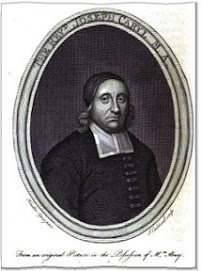
3- Joseph Caryl - Sermon from Revelation 3:4 - "In which encouragement I told you we might consider two things, or take it into two parts. First, " That they should walk with Christ." Secondly, " They should walk in white."

4- Thomas Case - Sermon on Revelation 2:5 - "CHRIST here prescribes precious physic for the healing of this languishing church of Ephesus; it is compounded of a threefold ingredient: 1. Self-reflection, " Remember from," &c. 2. Holy contrition and humiliation before the Lord, " Repent." 3. Thorough reformation, " Do thy first works."

5- William Jenkyn - Morning Sermon on Hebrews 11:38 - "The apostle in this excellent chapter, (that by some is deservedly called a little book of martyrs) discovers the triumph of faith, or victory against all difficulty we meet with."

6- William Jenkyn - Afternoon Sermon on Exodus 3:2-5 - "First then, for explanation, I shall here endeavour to open these two things to you: first, what it is for a place to be holy, or wherein the nature of the holiness of the places consists ; secondly, what that is, that is the foundation or cause of the holiness of places; and both these must in our discourse, and likewise apprehension, be accurately distinguished."

7- Richard Baxter - Sermon on Colossians 2:6,7 - "Omitting the division, and in part the opening of the words, the observation is ; - " That those that have received Christ Jesus the Lord, must accordingly be rooted, built Up in him, and established in the faith; and walk in him as they have been taught, and abound therein with thanksgiving."

8- Thomas Jacombe - Morning Sermon on John 8:29 - The observation I intend to speak to, shall be this: They that please God, and endeavour always to do the things that please God, such God will be with; such the Father will not leave alone; especially in times of suffering and trouble, for I will bring it to that case.

9- Thomas Jacombe - Afternoon Sermon on John 8:29 - Let me endeavour to prevail with every one of you, so to carry yourselves in your several places and capacities, that whatever you do, you may please God.

10- William Bates - Morning Sermon on Hebrews 12:20,21 - Now in these two verses he sums up, by way of recapitulation, all that which he had discoursed of at large, and in them you may observe these two things. 1. A description of God, to whom he addresses this prayer: The God of Peace. 2. The substance of the prayer itself.

11- William Bates - Afternoon Sermon on Hebrews 12:20,21 - It follows " that great Shepherd of the sheep." For the opening of this, 1. We will consider the title of Christ. 2. The person for whom this title relates.

12- Thomas Watson - Morning Sermon on John 13:34 - Doctrine. Christians ought to make conscience of this duty of loving one another. Confident I am, we shall never see religion thrive in the world, until we see this grace of love flourish in the heart of christians.

13- Thomas Watson - Afternoon Sermon on 2 Corinthians 7:1 - It is the title that I intend now, by the help of God, to insist upon, that sweet parenthesis in the text, "dearly beloved," wherein you have the apostle breathing forth his affections unto this people. He speaks now as a pastor, and he speaks to them as his spiritual children.

14- Thomas Watson - Farewell Sermon on Isaiah 3:10,11 - This text is like Israel's pillar or cloud; it hath a light side, and a dark side: it hath a light side unto the godly, "Say unto the righteous, it shall be well with him;" and it hath a dark side unto the wicked, "Woe unto the wicked, it shall be ill with him." Both you see are rewarded, righteous and wicked; but here is a vast difference, the one hath a reward of mercy, the other a reward of j ustice.

15- Thomas Lye - First Sermon on Philippians 4:1 - I shall without any more ado enter upon the text; in which you have two things considerable. A most melting compellation, and a most serious exhortation. 1. A melting compellation, "my brethren, dearly beloved," &c. 2. A serious exhortation; and in it first, the matter of the duty, stand, and stand it out, and stand fast. Secondly, the manner. First, so stand, so as you have stood, stand fast. Second, in the Lord; stand so, and stand in the Lord, in the Lord's strength, and in the Lord's cause.

16- Thomas Lye - Second Sermon on Philippians 4:1 - "It is the grand and indispensable duty of all sincere saints, in the most black and shaking seasons, to stand fast fixed and steadfast in the Lord."

17- Matthew Mead - Sermon on 1 Corinthians 1:3 - Being therefore now to part, I thought to go to the top of the mount, and leave with you grace and peace from God our Father, and from our Lord Jesus Christ. In which words there are two generals. 1. A double blessing desired: Grace and Peace 2. A double spring discovered: that is the Father and the Son, God and Christ.

18- Matthew Newcomen - Sermon on Revelation 3:3 - There are three doctrines obvious in the text; Doctrine 1. That it is the duty of christians, to remember those truths that they have heard and received. Doctrine 2. That it is the duty of christians to hold fast the truth that they have heard and received. Doctrine 3. That continued repentance is the duty of christians, as well as initial repentance. Remember therefore how thou hast received, and heard, and hold fast and repent.

19- Thomas Brooks - Sermon on Questions Asked and Answered followed by 27 Legacies that Brooks Left to his Beloved People

20- John Collins - Sermon on Jude 3 - These words contain two parts. 1. A duty exhorted to. 2. The manner of the management of duty. The duty exhorted to, is, to retain the faith delivered to the saints. The manner of its management is, that we should earnestly contend to keep it.

21- Edmund Calamy - Sermons 1 Samuel 4:13 - I shall gather two observations from the words. 1. That when the ark of God is in danger of being lost, the people of God have thoughtful heads and trembling hearts. 2. That a true child of God is more troubled, and more solicitous what shall become of the ark, than what shall become of wife and children or estate.

22- John Gaspine - Sermon on Luke 12:32 - The text contains that exhortation of Christ, wherein he exhorts them to undauntedness and resolution in the ways of God. " Fear not, little flock, for it is your Father's good pleasure to give you the kingdom." The words may be divided into these two parts. First, Here is an exhortation: "Fear not, little flock." Secondly, The reason of this exhortation: "for it is your Father's good pleasure to give you the kingdom."

23- Lazarus Seaman - Sermon on Hebrews 13:20,21 - In which words, there are two two things considerable. 1. The matter of the apostle's prayer. 2. The grounds, which he doth insinuate for audience.

24- George Evanke - Sermon on Matthew 26:39 - Doct. A gracious soul will endeavour the crossing his own will, when be sees that it crosses God's. Or, thus, A true Christian dare not, at least ought not, to gratify his own humour when it stands in opposition, or cometh in competition with God's honour.

Tuesday, 23 August 2011

Baxter on Simeon Ash

In his autobiography Baxter writes about the nonconformist Simeon Ash as follows:

Good old Mr Simeon Ash was buried the very even of Bartholomew's Day and went seasonably to heaven at the very time he was to be cast out of the Church. He was one of our very oldest Nonconformists (of the old strain; for now [1662] conforming is quite another thing than before the wars): he was a Christian of the primitive simplicity; not made for controversy, nor inclined to disputes, but of a holy life and a cheerful mind, and of a fluent elegancy in prayer, full of matter and excellent words: his ordinary speech was holy and edifying: being confined much to his house by the gout, and having a good estate, and a very good wife, inclined to entertainments and liberality, his house was very much frequented by Ministers: he was always cheerful, without profuse laughter or liberty, or vain words: never troubled with doubtings of his interest in Christ; bat tasting the continual love of God, was much disposed to the communicating of it to others, and comforting dejected souls: his eminent sincerity made him exceedingly loved and honoured: insomuch as Mr Gataker, Mr Whittaker, and others of the most excellent divines of London, when they went to God, desired him to preach their funeral sermons. He was zealous for bringing in the king; having been chaplain to the Earl of Manchester in the wars, he fell under the obloquy of the Cromwellians for crossing their designs: he wrote to Colonel Sanders, Colonel Barton, and others in the army, when General Monk came in, to engage them for the king. Having preached his lecture in Cornhill, being heated, he took cold in the vestry, and thinking it would have proved but one of his old fits of the gout, he went to Highgate; but it turned to a fever. He died as he lived, in great consolation and cheerful exercise of faith, molested with no doubts or fears, discernible: exceeding glad of the company of his friendsand greatly encouraging all about him with his joyful expressions in respect of death and his approaching change; so that no man could seem to be more fearless of it. When he had at last lain speechless for some time, as soon as I came to him, gladness so excited his spirits that he spake joyfully and freely of his going to God to those about him. I stayed with him his last evening, till we had long expected his change (being Speechless all that day), and in the night he departed.

Friday, 5 August 2011

Baxter's Analysis

In his autobiography Baxter attempts an analysis of the way things stood after the Great Ejection. He speaks of
1. Conformists
1 Some conformed who had previously been known as Presbyterians as simply subscribed understanding it in their own sense. Baxter suggests considerations of family and poverty held sway with some. He adds that "most that I knew, when once they inclined to Conformity, did avoid the company of their brethren, and never asked them what their reasons were against Conformity."
2 Latitudinarians - (neo-)Platonists, Cartesians, many Arminian, some universalists. Some scholars some ambitious to rise.
3 Hearty conformists
(1) Some zealous for diocesan views and against the Nonconformists
(2) Some more sympathetic (privately) to Nonconformists
(3) The ignorant adn unlearned and the snesuous and scandalous
2. Nonconformists
1 Some few were for the old conformity, not covenanters nor happy about the civil wars yet unable to assent to all things now imposed
2 Men like Baxter himself, not strongly pro- or anti- episopal
3 Genuine Presbyterians
4 Independents. Mostly these, Baxter says, are like the moderate Presbyterians but some are more factious. He also mentions sects such as the Quakers and some Anabaptists who also fell foul of the new laws, of course.

Thursday, 4 August 2011

More Baxter

"And now," Baxter continues " came in the great inundation of calamities, which in many streams, overwhelmed thousands of godly Christians together with their pastors. ... (1) Hundreds of able ministers with their wives and children had neither house nor bread; for many of them had not past thirty or forty pounds per annum apiece, and most but sixty or eighty pounds per annum, and few had any considerable estates of their own. (2) The people's poverty was so great, that they were not able much to relieve their ministers. (3) The jealousy of the state and the malice of their enemies were so great, that people that were willing durst not be known to give to their ejected pastors, lest it should be said that they maintained schism, or were making collections for some plot or insurrection. (4) The hearts of the people were much grieved for the loss of their pastors. (5) Many places had such set over them in their steads, as they could not with conscience or comfort commit the conduct of their souls to: and they were forced to own all these"... receiving the sacrament in the several parishes whether they would or not. (6) Those that did not this were to be excommunicated, and then to have a writ sued out against them de excommunicato capiendo, to lay them in the jail, and seize on their estates." Baxter lengthens out this catalogue of evils by enumerating the many divisions among ministers and among Christians which the great controversy of the time occasioned, the murmuring and complaining of the people against the government; and he concludes with the remark that "by all these sins, these murmurings, and these violations of the interest of the church and the cause of Christ, the land was prepared for that further inundation of calamities, by war and plague, and scarcity, which hath since brought it near to desolation."

Baxter on that day

"When the Act of Uniformity was passed," says Richard Baxter in his autobiography, "it gave no longer time than till Bartholomew's day, Aug. 24, 1662, and then they must be all cast out. This fatal day called to remembrance the French massacre, when, on the same day, thirty or forty thousand Protestants perished by Roman religious zeal and charity. I had no place of my own; but I preached twice a week, by request, in other men's congregations, at Milk Street and Blackfriars. The last sermon that I preached in public was on May 25. The reasons why I gave over sooner than most others were, because lawyers did interpret a doubtful clause in the act, as ending the liberty of lecturers at that time; because I would let authority soon know that I intended to obey in all that was lawful; because I would let all ministers in England understand in time, whether I intended to conform or not; for, had I staid to the last day, some would have conformed the sooner, from a supposition that I intended it. These, with other reasons, moved me to cease three months before Bartholomew's day, which many censured for a while, but, afterwards, better saw the reasons of it."

Tuesday, 26 April 2011

The Savoy Conference

(From Wikipedia)

The Savoy Conference of 1661 was a significant liturgical discussion that took place, after the Restoration of Charles II, in a supposed attempt to effect a reconciliation within the Church of England.
It was convened by Gilbert Sheldon, in his lodgings at the Savoy Hospital in London (where the Savoy Hotel now is) and was attended by commissioners: 12 Anglican bishops and 12 representative ministers of the Puritan and Presbyterian factions. Each side also had nine deputies (called assistants or coadjutors). The nominal chairman was Accepted Frewen, the Archbishop of York. The object was to revise the Book of Common Prayer. Richard Baxter for the Presbyterian side presented a new liturgy, but this was not accepted. In 1662 the Act of Uniformity followed and the Great Ejection.

Commissioners
The nominated commissioners and deputies were as follows:

Accepted Frewen, Archbishop of York
Gilbert Sheldon, Bishop of London
John Cosin, Bishop of Durham
John Warner, Bishop of Rochester
Henry King, Bishop of Chichester
Humphrey Henchman, Bishop of Salisbury
George Morley, Bishop of Worcester
Robert Sanderson, Bishop of Lincoln
Benjamin Laney, Bishop of Peterborough
Brian Walton, Bishop of Chester
Richard Sterne, Bishop of Carlisle
John Gauden, Bishop of Exeter

For the presbyterians (eventually ejectees marked *):
Edward Reynolds, Bishop of Norwich
Anthony Tuckney*
John Conant (Reynolds' son-in-law)
William Spurstow*
John Wallis
Thomas Manton*
Edmund Calamy*
Richard Baxter *
Arthur Jackson*
Thomas Case*
Samuel Clarke*
Matthew Newcomen*

Deputies
On the episcopal side:
John Earle, Dean of Westminster
Peter Heylin Sub-dean of Westminster.
John Hacket
John Barwick
Peter Gunning
John Pearson
Thomas Pierce
Anthony Sparrow
Herbert Thorndike

On the presbyterian side:
Thomas Horton (ejected but then conformed) 
Thomas Jacomb*
William Bates*
John Rawlinson*
William Cooper*
John Lightfoot
John Collinges*
Benjamin Woodbridge (ejected but then conformed and then became a nonconformist again)

There was to have been one more deputy on the presbyterian side, the former physician Roger Drake*. A clerical error caused his name to appear as "William Drake" in the official document, and he did not actually attend.

Thursday, 4 March 2010

Thomas Doolittle


Thomas Doolittle (1630-1707) was an English Puritan pastor of the 17th century. At his death, in 1707, at the age of 77, he had the distinction of being the last surviving pastor of the Great Ejection.

Born in Kidderminster, as a boy he heard Baxter preach "The Saints’ Everlasting Rest" (published 1653). The addresses led to Doolittle’s conversion and he would later call Baxter his “father in Christ.”
As an assistant to a county lawyer, he was required to work on the Sabbath adn so he left. Baxter encouraged him to enter the ministry. He studied at Pembroke Hall, Cambridge, earning a BA 1653 and MA 1656. His tutor was William Moses, later ejected from Pembroke.
Doolittle quickly earned a reputation as a great preacher. In 1653, he received Presbyterian ordination but committed himself to St Alfege, London Wall, where he until ejected in 1662. His ministry there had been eminently successful. In 1657, he had written to Baxter “God hath given me abundant encouragement in my work, by giving me favour in the hearts and affections of the people … and others in the city."

Friday, 11 April 2008

Educated men

Though not all university men, the ejected men of 1662 were well educated and trained in rhetoric often using Latin, Greek and even Hebrew to get the message across. Non-university men like Richard Baxter and John Oldfield were clearly well read, which was a Puritan tradition. David Appleby makes the point that 'Far from being inferior, the ejected ministers of 1662 were at the very least the intellectual equals of the confomrist clergy.' They were educated not just in their college days but after through household seminaries run by experienced ministers. From the time of Elizabeth godly conferences had been a feature of the scene. Those such as the one at Dedham had become famous. They have been compared to modern professional associations.

Sunday, 16 December 2007

Victorian Silks


I was in someone's home recently and I saw an attractive Victorian silk like these ones. These examples are found at the bottom of this web page here.