Showing posts with label John Oldfield. Show all posts

Tuesday, 14 February 2023

Ejected men in the ODNB 'O/P'

O
New England Urian Oakes c 1631–1681 returned to New England in 1671 to be head of the infant Harvard College.
Midlands preacher Henry O[a]sland 1625-1703
Lancashire born Samuel Ogden 1627/8–1697 who ‘thought the idolising the Common Prayer, and placing all religion in it, was a provocation to the good spirit of God’.
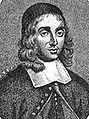
Derbyshire born John Oldfield 1626/7–1682 who wrote about his nonconformity and was later quoted by Unitarian Elizabeth Gaskell in Chapter 4 of her novel North and South. Oldfield wrote
When thou canst no longer continue in thy work without dishonour to God, discredit to religion, foregoing thy integrity, wounding conscience, spoiling thy peace, and hazarding the loss of thy salvation; in a word, when the conditions upon which thou must continue (if thou wilt continue) in thy employments are sinful, and unwarranted by the word of God, thou mayest, yea, thou must believe that God will turn thy very silence, suspension, deprivation, and laying aside, to His glory, and the advancement of the Gospel's interest.
P
Thomas Pakeman c 1614–1691
Anthony Palmer 1616-1679 of Bourton on the Water
Bolton born Robert Parke 1600-1668
London born Thomas Parson 1631- c 1668
Edward Pearse c 1633–1673
Lancashire born Henry Pendlebury 1626–1695
Samuel Petto c 1624–1711 who wrote on coveannt theology
Pembrokeshire born Peregrine Philips 1623–1691
Lavenham born Abraham Pinchbecke 1626-1681/2
London born John Poynter 1600–1684

Tuesday, 25 February 2020

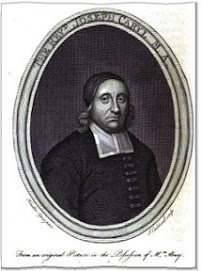
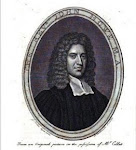
John Oldfield c 1627-1682

This ejected minister, father of Joshua, was born near Chesterfield, Derbyshire, about 1627. He was educated at the grammar school of Bromfield, Cumberland. Though of no university, he was a good scholar and mathematician. He held the rectory of Carsington, Derbyshire, having been appointed in or before 1649. His parishioners, according to Calamy, were 'very ticklish and capricious, very hard to be pleased in ministers,' but he suited them; and, though the living was worth but 70l., he refused a better offer of the perpetual curacy of Tamworth, Warwickshire. He was present, as a member, at the first known meeting (16 Dec. 1651) of the Wirksworth classis, of which he was a most regular attendant (15 times moderator) till its last recorded meeting (17 Nov. 1658). His sermon before the classis on 17 July 1655 was 'well approved' as 'orthodox and seasonable.' On 15 Jan. 1656, by appointment of the classis, he delivered the fifth of a series of doctrinal arguments directed against the errors of Socinians, his thesis being 'that the name Jehovah is incommunicable.' In the minutes, as in the Carsington parish register, his name is always written Otefield or Oateield (twice). By the Uniformity Act (1662) he was ejected from Carrington. After this he moved from place to place, sometimes attending the established church, and often preaching in conventicles. Latterly he settled at Alfreton, Derbyshire. Once a fortnight he preached at Road Nook, Derbyshire, in a house belonging to John Spateman, and was informed against for so doing. It was proved that he was 10 miles off on the specified day; the informers were prosecuted, and one of them pilloried at Derby.
For some time before his death he was disabled. He died on 6 June 1662, 'ætat. 55,' and was buried in Alfreton Church, where there is a brass plate to his memory. He married Ann, sister of Robert Porter (d. 1690), vicar of Pentrich, Derbyshire. Four of his sons entered the ministry:
(1) John (b. 1 Nov. 1654), who received Presbyterian ordination in September 1681, and afterwards conformed;
(2) Joshua (see previous post);
(3) Nathaniel, Presbyterian minister (1689-96) at Globe Alley, Maid Lane, Southwark (d. 31 Dec. 1696, aged 32);
(4) Samuel, who received Presbyterian ordination on 14 April 1698, and was minister at Woolwich, Kent, and from 1719 at Ramsbury, Wiltshire (living in 1729).
John Oldfield published
‘The First Last and the Last First . . . substance of . . . Lecture in the Country,' &c., 1666, 12mo (addressed by ‘J. O.’ to the 'parishioners of 'C. and W. in the county of D.') 
Calamy mentions that he published 'a larger piece about prayer.'
His last sermon at Carsington is in 'Farewell Sermons,' 1663, 8vo (country collection).
His ‘soliloquy’ after the passing of the Uniformity Act is abridged in Calamy; some striking sentences from it are noted in 'North and South,' 1855, vol. i. ch. iv., by Mrs Gaskell.

Monday, 30 July 2012

Banner of Truth Trust

This is the cover of the Banner of Truth magazine for August. The cover is flagging up the reissue of a small book of farewell sermons originally published by Banner back in 1962 and includes introductory material from the book by Iain Murray, which includes biographical material on the seven preachers. The book's contents are as follows:


Introduction
Edmund Calamy Trembling for the Ark of God (1 Sam. 4:13)
Thomas Brooks A Pastor’s Legacies
John Collins Contending for the Faith (Jude 3)
Thomas Lye A Pastor’s Love for His People (Phil. 4:1) Stand Fast in the Lord (Phil. 4:1)
Thomas Watson Weal to the Righteous but Woe to the Wicked (Isa. 3:10, 11) Parting Counsels (2 Cor. 7:1)
John Oldfield Stumbling at the Sufferings of the Godly (Psa. 69:6)
John Whitlock Remember, Hold Fast and Repent (Rev. 3:3)
The Nonconformist’s Catechism

Friday, 11 April 2008

Educated men

Though not all university men, the ejected men of 1662 were well educated and trained in rhetoric often using Latin, Greek and even Hebrew to get the message across. Non-university men like Richard Baxter and John Oldfield were clearly well read, which was a Puritan tradition. David Appleby makes the point that 'Far from being inferior, the ejected ministers of 1662 were at the very least the intellectual equals of the confomrist clergy.' They were educated not just in their college days but after through household seminaries run by experienced ministers. From the time of Elizabeth godly conferences had been a feature of the scene. Those such as the one at Dedham had become famous. They have been compared to modern professional associations.