Thursday, 7 September 2017

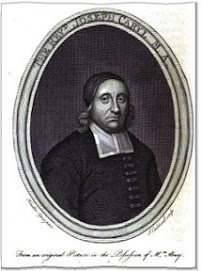
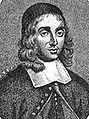
Bunhill Fields Thomas Rosewell 1630-1692

In his book on Bunhill Fields Alfred W Light tells that turning the back on Bunyan's tomb, and leaving the path to the left, the visitor will see, about five rows of stones ahead but nearer the railings, the now "double " headstone of Thomas Rosewell. On the original stone there was a Latin inscription, of which the translation is given as follows: — 
Here lieth the body of that celebrated divine, Thomas Rosewell, M.A. A man not more eminent for his learning than for his piety and modesty; a preacher distinguished for judgment, eloquence, and study ; a most diligent and skilful interpreter of the sacred volume. Who after many labours, and through the iniquities of the times, and many bitter sufferings, which for the sake of Christ be bore with the greatest fortitude, calmly departed this life at Rotherhithe, February 15th, in the 62nd year of his age, and of Christ, 1692.
There is now this inscription: — 
Thomas Rosewell, Nonconformist Minister, Rotherhithe. Died 1692. Tried for High Treason under the infamous Jefferies. See "State Trials, 1684.
Mr. Rosewell was born at Dunkerton, near Bath, on May 3rd, 1630, and his mother and father both died before he was ten years old. He and his sister had a considerable fortune bequeathed to them, but this was dissipated whilst living with an uncle during their minority. When about 16 years of age he began to sit under the ministry of Mr. Matthew Haviland, and to his preaching Rosewell always confessed that he owed his conversion. After spending some time under a tutor in London, he removed in March, 1674, to Pembroke College, Oxford, where he prosecuted his studies under Dr. Langley. He entered the ministry of the Church of England, and was presented to the rectory at Rhode in Somersetshire, in 1653, and in 1657 to Sutton Mandeville in Wilts. He was vicar here in 1662 when the Act of Uniformity came into force, and was one of the noble men who suffered ejectment then. He now became tutor to the son of Lady Hungerford, but in 1674 he was elected minister of the Presbyterian congregation meeting at Rotherhithe. In spite of much persecution he continued preaching, but he was tried for high treason in 1685. Daniel Neal gives an account of this in his History as follows: —
"Jefferies, now Lord Chief Justice of England, who was scandalously vicious, and drunk every day, besides a drunkenness of fury in his temper that looked like madness, was prepared for any dirty work the court should put him upon. September 23rd, Mr. Thomas Rosewell, the Dissenting minister at Rotherhithe, was imprisoned in the Gate House, Westminster, for high treason; and a Bill was found against him at the Quarter Sessions, upon which he was tried on November 8th at the King's Bench Bar, by a Surrey jury, before Lord Chief Justice Jefferies, and his brethren (viz.) Withins, Holloway, and Walcot. He was indicted for the following expressions in his sermon of September 14th:
"That the King could not cure the King's evil, but the priests and prophets by their prayers could heal the griefs of the people; that we had had two wicked Kings (meaning tke present King and his father), whom we can resemble to no other person but to the most wicked Jeroboam; and that if they (meaning his hearers), would stand to their principles, he did not doubt, but they should overcome their enemies (meaning the King), as in former times, with rams' horns, broken platters, and a stone in a sling.'
The witnesses were three infamous women, who swore to the words without the innuendos; but they were laden with the guilt of many perjuries already, and such of them as could be found afterwards, were convicted, and the chief of them pilloried before the Exchange. The trial lasted seven hours, and Mr. Rosewell behaved with all the decency and respect to the Court that could be expected, and made a defence that was applauded by most of the hearers. He said it was impossible the witnesses should remember, and be able to pronounce so long a period, when they could not so much as tell the text, nor anything else in the sermon, besides the words they had sworn. Several who heard the sermon and writ it in shorthand, declared they heard no such words. Mr. Rosewell offered his own notes to prove it, but no regard was had to them. The women could not prove (says Burnet), by any one circumstance, that they were at the meeting; or that any person saw them there on that day; the words they swore were so gross, that it was not to be imagined that any man in his wits would express himself so, before a mixed assembly: yet Jefferies urged the matter with his usual vehemence. He laid it for a foundation, that all preaching at conventicles was treasonable, and that this ought to dispose the jury to believe any evidence upon that head, so the jury brought him in guilty; upon which (says the bishop), there was a shameful rejoicing; and it was now thought, all conventicles must be suppressed, when such evidence could be received against such a defence. But when the words came to be examined by men learned in the law, they were found not to be treason by any Statute. So Mr. Rosewell moved in arrest of judgement, and though it was doubtful, whether the motion was proper on this foundation after the verdict, yet the King was so out of countenance at the accounts he heard of the witnesses, that he gave orders to yield to it; and in the end he was pardoned. The Court lost a great deal of reputation by this trial, for besides that Rosewell made a strong defence, he proved that he had always been a loyal man even in Cromwell's days, that he prayed constantly for the king in his family, and that in his sermons he often insisted upon the obligations to loyalty."
The manner of his escape was quite unusual. For once a Dissenter who had been condemned to death, and who was bitterly hated by Jefferies, did not suffer the full penalty of the law. Sir John Talbot, who had been present at the trial, went to the King, and speaking quite plainly, told him, "that he had seen the life of a gentleman and a scholar dependent on such evidence as he would not hang his dog on." He also said, "Sir, if your Majesty suffers this man to die, we are none of us safe in our houses." Just at this moment Jefferies, delighted with what he had done, burst into the room, and with much joyful pleasure told the King what a good deed he had accomplished, and what great service he had rendered to his Master. The surprise of Jefferies may be imagined when Charles II told him that Rosewell should not die, but that he must by some means make a way of escape. This was most unpalatable to Jefferies, who was simply thirsting for the blood of Rosewell, but a new trial was ordered, and Counsel was assigned the condemned man in order to plead the insufficiency of the indictment in arrest of judgment. There was an adjournment until the following term, and in the meantime the King granted Rosewell a pardon and he was discharged.
The prosecution of Rosewell was particularly unjust in that whilst a strong Puritan, he always had a very kindly feeling towards the Stuart family. While he was a schoolboy at Bath during the Civil War, the King's army seized the town, and the school was broken up. It was about this time that while he was taking a walk from home, he saw Charles I in a field, sitting at dinner under a tree with a few persons around him. This occurrence always disposed him to be loyal to the Royal Family, but it in no way influenced Jefferies in his decision.
His death took place on February 14th, 1692, in the 62nd year of his age, so that he outlived his trial about seven years.
Wikipedia article here.

Bunhill Fields

Alfred W Light wrote of Bunhill Fields
To the mere passer-by, this sacred plot in the City Road, London, is just an ordinary disused burying ground. To the tired factory girl and weary mechanic it is a place in which to rest during the dinner hour. To the builder it presents itself as a splendid site for factories and offices. To crowds of people it is a short cut from the busy City Road to the quieter Bunhill Row. To popish clerics it is almost as a plague spot that should be carefully avoided. To a lover of liberty of conscience, of freedom of thought, of an open Bible and of spiritual religion, it is, however, hallowed ground, for beneath its turf there are resting thousands of brave men and women who counted not their lives dear unto them, but who "contended earnestly for the faith once delivered to the saints." The principles of Scriptural Dissent are here magnified, whilst thoughts of cruel and wicked persecutions by spiritually ignorant clerics, magistrates, and evil princes crowd into the mind. Here are buried some 120,000 persons. Many of these died in poverty and distress, some even within prison walls, whilst had they been willing to comply with the regulations and to accept blindly the teachings of such popish bishops as Laud, many would have occupied positions of national distinction.
The following account is chiefly compiled from two publications of the City Corporation, viz., "Bunhill Fields Burial Ground; Proceedings in reference to its Preservation," and the Official Guide. The former, which contains very important correspondence between the City Fathers and the Ecclesiastical Commissioners, was pubhshed in 1867, and is now somewhat rare; the latter can still be obtained of the keepers at the Grounds.
The history here given is of great importance, and there is true cause for thankfulness that the Ecclesiastical Commissioners, into whose hands the valuable Finsbury estate, of which Bunhill Fields is a portion, fell in 1867, had a wealthy and powerful body to contend against. Amongst the City Fathers during the critical period there were Sir Charles Reed and others who boldly championed the cause of righteousness and justice. In the old days, at the original entrance, there was a stone with the following inscription: "This churchyard was enclosed with a brick wall, at the sole charge of the City of London, in the Mayoralty of Sir John Lawrence, Kt., A.D. 1665; and afterwards the gates hereof were built and finished in the Mayoralty of Sir Thomas Bludworth, Kt., A.D. 1666." Strangely enough it has been completely lost.
This takes us back to the days of the Great Plague and Fire of London, although it is probable that centuries before there was a Saxon burying place at Bon-hill or Bone-hill Fields.
The whole district was swampy, and at various spots archers, apprentices, and the soldiers practised with their bows, staves, and other weapons. From this place many had in the past gone to fight the French at Cressy, Poitiers, and other famous battles; and here the City train bands brought themselves to a state of proficiency by zealously and constantly engaging in their more peaceful combats.
The land itself was originally part of a great church property, but in the fifteenth century the Corporation took it over at a yearly rent of twenty shillings. For this sum the Lord Mayor was granted "for himself and for his successors all his right and claim" to the property, which was considered to be a grant of the land in perpetuity. There must have been, however, some flaw in the provisions, as in 1653 the Corporation obtained a lease for ninety years at a rental of £29 13s. 4d.
In 1561 a most terrible thunderstorm and tempest burst over London, and in every quarter houses were wrecked, whilst the lightning struck and seriously damaged St. Paul's Cathedral. Indeed a portion of the Cathedral was actually destroyed whilst the terrified citizens for the most part gazed helplessly on. To repair the noble structure and to re-lead the roof was a great undertaking, towards which the Corporation provided about twenty tons of lead. In return for this two further leases of seventy years each were granted, which gave the City possession for 215 years, and this was naturally considered to be very little short of a freehold.
During the Commonwealth, when the church lands were sold, the Corporation bought the Finsbury estate and thus became Lords of the manor. As such they paid no rents, but when some ten years later the Stuart family in the person of Charles II regained the throne of England, all the properties returned to the Church. It was quite in keeping with the character of the new king and of the ecclesiastical authorities that there was no repayment of the purchase money, so the City suffered the loss of their money and property. The land was now put to some use in order to produce income, and De Foe is of opinion that the Great Plague Pit was at or near this spot. The City burying places were soon filled, for persons were dying at the rate of eight or ten thousand every week.
It is stated in "Maitland's Survey" (1739) concerning this land that "Part whereof at present denominated Tindal's or the Dissenters' burial-ground, was by the Mayor and Corporation of London, in the year 1665, set apart and consecrated as a common cemetery for the interment of such corpses as could not have room in the burial-grounds in the dreadful year of the pestilence. However, it not being made use of on that occasion, the said Tindal took a lease thereof, and converted it into a burial-ground."
The ground is marked for a time on the maps by the name of Tindal instead of the Bon-hill Fields. As the books of the City were destroyed by fire there is no record of it earlier than 1698, but a stone was found on which was the name of Debora Warr, the date being November 10th, 1623. It is thought probable that this is the date of the woman's death, but that the body was re-interred. There was another, however, of "Joannes Seaman, natus 6 Feb. 1665, ob Jul. 23, 1665," and this is most likely to be the more ancient. In turn, Bunhill Fields was in the possession of a James Browne, and a certain Elizabeth Fetherstonhaugh, but about 1741 the Corporation took sole charge once again, and by this time the revenue was very considerable.
Special attention was drawn to the Finsbury Estate in the Parliament of 1766, and there were proposals to make some use of the lands "now the resort of idle and disorderly persons." These arrangements were far reaching, but in all the plans it is clearly shown that the burying-ground was to remain untouched. Merchants' houses and homes for professional men were to be erected, and the City authorities entered without delay into negotiations with Prebendary Wilson. The official committee reported to the Common Council that they had "agreed with the Prebendary to join in an application to Parliament for an Act to enable the Prebendary and his successors to grant a lease to the City of the Prebendal Estate, from Christmas last, for a term of ninety-nine years, renewable at the expiration of seventy -three years by adding fourteen years, to make up a term of forty years, and afterwards every fourteen years in like manner for ever." In some extraordinary way a clause to this effect (although in the Bill) was omitted from the Act, but it has not been discovered how this unfortunate accident occurred. It is obvious that the renewal of the lease every fourteen years for ever was to be a vital point in the agreement, but at the appointed time no renewal did take place or was ever allowed to do so. The result ultimately was that an immense and most valuable property fell into the hands of the Ecclesiastical Commissioners, and thus from henceforth the enormous income was to be used for Church of England purposes. The spirit of the voluntary agreement was absolutely ignored by the clerical party, and the Corporation had to suffer this second great loss by the absolute letter of the Act being maintained. 
There is ample evidence that in addition to the City authorities, the public and also the church party believed that the property was to be held in public trust practically Bunhill Fields, 5 till the end of time, and that because of this there was a conviction that the stones and resting-places of the noble dead in Bunhill Fields would never be disturbed. Any other supposition is impossible, for certainly Dissenters would not have purchased graves and erected monuments if these afterwards were to be placed at the mercy of a priestly caste. When it became known to the public that Bunhill had changed hands, a Committee made application that the burial-ground should be held sacred for ever. Considering that hitherto this portion of the estate had been always omitted for valuation purposes the reply of the Commissioners was very strange. They stated that the ground was considered to be worth £100,000 - presumably for building purposes - but that they were willing under the circumstances to receive £10,000 by way of compensation. This led to a memorial being presented to the Corporation, at which ah appeal was made that authority should be obtained from Parliament to prevent secular use being made of this sacred spot.
On the 16th November, 1865, at the Court of Common Council, the following special resolution was passed: — 
"Resolved unanimously - That this Court learns with regret that in the communications with the Ecclesiastical Commissioners, the Committee have not found any disposition to concur in an arrangement for the preservation of the Bunhill Fields' Burial Ground, except upon the terms of sale and purchase
"That having regard to the antiquity of this spot as a place of extramural sepulture, that it has been held by this Corporation for more than five hundred years, that it has been set apart and used for centuries as a place of interment ; that a public pledge has been given by the conjoint authorization of the Ecclesiastical authorities and the Corporation - 'That the ground should at all times hereafter remain for the purposes of burials only,' and that up to the year 1832, upon these conditions and assurances, vaults have been sold: this Court protests against this ground or any part thereof being applied to secular uses. That, considering the high historic interest attaching to the Bunhill Fields Burial Ground, in consequence of the interment of so many distinguished and honoured men of all creeds and parties, this Court is willing to accept 6 Bunhill Fields, the care and preservation of the ground on behalf of the public, and to assist in promoting any well-advised scheme for securing against molestation and disturbance the final resting place of so many thousands of their fellow-citizens.
"Ordered: That a copy of the foregoing Kesolutions be transmitted to the Ecclesiastical Commissioners."
In a remarkably short time a Bill was prepared and became an Act, one of the clauses being:— "The Burial Ground shall from time to time and at all times ... be held, used, and enjoyed, as an open space, accessible to the public at such times and under such regulations as the Corporation shall from time to time think proper and expedient ... and no house or other building, whether for the purpose of residence or trade, or for any other purpose, shall, from henceforth and for ever hereafter, be built or erected upon the burial ground or any part thereof."
Immediately after the Act was obtained a special Committee was appointed by the City authorities to make alterations and to restore and improve the ground generally, the place being opened to the public in October, 1869, after two years labour. A statement was made to the Corporation by the Chairman of the Committee in the following words: — 
"In the presence of representatives of families whose dead were buried here, and of the delegates of churches and societies whose pastors and founders rest in this ground, I desire to say that in all the reparations and alterations carried on within this enclosure, not a fragment of stone has been taken away, nor has any portion of the soil been removed. Tombs have been raised from beneath the ground, stones have been set straight, illegible inscriptions have been deciphered and re-cut, hundreds of decayed tombs have been restored, paths have been laid and avenues planted : and in all the sacred rights of sepulture scrupulously respected. An accurate copy of all the principal inscriptions exists ; a complete register of all interments is preserved ; an exact plan of the entire ground has been taken ; and it is now hoped that the Corporation of London having voluntarily done so much, the families owning graves here may come forward to do the rest. Within a few weeks the Committee will have discharged a trust readily undertaken in the public interest. They have considered themselves as fulfilling a sacred duty while renewing to posterity the emblems of the zeal and the suffering of their forefathers, and thereby, in the language of one buried here, 'trimming, as it were, the beacon-light left to warn future generations to defend their religion, even unto their blood.' It only remains that I should ask your lordship (The Right Honourable the Lord Mayor, Sir James Clarke Lawrence, Bart., M.P.) to declare this ground open, under the conditions of the Act of Parliament which gives to the people this their prized and rightful inheritance."
The appeal that "the families owning graves here may come forward and do the rest" met with some response, and certain monuments were erected by public subscription. It is full time, however, that more interest and love should be shown for the tombs of such noble men and women. The decaying hand of time is to be seen upon almost every stone; some are broken in two, others have sunk into the ground, and many more are now practically unreadable. Unless something is done it will be quite impossible to locate the stones of some of the most famous and godly persons, and this will be a disgrace to the public in general, but to Dissenters in particular. At different times since the opening various alterations have been made. There is now a new entrance and a path running through from the City Eoad to Bunhill Eow, but the old gateway may still be seen with its row of fierce, cruel-looking spikes which were placed there to prevent the body-snatchers doing their gruesome work. Trees have also been planted, especially the planes with their strange " moulting " trunks, and the ground has been re-turfed, flowers planted and seats provided. In addition to the official keeper there is also a gardener employed, so that for the most part this " God's Acre" is in a fair condition. But one look at the stones in their decaying state is a sad, sad sight, and the expense of preserving the main ones would be but a small matter to the great Dissenting bodies, whilst in addition, surely there are many others who love the honour of these men and the truth of God sufficiently to subscribe in order that the last resting-places of some of England's noblest children may not sink entirely into obscurity.
The writer of the Official Guide makes a most moving appeal in the following words: "Shall no friendly hand clear away those dank weeds which hide the lowly stones? Shall none appear to cleanse the soiled and weather-worn slab, so that its record may be traced? Shall none be found to lift up the headstone fallen slantwise to the earth, or to renew the masonry of the altar tombs, lying now in shapeless and pitiable ruin? Is there none to chisel out the faded inscription, and with pious hand to grave still more deeply the time-honoured memorials? Nonconformists! is there no 'Old Mortality ' amongst you, who, out of love for these sainted ones and for their Lord and Master, would live awhile amongst the tombs, and make it impossible that the names of our illustrious dead - confessors, historians, pastors, poets - and their dying witness to His love, shauld evermore be hidden from our view?"

Light on The Act of Uniformity

Alfred W Light in his Book on Bunhill Fields
The Act of Uniformity
As frequent reference must be made in these pages to this infamous Act, it is desirable that some little account should be given of it. At the death of Cromwell on the 3rd September, 1658, the future king of England (Charles II) was an exile at Breda, in Holland, and seizing a favourable opportunity to return as king he, on April 14th, 1660, issued a declaration which was purposely drawn up to catch the unwary. Amongst other things he stated although "the passion and uncharitableness of the times have produced several opinions in religion" he did "declare a liberty to tender consciences; and that no more shall be disquieted or called in question for differences of opinion in matters of religion which do not disturb the peace of the kingdom, and that we shall be ready to consent to such an Act of Parliament as upon mature deliberation shall be offered to us for the full granting that indulgence." Much joy was caused in England by this apparently frank statement, for after the dreadful persecutions of the past the people were particularly anxious as to their religious liberty. So satisfied were the Puritans that several of them made special journey to Breda to return thanks to Charles and also to make clear some other points. The false Prince (one writer has stated that Charles "superseded the reign of saints by the reign of strumpets: who was crowned in his youth with the Covenant in his hand and died with the Host sticking in his throat.") received them graciously, and strove with much success to impress upon his visitors a sense of his godliness. One of the chief things mentioned was the fact that the Book of Common Prayer was so very little used that in many parts the people had never seen or heard it; "and therefore they besought him that he would not use it so entirely and formally, and have some parts only of it read, with mixture of other prayers which the Chaplains might use." This point was also insisted upon after the Restoration at a Conference with the King in London, where they presented a document which had been drawn up at the invitation of Charles himself. Some of the bishops made reply, and whilst a controversy was proceeding the monarch issued another declaration dated the 25th October, 1660, in which he clearly and definitely promised many reforms. The year passed away without anything being accomplished, but on January 10th, 1661, a most disheartening declaration was published! (See footnote below). This was a prohibition of conventicle services, and several sects were definitely mentioned with a view to suppression. The only places where services could be held were "in some parochial church or chapel in this realm or in private houses by the persons there inhabiting." The value of the reference to "tender consciences" and the promises so lavishly made were now seen in measure, but very few seemed to apprehend the real dangers which were ahead. There were naturally many disputations, and Charles appears to have been weary of it all, and, in order to bring the matter to a conclusion, issued a warrant dated March 25th, 1661, convening the Savoy Conference. On each side were to be twelve men - the Establishment sending one archbishop and eleven bishops; whilst Reynolds, Bishop of Norwich, appeared on the other side with eleven Puritan divines. The instructions of Charles were to the effect that the Prayer Book was to be considered, and whilst as few alterations as possible were to be made, due notice should be taken of real objections. The first session was held on April 15th, 1661, but it was soon evident that the Conference would be utterly fruitless as the Bishops absolutely refused to make even the slightest concession. In vain did Baxter, Reynolds and the others plead for relaxation on eight several points, viz., using the sign of the cross in baptism, the compulsory wearing of a surplice, the forcing of people to receive the bread and wine kneeling, the obligation to pronounce all baptized persons regenerated by the Holy Spirit, the admitting of evil persons to the table, the absolution in definite expressions of unfit persons, the giving of thanks to God for all whom they buried, and the solemn declaration "that there is nothing in the Common Prayer Book, Book of Ordination and the Thirty-nine Articles, contrary to the Word of God."
The arguments of the Puritans were unanswerable, but the Bishops were determined not to give way, and the Conference broke up on July 25th, without arriving at any agreement. It is true that a revision of the Prayer Book shortly afterwards took place, but although the alterations were numerous they were of comparatively small importance, and everything to which the Puritans objected was carefully retained. Following this the Act of Uniformity was passed, and on the 19th May, 1662, the Royal Assent was given. The object was to force every beneficed clergyman to use and to declare his "unfeigned assent and consent to all and everything contained and prescribed in and by the book intituled The Book of Common Prayer !" The day appointed was Michaelmas, but it was altered to St. Bartholomew's, August 24th. Why this change ? In giving an answer it is impossible to avoid charging the officials of the Establishment with a particularly mean and cruel action. On Michaelmas Day the tithes became due, and it was then that the clergy paid their accounts for the year and generally straightened out their financial matters. By altering the date to August 24th, the non-conforming ministers would be compelled to leave their benefices without means to discharge their debts and without any money to help them through a very trying period. But such refined cruelty could after all only be expected from such men, and they certainly were not disappointed at the result of their eiforts. It was generally known that an Act of Uniformity had been passed, but as this was by no means the first, the terrible results were not expected. When, however, the terms of the Act were made public there was great consternation, for it was clear that there was no middle course, but that it was either conforming or non-conforming. A study of this period and of the correspondence between the Puritans is most instructive and touching. The ill-fated day drew on apace. In the reign of Elizabeth it had been celebrated by the French King and priests in a great massacre of unresisting and innocent Huguenots, and now England under the guidance of Charles the false, and godless bishops, was to sin against light and knowledge. There was little, if any, drawing back amongst the Puritans, and a most noble spirit was manifested. One clergyman, Mr. Lawrence of Baschurch, alluding to his wife and ten children said, "I have eleven arguments for conformity, but Christ has said, 'Whoso loveth wife or children more than Me is not worthy of Me.'" Old Richard Baxter wrote:

"Must I be driven from my books?
From house, and goods, and dearest friends?
One of Thy sweet and gracious smiles,
For more than this will make amends:
My Lord hath taught me how to want
A place wherein to lay my head;
While He is mine I'll be content
To beg or lack my daily bread."

Some two thousand noble men, with brave wives and children, left their dear homesteads, and "took cheerfully the spoiling of their goods " that they might "keep a conscience void of offence towards God and towards man." Was there ever an occasion quite like this, or a fact equal to this fact? Think of it! Two thousand godly, educated, tender, intelligent men severed friendships, cast aside all hope of earthly prosperity, gave up their homes, their daily bread, their treasured libraries, with all their comforts, and w^ent forth into the wilderness - many to perish of want and privation, some to be harried like hares, others to die in prison, and all because they could not sully their consciences by making a false oath and by declaring their agreement with doctrines and ritual which they believed were contrary to the Word of the living God. Well might the Act of Uniformity be called the Act of Ejection! In roaming through Bunhill Fields it is not easyto avoid a contemplation of this subject, and without some knowledge of the facts here briefly recorded, it is quite impossible to understand the reason why so many men who believed in Episcopacy, in set forms of worship, and who had no objection to a State church, are resting in a Nonconformists' burying ground.

A study of the Corporation Act by means of which all persons who refused on principle to conform to the Episcopal Church were expelled and excluded from the magistracy and from all public ofi&ces, and the other persecuting Acts passed in the early days of the reign of Charles II., is most instructive. By the statute against the Quakers more than 4,000 persons were cast into prison, whilst the Conventicle Act decreed that all persons who refused to attend the public services of the Established Church should for the first and second offence be imprisoned and fined, whilst for the third offence transportation .was the sentence, and if the sufferer ever returned to the homeland death was the penalty. This abominable Act was passed in 1664, but it in measure broke down during the great Plague when after the Clergy had through fear left their churches and flocks the non-conforming divines returned to the metropolis, which was virtually a death trap, and preached to their old congregations once again. The King and Court were safely housed at Oxford, but a new penal law was passed to deal with the case, and in 1670 the Conventicle was a prohibition of conventicle services, and several sects vrere definitely mentioned with a view to suppression. The only places where services could be held were "in some parochial church or chapel in this realm or in private houses by the persons there inhabiting." The value of the reference to " tender consciences " and the promises so lavishly made were now seen in measure, but very few seemed to apprehend the real dangers which were ahead. There were naturally many disputations, and Charles appears to have been weary of it all, and, in order to bring the matter to a conclusion, issued a warrant dated March 25th, 1661, convening the Savoy Conference. On each side were to be twelve men—the Establishment sending one archbishop and eleven bishops ; whilst Keynolds, Bishop of Norwich, appeared on the other side with eleven Puritan divines. The instructions of Charles were to the effect that the Prayer Book was to be considered, and whilst as few alterations as possible were to be made, due notice should be taken of real objections. The first session was held on April 15th, 1661, but it was soon evident that the Conference would be utterly fruitless as the Bishops absolutely refused to make even the slightest concession. In vain did Baxter, Eeynolds and the others plead for relaxation on eight several points, viz., using the sign of the cross in baptism, the compulsory wearing of a surplice, the forcing of people to receive the bread and wine kneeling, the obligation to pronounce all baptized persons regenerated by the Holy Spirit, the admitting of evil persons to the table, the absolution in definite expressions of unfit persons, the giving of thanks to God for all whom they buried, and the solemn declaration "that there is nothing in the Common Prayer Book, Book of Ordination and the Thirty-nine Articles, contrary to the Word of God." Act was enforced with even harsher terms. No trial by jury of these godly men could now take place, their persons could be seized on any and every occasion, whilst no exception could be taken to the warrants even though these were irregularly and incorrectly drawn. It has been recorded that one notable ecclesiastic, the Bishop of Peterborough, declared that, " It hath done its business against all fanatics except the Quakers ! but when the Parliament sits again, a stronger law will bo made, not only to take away their lands and goods, but also to sell them for bond slaves." What a kind and good shepherd!

Saturday, 22 July 2017

Matthew Henry on dissent

When in the books and sermons, that plead for the church of England, I find sober dissenting ministers censured and condemned as usurpers, impostors, and lay-intruders; all their administrations nulled, their assemblies denied to be parts of the catholic church, all who join with them sentenced as schismatics to the pit of hell, and no hopes of salvation given them, but what God's general mercy allows to moral heathens; and all the reformed churches that have no bishops, - that is, diocesan bishops, - falling so far under the same censure, that their ministers cannot be admitted ministers of the church of England, unless they be re-ordained, while those who have been popish priests may; and all these harsh censures excused from uncharitableness with this, that they cannot help it, their principles lead them to it: then, think I, the Lord deliver me from such principles, and from that pretended unity, which is destructive of real charity.
The Rev. Matthew Henry
(See his THE LAY-MAN'S REASONS for his JOINING IN STATED COMMUNION WITH A CONGREGATION OF MODERATE DISSENTERS)

The Sufferers Catechism


The Sufferers-catechism, Wherein are Many Necessary and Reasonable Questions and Cases of Conscience Resolved, Etc was a 44 page book published anonymously in 1664. It appears to be the work of the Welshman Vavasor Powell (1617-1670) who wrote in prison with Nathaniel Rich (d 1701).

Here is a brief extract

Quest. 7 . Why are all the godly to expect sufferings and persecutions?
Because it is one of the wayes that God bath appointed to do them good by; it is food to feed them; a school to teach them; water to cleanse them; fire to purify them; a hedge, and a wall, to keep them from their sins; and a means to help them to be partakers of his holiness ... 

Quest. 15. Is it the revealed will of God the Father, and of Christ, that any should be persecuted or destroyed. for Religion or Conscience sake?
Answ. No surely. See Job. 19.22-28, Psal. 69.25 and 109.16, Mat. 7.12, Acts 7.52.

Quest 16. How doth that further appear?
Answ.
1. Because it is contrary to the nature and behaviour of God and Christ. who are gracious, merciful, patient, and long-suffering to the worst of men, much more to the Righteous, Job 33.24.25, Jonah 4.2. Mat. 5.45, Luke 6.35, 36, Rom. 2.4.
2. Because it is contrary to the end of Christ's coming into the world, who came to save men's lives, and not to destroy them. Luke 9.56, 1 Tim 1.13.
3. Because persecution for Religion is a sin, therefore it is contrary. and not according to the revealed will of God; See Mat. 5.12, Luke 11.9, 1 Cor 15.49,  Gal 1.12-17, 1 Tim 1.13 .....

More here

Saturday, 4 March 2017

Westminster Divine Simeon Ashe died 1662

Simeon Ashe was educated at the Puritan Emmanuel College, Cambridge. He began his career as a minister in Staffordshire, but was ejected from his living on account of his refusal to read the Book of Sports and to conform to other ceremonies. On his dismissal Sir John Burgoyne befriended him and allowed him the use of an 'exempt' church at Wroxhall; and he was afterwards under the protection of Robert Greville, 2nd Baron Brooke. He was a regular Sunday preacher at Warwick Castle, and a friend of the minister Thomas Dugard (brother of William, father of Samuel Dugard).
When the First English Civil War broke out, he became chaplain to the Earl of Manchester. At the close of the war he received the living of St. Austin, and was also one of the Cornhill lecturers. He was nominated to the Westminster assembly after the death in 1643 of Josias Shute. Although he had joined the side of the parliament, Ashe was strongly opposed to the Cromwellians; and when the time was ripe for the English Restoration he was among the divines who went to Breda to meet Charles II. He died a few days before the passing of the Act of Uniformity, and was buried on 24 August 1662. Had he lived to see the passing of the act, he would have vacated his living and so should be counted among the ejected.
Ashe was a man of some property, and while he held the living of St. Austin, his house was always open to his clerical brethren. Walker charges him with exercising severity against the conforming clergy.
His works - In 1644 he joined with William Goode, another chaplain of the Earl of Manchester, in writing a pamphlet entitled A particular Relation of the most Remarkable Occurrences from the United Forces in the North. This was followed by another pamphlet, for which Ashe alone was responsible, entitled A True Relation of the most Chiefe Occurrences at and since the late Battell at Newbery. The writer's object in both cases was to vindicate the conduct of his patron. In John Vicars's Parliamentary Chronicle there is a letter of his, describing the proceedings of the Earl of Manchester in reducing several garrisons after the battle of Marston Moor. Ashe was the author of sermons, including
'A Sermon on Ps. ix. 9,' preached before the House of Commons on 30 March 1642
'A Sermon before the House of Lords,' 26 Feb. 1644
'A Funeral Sermon on the Death of the Countess of Manchester,' 12 Oct. 1658, etc.
He also edited some treatises of John Ball, John Brinsley, Ralph Robinson, and others.

Memorial Sermon by J M Cramp 1818

A memorial sermon referring to the great ejection was preached by the Baptist historian J M Cramp in 1818. It can be accessed here.
His text is Acts 5:29.
At the end of his sermon he makes four applications.

1. In the conduct of these excellent men, we have a noble example for our imitation
2. As Dissenters, we should not be unmindful of our obligations to divine goodness
3. The principles of dissent deserve to be carefully studied, and warmly supported
4. In the event which we have now commemorated, we have a striking proof of the power of religion

Monday, 4 July 2016

Westminster Divine Richard Byfield c 1598-1664

Richard Byfield (1598?–1664) a Sabbatarian controversialist, a member of the Westminster Assembly and an ejected minister was 16 years of age in 1615 and 67 at his death in December 1664; he was probably born in 1598. He was a son of Richard Byfield by his second wife. Nicholas Byfield was his elder half-brother.  Richard Senior became vicar of Stratford-on-Avon in January 1597, so it is reasonable to conclude that, like his elder half-brother, Richard Junior was a Warwickshire man, though his baptism is not to be found in the Stratford-on-Avon register.
In Michaelmas term 1615 he was entered either as servitor or batler at The Queen's College, Oxford. He graduated B.A. 19 October 1619, and M.A. 29 October 1622.
He was curate or lecturer at Isleworth, probably during his brother's incumbency (i.e. before 8 September 1622), and had some other minor employments before being presented in 1627 by Sir Thomas Evelyn to the rectory of Long Ditton, Surrey. He sat in the Westminster Assembly, but was not one of the divines nominated in the original ordinance of 12 June 1643, being appointed, perhaps through the influence of his nephew Adoniram Byfield, to fill the vacancy caused by the 1645 death of Daniel Featley.
During the protectorate he quarreled with Sir John Evelyn, his patron, about the reparation of the church, and Edmund Calamy recounts their amicable reconciliation through the intervention of Cromwell. In 1654 he was appointed one of the assistant commissioners for Surrey, under the ordinance of 29 June for the ejection of scandalous, etc, ministers and schoolmasters.
He wrote a commendation of John Owen's famous work Death of death in Christ.
He held his rectory, with a high character for personal piety and zeal in the ministry until ejection in 1662. At his ejection he was the oldest minister in Surrey, i.e. probably in seniority of appointment, for he was not an old man. Leaving Long Ditton, he retired to Mortlake, where he was in the habit of preaching twice every Sunday in his own family, and did so the very Sunday before his death. He died suddenly in December 1664, and was buried in Mortlake church.
Works
Some of the works of his brother Nicholas have been assigned to Richard; he edited a few of them. His own works are:
'The Light of Faith and Way of Holiness,' 1630.
'The Doctrine of the Sabbath Vindicated, in Confutation of a Treatise of the Sabbath written by Mr. Edward Brerewood against Mr. Nicholas Byfield,' 1631. Byfield attacks the spelling 'Sabaoth' adopted by Edward Brerewood.
'A Brief Answer to a lae Treatise of the Sabbath Day,' 1636? (given to Byfield by Peter Heylin, in The History of the Sabbath,' 2nd edit. 1636; it was in reply to A Treatise of the Sabbath Day etc, 1635, by Francis White, who rejoined in An Examination and Confutation, etc, 1637).
'The Power of the Christ of God,' etc, 1641
'Zion's Answer to the Nation's Ambassadors,' etc, 1645 (fast sermon before the House of Commons on 25 June, from Is. xiv. 32)
'Temple Defilers defiled,' 1645 (two sermons at Kingston upon Thames from 1 Cor. iii. 17; reissued with new title-page 'A short Treatise describing the true Church of Christ,' etc, 1653, directed against schism, anabaptism and libertinism)
'A message sent from ... Scotland to ... the Prince of Wales,' 1648 (letter from Byfield)
'The Gospel's Glory without prejudice to the Law,' etc, 1659 (an exposition of Rom. viii. 3, 4)
'The real Way to good Works: a Treatise of Charity.'

Thursday, 30 June 2016

William Dyer c 1632-1696

DYER, WILLIAM (c. 1632-1696). Nonconformist English minister. Little of Dyer's early life is known. He began his preaching career in Chesham, then accepted then accepted a call to minister at Cholesbury in Buckinghamshire. By 1662, he had vacated his pulpit, most likely in response to the Act of Uniformity. Dyer preached at St. Anne's, Aldersgate Street, London, in 1665, and the sermons, in which Dyer claimed the plague was God's punishment on London, were published under the title Christ's voice to London (1666). In later life, Dyer is thought to have been sympathetic to Quakers and may have converted to Quakerism. He is buried in a Quaker cemetery in Southwark. Dyer's writing has been compared stylistically to John Bunyan's and John Saltmarsh's.

This biographical piece from The A-Z of the Puritans is based on the following older piece
 
WILLIAM DYER, an eminent English Nonconformist divine, was born in 1636. He was successively minister of Cholesbury and Chesham, Buckinghamshire. He was one of the two thousand ministers who were ejected from the Establishment in the year 1662 - a year which shall be ever memorable in the history of nonconformity. After his ejectment he removed to London, where he resided during the time of the plague, meanwhile preaching and assisting in the good work, which afterwards resulted in the nonconforming party being more favourably dealt with by the State than it had previously been. During this year he preached the celebrated sermons called Christ's Voice to London, and the Great Day of God's Wrath, two powerful discourses on the pestilence then prevailing. Later in life, from conscientious motives, he became a member of the Society of Friends, with the principles of which he afterwards identified himself. After living a life of usefulness, and passing through many vicissitudes, he died in 1696, aged sixty years.
The reputation of Dyer as an author rests chiefly upon Christ's Famous Titles handled in divers Sermonsa and first published in 1663. He afterwards published a sequel to this work, entitled, A Golden Chain for Believers to hang about their necks which has maintained a popularity almost equal to that of the Famous Titles. He also wrote A Cabinet of Jewels; or, a Glimpse of Sion's Glory. The style and composition of our author resemble those of John Bunyan, although they must be acknowledged to be inferior to those of the author of the Pilgrim's Progress, being deficient in the beautiful simplicity distinguishing that work; but in intensity and sincerity they are equally excellent.


Tuesday, 28 June 2016

Numbers

The number ejected is sometimes disputed. In my book I write

Estimates vary but it seems that, including those ejected before 1662 and some who jumped rather than waiting to be pushed, nearly two thousand ministers and others were silenced or ejected. There will always be some vagueness about the figure as some changed their minds. A G Matthews says that some 210 later conformed. A contemporary writer, John Walker, says of an Evan Griffiths of Oxwich in South Wales, who was ejected but then conformed, that he became as violent against dissenters as he had once been against royalists. Also, the ejection included not only ministers but also lecturers and even private tutors. Further, some such as Cornishman Francis Howell 1625-1679 present anomalies. Howell, “a man mighty in the scriptures” according to Calamy, was expelled both as Principal of Jesus College, Oxford in 1660 and as incumbent of Llanrhaeadr-ym-Mochnant in North Wales in 1662.
In his Nonconformist Memorial Calamy deals with some 2,465 people altogether. Matthews and Watts say that the number unwilling to conform in 1662 was 2029, around 936* in England and 120 in Wales. Some 200 of these were university lecturers. Matthews points out that a further 129 were deprived at an uncertain date between 1660 and 1663 and with the ejections of 1660 as well, he gives a total of 1760 ministers (which is about 20% of the clergy) thrust out of the Church of England, silenced from preaching or teaching because they could no longer conform by law and so deprived of a livelihood.
Gerald Bray comments that “almost all of these were Puritans, and so the Act may be said to represent the expulsion of Puritanism from the national Church. "On the other hand, John Spurr points out that Puritans remained within the state church and others, like Quakers and General Baptists, were ejected. He quotes John Corbet 1620-1680, saying, " it is a palpable injury to burden us with the various parties with whom we are now herded by our ejection in the general state of dissenters."
* That figure I'm sure should be 1909