Wednesday, 1 April 2020

Thomas Vincent 1665

The great plague in London, in the year 1665, gave occasion for the display of the piety and zeal of several of the ejected ministers, and of the providence of God in preserving them from the contagion, when prosecuting their ministerial labours in the midst of it.
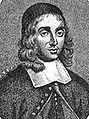
The Rev Thomas Vincent was at this period tutor of an academy at Islington, but determined to leave his situation, and devote himself to the spiritual instruction of the people in London, where many of the pulpits were deserted. His friends vainly endeavoured to dissuade him from the dangerous enterprise. He agreed, however, to follow the advice of his reverend brethren in and about the city. When they were assembled, he told them his resolution, and assured them that it had been the result of much serious thought. He had carefully examined the state of his own soul, and could look death in the face with comfort. He thought it absolutely necessary that the vast numbers of people then dying, should have some spiritual assistance, and that he could never again have such a prospect of ministerial usefulness as now presented itself. He added, that he had solemnly devoted himself to God and souls upon this occasion; and that, therefore, he hoped none of them would endeavor to weaken his hands in this work.
Encouraged by the ministers, who prayed for his protection and success, he entered on his labors with fortitude and diligence. During all the time of the plague, he preached every sabbath in some of the parish churches. He chose the most moving and important subjects, and treated them in the most pathetic and searching manner.
The awfulness of the judgment then before the eyes of all, gave great force to his addresses, and a very general inquiry was always made where he would preach the next sabbath. Many learned from him the necessity of salvation, and the way to heaven through the blood of Christ. He visited all who sent for him, and it pleased God to take especial care of his life; for though in this year there died in London, of the plague, 68,596, including seven persons in the family in which he lived, he continued in perfect health all the time, and was a useful minister to a numerous congregation at Hoxton for upwards of twelve years afterwards. Thus were the promises in the ninety-first psalm fulfilled to this servant of God.
From Anecdotes. Originally published 1841 by the Religious Tract Society of London.

Monday, 23 March 2020

Appleby on the Nonconformists and the Plague 1665 Part 2

... In some cases the courage of certain Nonconformists drew praise even from Anglicans. When the impeccably royalist third Earl of Devonshire, Lord Lieutenant of Derbyshire, received a request 
that the ejected minister Thomas Stanley be expelled from his residence at Eyam, the Earl replied 'that it was more reasonable, that the whole Country should in more than Words testifie their Thankfulness to him, who together with Isis Care of the Town had taken such Care, as none else did, to prevent the Infection of the Towns adjacent. If Nonconformist clergy had demonstrated their worth by preaching and pastoral work in the affected areas, the plague had also worked to their disadvantage. The finances of many merchants who had previously provided financial support for the Nonconformist ministry had been badly affected. Meanwhile, the ecclesiastical authorities were 
stung by pamphlets deriding those Church of England clergy who had fled from their livings in panic, allowing Nonconformists to take their places. Even a pamphlet such as A Friendly Letter to the Flying Clergy, which praised Archbishop Sheldon for remaining at his post, gave a damaging impression of Anglican pusillanimity. This public perception was later reinforced by Daniel Defoe in his fictitious Journal of the Plague Year, and even more so by Richard Baxter's published memoirs. The appropriation of the vacant London pulpits, however, was not in itself responsible for the Five Mile Act. Among the items that had been occupying Sheldon's attention even before the Great Plague marooned him in Lambeth Palace had been the results of a questionnaire that he had sent to his subordinate bishops in order to ascertain the state of the ministry within the Church of England. The responses that he received in return included alarming appraisals regarding the potential scope of Nonconformist activities and the extent to which the ejected ministers continued to exercise influence over their former congregations. The various concerns of the Lords and Commons meeting at Oxford in October 1665 also served to fuel their anxieties regarding Dissent, and in particular the need to restrict the movements of ejected ministers. Michael Wafts has opined that it is possible to justify the Conventicle Act by reason of the Cavalier Parliament's fear of rebellion, but no such excuse can be offered in defence of the Five Mile Act of 1665 In fact, a deteriorating military situation coupled with political and economic dislocation caused by the worst plague for three hundred years had rendered a fragile state more vulnerable to sedition than ever before. The Cavalier Parliament probably had more excuse for anxiety in 1665 rather than less. As ever, Clarendon recoiled from such indiscriminate repression, and so joined the earls of Manchester and Southampton, and Lord Wharton, in opposing the bill. The preamble to the Five Mile (or 'Oxford') Act declared that many clergy who had refused to subscribe to the various declarations required by the Act of Uniformity had nevertheless continued to preach illegally, and conducted worship at meetings in contravention of the law. Such people were now to be required, as from 24 March 1666, not to live or approach within five miles of any city, corporate town or borough of England, Wales or Berwick-on-Tweed, unless passing through whilst travelling to another destination. The ejected ministers were in addition forbidden to live or come within five miles of any parish, town or place where they had had a ministry since the Act of Oblivion (1660), unless they first took the oath of non-resistance detailed in the Act of Uniformity, with the additional clause that they would not seek any change of government, either in church or state. This became known as the 'Oxford Oath'. The fine for each transgression was to he £40. Any cleric or lay person refusing to take the oath was further forbidden to teach or take on boarders to instruct, on pain of a fine of £10 for each offence. Any two or more justices were henceforth empowered to imprison any found guilty of such offences for  aperiod of six months without bail.


Appleby on the Nonconformists and the Plague 1665 Part 1

From David J Appleby's essay in The Great Ejectment of 1662: Its Antecedents, Aftermath, and Ecumenical Significance editor Alan P F Sell

In 1665 plague crossed the Channel, bringing perhaps the worst visitation since the Black Death of 1348. Over the next two years it spread across England and Wales, mainly through the cloth trade routes. As London citizens began to die in droves, the wealthy and well connected fled. King and Parliament removed to Oxford, leaving George Monck, Duke of Albemarle and his army in charge of London. England was by now at war with the Dutch and, with the economic and political life of the capital seriously disrupted, the authorities were understandably more nervous than usual. The traditional ties between English religious dissenters and the Netherlands gave rise to suspicions of treasonable collaboration, and Albemarle kept his soldiers busy rounding up both Quakers and more conventional Nonconformists. Many of these unfortunate individuals subsequently died of plague in the unhealthy environs of London's prisons; including Richard Flavell, a minister who had come to London after having been ejected from his Gloucestershire living, only to perish in Newgate. Hundreds of arrests were also made in the provinces. Charles appointed his brother, James. Duke of York to supervise operations in the areas so recently affected by the Northern Rising. Predictably, little effort was made to distinguish been radicals and moderates, with the result that peaceable Presbyterian ministers such as Philip Henry found themselves caught in the net.
Whatever else he may have been, Gilbert Sheldon was no coward. He remained working in Lambeth throughout the epidemic. Similarly, at least nineteen Anglican clergy stayed to comfort their London congregations, and eleven of them paid for this devotion with their lives. Several of their colleagues, however, deserted their parishes in panic. Nonconformist clergy who had remained in the city promptly climbed into the empty pulpits, or held prayer meetings in private houses to bring spiritual solace to people by now desperately afraid that judgement day was approaching. Calamy records the names of fourteen such ministers who preached in London during these troubled times, the best known being Thomas Vincent, formerly of St. Mary Magdalen, Milk Street. Several more ministers are known to have been living in London and may also have participated in the work. A number of others, Richard Baxter among them, moved out of the city, taking the plague with them in some cases. Relatively little work has been done to investigate the conduct of Nonconformist clergy (and 
their episcopalian counterparts, for that matter) in provincial areas affected by the Great Plague, although it has been suggested that matters in the grievously afflicted cloth-working town of Colchester in Essex followed a similar course to London. The former Colchester minister Owen Stockton may well have engaged in pastoral work in the plague-ridden town, for example, and Obadiah Grew certainly did so in Coventry. ....

Tuesday, 25 February 2020

John Oldfield c 1627-1682

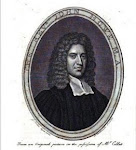
This ejected minister, father of Joshua, was born near Chesterfield, Derbyshire, about 1627. He was educated at the grammar school of Bromfield, Cumberland. Though of no university, he was a good scholar and mathematician. He held the rectory of Carsington, Derbyshire, having been appointed in or before 1649. His parishioners, according to Calamy, were 'very ticklish and capricious, very hard to be pleased in ministers,' but he suited them; and, though the living was worth but 70l., he refused a better offer of the perpetual curacy of Tamworth, Warwickshire. He was present, as a member, at the first known meeting (16 Dec. 1651) of the Wirksworth classis, of which he was a most regular attendant (15 times moderator) till its last recorded meeting (17 Nov. 1658). His sermon before the classis on 17 July 1655 was 'well approved' as 'orthodox and seasonable.' On 15 Jan. 1656, by appointment of the classis, he delivered the fifth of a series of doctrinal arguments directed against the errors of Socinians, his thesis being 'that the name Jehovah is incommunicable.' In the minutes, as in the Carsington parish register, his name is always written Otefield or Oateield (twice). By the Uniformity Act (1662) he was ejected from Carrington. After this he moved from place to place, sometimes attending the established church, and often preaching in conventicles. Latterly he settled at Alfreton, Derbyshire. Once a fortnight he preached at Road Nook, Derbyshire, in a house belonging to John Spateman, and was informed against for so doing. It was proved that he was 10 miles off on the specified day; the informers were prosecuted, and one of them pilloried at Derby.
For some time before his death he was disabled. He died on 6 June 1662, 'ætat. 55,' and was buried in Alfreton Church, where there is a brass plate to his memory. He married Ann, sister of Robert Porter (d. 1690), vicar of Pentrich, Derbyshire. Four of his sons entered the ministry:
(1) John (b. 1 Nov. 1654), who received Presbyterian ordination in September 1681, and afterwards conformed;
(2) Joshua (see previous post);
(3) Nathaniel, Presbyterian minister (1689-96) at Globe Alley, Maid Lane, Southwark (d. 31 Dec. 1696, aged 32);
(4) Samuel, who received Presbyterian ordination on 14 April 1698, and was minister at Woolwich, Kent, and from 1719 at Ramsbury, Wiltshire (living in 1729).
John Oldfield published
‘The First Last and the Last First . . . substance of . . . Lecture in the Country,' &c., 1666, 12mo (addressed by ‘J. O.’ to the 'parishioners of 'C. and W. in the county of D.') 
Calamy mentions that he published 'a larger piece about prayer.'
His last sermon at Carsington is in 'Farewell Sermons,' 1663, 8vo (country collection).
His ‘soliloquy’ after the passing of the Uniformity Act is abridged in Calamy; some striking sentences from it are noted in 'North and South,' 1855, vol. i. ch. iv., by Mrs Gaskell.

Bunhill Fields Joshua Oldfield 1656-1729

Alfred Light tells us that Oldfield's head-stone is in the third row south from Dame Mary Page. The inscription reads

Here lyeth the body of the Rev. Joshua Oldfield, dyed Nov. 8th, 1729, aged 73 years.

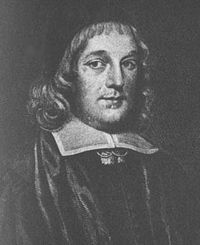
Mr. John Oldfield (c 1627-1681), the father of Joshua, was minister of the church at Carsington, Derbyshire, where his son Joshua was born in 1656. When the Act of Uniformity came into force Mr. Oldfield was ejected for non-conforming. He gave his son a most excellent education during his early years and afterwards sent him as a student to Christ College, Cambridge. Here Joshua became noted, not only for diligence in his studies, but also for his exemplary life and conduct. On leaving the University Oldfield became chaplain to Sir Philip Gell at his family seat in Derbyshire. Here he became very friendly with a clergyman in the neighbourhood, and they were accustomed to express their views to each other in very frank terms. At this time a good living became vacant, which was in Sir Philip's gift. It was offered to Oldfield. After due consideration he thanked his patron, but told him he could not conform either for that or even a greater living. Sir Philip, being anxious that Oldfield should become vicar of this parish, asked his clergyman friend to press the matter upon him. This he was glad to do, and a great deal of argument took place between the two. Oldfield, however, was immovable but being mindful of the kindness of his friend, he suggested that as he could not sacrifice his non-conformist principles, and the living was a much better one than the clergyman was then in, he should press his claims upon Sir Philip. The clergyman thanked Oldfield very heartily for his kindness and goodwill, but earnestly begged him not to repeat anything of the kind; he stated that he should have been glad to have drawn Oldfield into the Church in the hope of good being accomplished; but although he himself had no scruple in remaining in the Established Church, his conscience would not allow him to renew his assent and his consent to all that was in the Book of Common Prayer. After leaving Sir Philip Gell, Oldfield took the post of tutor to the son of Mr Paul Foley, who was Speaker of the House of Commons during the reign of William III, and he travelled with his pupil for a time in Wales and Ireland. He then became assistant to Mr. Samuel Doolittle, and the pastor of a congregation in Tooting, London. Acting upon the advice of several fellow-ministers he next removed to Oxford, where "he had but small auditory and very slender encouragement, but took a great deal of pains." Coventry followed Oxford, and here upon the suspicion of his giving instruction to young people, he was cited to appear before the Ecclesiastical Court on October 14th, 1697. It seemed as if serious trouble were in store for him, but after he had brought the matter to the King's Bench, which put him to great trouble and expense, it was allowed to drop, as William III gave the Ecclesiastical authorities clearly to understand that he was much displeased with such persecution and prosecution. He again returned to London, where first at Southwark and afterwards at Hoxton he kept an Academy which became world-famous.
During his latter years he met with many sore afflictions, as he was subject to apoplectic fits, but it is recorded that "the Providence of God made the last stage of his life easy and honourable under the disadvantage of his outward circumstances; of which he entertained a high sense of gratitude." His last illness was a short one, an account of which is given by his friend, Dr. Harris, who preached the funeral sermon.
"The day before he died," said the preacher, "I asked him whether all was easy and comfortable within. He said he had a judicious satisfaction and peace of mind, though by reason of present weakness and lowness of spirits he was dull and heavy. He was sensible his life was drawing to an end, and continued sensible to the minute, without any violent shock of dissolving nature, and with an undisturbed tranquillity of mind. He said, 'That nature must submit,' and 'that all was well, and all was easy within.' "This," added Dr. Harris, " was an honourable testimony to religion, after so long a trial, and from so wise, sedate, and upright a person."

Thursday, 24 October 2019

Farewell Sermons Contents of Current Volume

1- Edmund Calamy - Sermon from 2nd Samuel 24:14 "Let us Fall into the Hand of the Lord"
2- Thomas Manton - Sermon from Hebrews 12:1 - "The people of God that have such a multitude of examples of holy men and women set before them, should prepare themselves to run the spiritual race with more patience and cheerfulness."
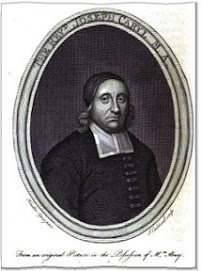
3- Joseph Caryl - Sermon from Revelation 3:4 - "In which encouragement I told you we might consider two things, or take it into two parts. First, " That they should walk with Christ." Secondly, " They should walk in white."
4- Thomas Case - Sermon on Revelation 2:5 - "CHRIST here prescribes precious physic for the healing of this languishing church of Ephesus; it is compounded of a threefold ingredient: 1. Self-reflection, " Remember from," &c. 2. Holy contrition and humiliation before the Lord, " Repent." 3. Thorough reformation, " Do thy first works."
5- William Jenkyn - Morning Sermon on Hebrews 11:38 - "The apostle in this excellent chapter, (that by some is deservedly called a little book of martyrs) discovers the triumph of faith, or victory against all difficulty we meet with."
6- William Jenkyn - Afternoon Sermon on Exodus 3:2-5 - "First then, for explanation, I shall here endeavour to open these two things to you: first, what it is for a place to be holy, or wherein the nature of the holiness of the places consists ; secondly, what that is, that is the foundation or cause of the holiness of places; and both these must in our discourse, and likewise apprehension, be accurately distinguished."
7- Richard Baxter - Sermon on Colossians 2:6,7 - "Omitting the division, and in part the opening of the words, the observation is ; - " That those that have received Christ Jesus the Lord, must accordingly be rooted, built Up in him, and established in the faith; and walk in him as they have been taught, and abound therein with thanksgiving."
8- Thomas Jacombe - Morning Sermon on John 8:29 - The observation I intend to speak to, shall be this: They that please God, and endeavour always to do the things that please God, such God will be with; such the Father will not leave alone; especially in times of suffering and trouble, for I will bring it to that case.
9- Thomas Jacombe - Afternoon Sermon on John 8:29 - Let me endeavour to prevail with every one of you, so to carry yourselves in your several places and capacities, that whatever you do, you may please God.
10- William Bates - Morning Sermon on Hebrews 12:20,21 - Now in these two verses he sums up, by way of recapitulation, all that which he had discoursed of at large, and in them you may observe these two things. 1. A description of God, to whom he addresses this prayer: The God of Peace. 2. The substance of the prayer itself.
11- William Bates - Afternoon Sermon on Hebrews 12:20,21 - It follows " that great Shepherd of the sheep." For the opening of this, 1. We will consider the title of Christ. 2. The person for whom this title relates.
12- Thomas Watson - Morning Sermon on John 13:34 - Doctrine. Christians ought to make conscience of this duty of loving one another. Confident I am, we shall never see religion thrive in the world, until we see this grace of love flourish in the heart of christians.
13- Thomas Watson - Afternoon Sermon on 2 Corinthians 7:1 - It is the title that I intend now, by the help of God, to insist upon, that sweet parenthesis in the text, "dearly beloved," wherein you have the apostle breathing forth his affections unto this people. He speaks now as a pastor, and he speaks to them as his spiritual children.
14- Thomas Watson - Farewell Sermon on Isaiah 3:10,11 - This text is like Israel's pillar or cloud; it hath a light side, and a dark side: it hath a light side unto the godly, "Say unto the righteous, it shall be well with him;" and it hath a dark side unto the wicked, "Woe unto the wicked, it shall be ill with him." Both you see are rewarded, righteous and wicked; but here is a vast difference, the one hath a reward of mercy, the other a reward of j ustice.
15- Thomas Lye - First Sermon on Philippians 4:1 - I shall without any more ado enter upon the text; in which you have two things considerable. A most melting compellation, and a most serious exhortation. 1. A melting compellation, "my brethren, dearly beloved," &c. 2. A serious exhortation; and in it first, the matter of the duty, stand, and stand it out, and stand fast. Secondly, the manner. First, so stand, so as you have stood, stand fast. Second, in the Lord; stand so, and stand in the Lord, in the Lord's strength, and in the Lord's cause.
16- Thomas Lye - Second Sermon on Philippians 4:1 - "It is the grand and indispepsable duty of all sincere saints, in the most black and shaking seasons, to stand fast fixed and stedfast in the Lord."
17- Matthew Mead - Sermon on 1 Corinthians 1:3 - Being therefore now to part, I thought to go to the top of the mount, and leave with you grace and peace from God our Father, and from our Lord Jesus Christ. In which words there are two generals. 1. A double blessing desired: Grace and Peace 2. A double spring discovered: that is the Father and the Son, God and Christ.
18- Matthew Newcomen - Sermon on Revelation 3:3 - There are three doctrines obvious in the text; Doctrine 1. That it is the duty of christians, to remember those truths that they have heard and received. Doctrine 2. That it is the duty of christians to hold fast the truth that they have heard and received. Doctrine 3. That continued repentance is the duty of christians, as well as initial repentance. Remember therefore how thou hast received, and heard, and hold fast and repent.
19- Thomas Brooks - Sermon on Questions Asked and Answered followed by 27 Legacies that Brooks Left to his Beloved People
20- John Collins - Sermon on Jude 3 - These words contain two parts. 1. A duty exhorted to. 2. The manner of the management of duty. The duty exhorted to, is, to retain the faith delivered to the saints. The manner of its management is, that we should earnestly contend to keep it.
21- Edmund Calamy - Sermons 1 Samuel 4:13 - I shall gather two observations from the words. 1. That when the ark of God is in danger of being lost, the people of God have thoughtful heads and trembling hearts. 2. That a true child of God is more troubled, and more solicitous what shall become of the ark, than what shall become of wife and children or estate.
22- John Gaspine - Sermon on Luke 12:32 - The text contains that exhortation of Christ, wherein he exhorts them to undauntedness and resolution in the ways of God. " Fear not, little flock, for it is your Father's good pleasure to give you the kingdom." The words may be divided into these two parts. First, Here is an exhortation: "Fear not, little flock." Secondly, The reason of this exhortation: "for it is your Father's good pleasure to give you the kingdom."
23- Lazarus Seaman - Sermon on Hebrews 13:20,21 - In which words, there are two two things considerable. 1. The matter of the apostle's prayer. 2. The grounds, which he doth insinuate for audience.
24- George Evanke - Sermon on Matthew 26:39 - Doct. A gracious soul will endeavour the crossing his own will, when be sees that it crosses God's. Or, thus, A true Christian dare not, at least ought not, to gratify his own humour when it stands in opposition, or cometh in competition with God's honour.

Tuesday, 20 August 2019

John Evans

This is from Welsh Biography online
JOHN EVANS 1628-1700 Born at Great Sutton, near Ludlow. His father, Matthew Evans, rector of Penegoes (near Machynlleth) and son of a former rector, was ejected from his living in 1650 by the Puritan Commissioners for the Propagation of the Gospel in Wales. The son had meanwhile matriculated (6 March 1647) at Balliol College, Oxford, but was ejected by the Parliamentary visitors in May 1648 and secretly ordained the same year (28 November) by Roger Mainwaring, the deprived bishop of St Davids. Changing his views (to the chagrin of his father), he was appointed, 23 March 1653, to take charge of the school set up by the commissioners at Bala, with a salary of £35 a year and a licence to preach. He was critical of the Protectorate, signing the remonstrances of 1654 and 1655, and in consequence had some trouble over recovering arrears of pay, but in 1656 the Council of State ordered payment of two years’ arrears and in 1657 he was elected by the bailiffs and burgesses of Oswestry (on the Protector's personal direction) to the headship of the municipal school there, from which his predecessor had been ejected for delinquency. The latter was reinstated in 1660, and Evans joined Rowland Nevett, the deprived Puritan vicar, in ministering to the Dissenting congregation there, and with Vavasor Powell in sustaining similar conventicles at Llanfyllin and Llanfechain. For this he was denounced in 1669 under the Conventicle Act; Palmer (Nonconformists’ Memorial, 1775, ii, 645) makes him also pastor of the Wrexham Independents from 1668. He formed a close friendship with Powell and after the latter's death (1670) and that of his own wife he married Powell's widow.
Under the Declaration of Indulgence he was licensed (May 1672) to preach to the Independent congregation at Wrexham that had first gathered round Morgan Llwyd, now meeting in a barn rented from Edward Kenrick, while the minister lived in the house in which John Jones the regicide had formerly accommodated Llwyd, and still belonging to the regicide's son. The revocation of the Declaration reduced Evans to poverty, which he relieved by selling much of his library and by acting as tutor to the children of gentlemen of rank in the district. Their protection, and especially that of lady Eyton (widow of Sir Kenrick Eyton of Eyton Isaf), saved him from persecution. In 1681 William Lloyd (1627-1717), bishop of St Asaph, made strenuous efforts to bring him to conformity, challenging him to public disputations; on his refusal he was fined and outlawed. He continued, however, to minister to his congregation, to which from 1689-91 the Presbyterians (who had worshipped separately under the Indulgence) were joined. From 1691 (when the Presbyterians withdrew and formed the New Meeting) Evans's congregation included Independents and Baptists, he himself (according to one account) inclining towards the latter in his later years. Declining health and loss of memory made it necessary for him during these later years to devolve most of his pastoral duties on assistants.
He died 19 July 1700, and was buried in the Dissenters’ graveyard at Wrexham. He left, by his second wife, a son, John Evans (1680-1730), and, by his first, a daughter, who married Timothy Thomas (friend of Matthew Henry) and whose son Timothy became an Independent minister at Pershore.

A recent message on 1662


See here for the message delivered at the recent Steadfast Conference

Saturday, 10 August 2019

Speaking on 1662 in London

It was great to speaking at a conference on the Great Ejection recently. Sold a few books too. Thanks Tom, Adam and co.

Thursday, 4 July 2019

Marmaduke Matthews 1606-1683

This is from the online Dictionary of Welsh Biography
Born at Swansea, 1606, the son of Matthew Johnes of Nydfywch, Llangyfelach, and Mary his wife. He matriculated from All Souls College, Oxford, 20 February 1623/4 and graduated BA 25 February 1624/5 and MA 5 July 1627. (Foster, Alumni Oxon.). In 1636 he was vicar of Penmain, Gower, and showed Puritan tendencies displeasing to the bishop of St Davids. Proceedings were begun against him in the Court of High Commission, but he emigrated to America [in 1638; he was pastor at Yarmouth, 1640, and at various other places in New England.]
In [1654] he returned at the request of colonel Philip Jones, and became minister of St John's, Swansea. He was ejected from the living in 1662. He took out a licence to preach under the Act of Indulgence, describing himself as an Independent. He died about 1683.
He was the author of The Messiah Magnified (London, 1659), The Reconciling Remonstrance (London, c. 1670), and other works.
His son, Lemuel Matthews (1644-1705), archdeacon of Down, matriculated from Lincoln College, Oxford, 25 May 1661, and became chaplain to Jeremy Taylor, bishop of Down. He obtained the archdeaconry of Down on 2 November 1674, and was appointed chancellor of Down and Connor in 1690. He was suspected of ecclesiastical misdemeanours and suspended from his offices by a royal commission. He died before his protracted appeals for redress brought any result.
Two other sons of his are known. Manasseh, born at Yarmouth, New England, left America with or soon after his father, and entered Jesus College, Oxford, in 1658, but did not graduate. He conformed, and became rector of Porteynon and afterwards (1670) vicar of Swansea. Mordecai, also born (c. 1640) at Yarmouth, went in 1655 to Harvard, and graduated there. He, too, left America, and was placed by the ‘Triers’ in the vicarage of Llancarfan. Ejected in 1660, he afterwards conformed, and in 1661 was given the living of Renaldston.