Wednesday, 6 July 2011

Millard The Great Ejectment of 1662

Benjamin A Millard's 1912 book The Great Ejectment of 1662 is just 114 pages and seeks to introduce the subject to young Congregationalists of the time. It is the sort of thing we need today updated.
It was published by the Congegational Union of England and Wales has 8 chapters.
1. Before the king came home - Giving the background and explaining the religous parties of the time (Independents, Presbyterians, Praltists adn Roman Catholics)
2. "Presbyterian" Ideals - Having explained their dominance among the Puritans at this time he says that they sought four things - 1. Limitation of the scope and powers of the Episcpal office 2. A more thorough and effective system of spiritual discipline 3. Omission of certain ceremonial acts and prohibition of certain vestments 4. Thorough revision of the Prayer Book inviolving omissions and additions.
3. The Act of Uniformity - Here he surveys the course of events to the passing of the act
4. "Black Bartholomew" - This relates the actual events of the time the act was implemented
5. The whip of scorpions - Here he realtes the persecution that followed including the bringing in of further Acts that served to make the suffering of the Nonconformists greater.
6. "Of whom the world was not worthy" - something further on the sufferings that were endured 1662-1688 with some examples
7. The spoils of victory (1) - After a brief review he give, first, more particular consideration to the matters arising, namely 1 The supremacy of Scripture 2 The responsibilities of conscience 3 The basis on which a National Church should be established 4 How spiritual unity can be realised
8. The spoils of victory (2)  - The final brief consideration is to do with 1 Human rights 2 Spiritual freedom


Peter Ince

The story of the ejected minister Peter Ince is often told. Coleman has it like this
A Pleasing Discovery
Mr Peter Ince, ejected from the rectory of Dunhead, in Wilts, after being silenced, clothed himself in the dress of a shepherd, and engaged himself in that capacity to a Mr Grove, that in this way he might obtain support for himself and his family.
But not long after the year 1662, the wife of Mr Grove, who was a gentleman of great opulence, was taken dangerously ill, and Mr G sent for the parish minister to pray with her. When the messenger came, he was just going out with the hounds, and sent word that he would come when the hunt was over.
Mr Grove expressed much resentment against the minister, for choosing rather to follow his diversion than attend his wife, under the circumstances in which she then lay, when one of the servants said, "Sir, our shepherd, if you will send for him, can pray, very well; we have often heard him at prayer in the field." Upon this he was immediately sent for, and Mr Grove asked him whether he ever did or could pray. The shepherd fixed his eyes upon him, and, with peculiar seriousness in his countenance, replied,
"God forbid, sir, I should live one day without prayer." Hereupon he was desired to pray with the sick lady, which he did so pertinently to her case, with such fluency and fervency of devotion, as greatly to astonish the husband and all the family that were present. When they arose from their knees, Mr. Grove said, " Your language and manner discover you to be a very different person from what your present appearance indicates. I conjure you to inform me who and what you are, and what were your views and situation in life before you came into my service." Whereupon he told him that he was one of the ministers that had been lately ejected from the Church, and that having nothing of his own left, he was content, for a livelihood, to submit to the honest and peaceful employment of tending sheep. Upon hearing this, Mr Grove said, "Then you shall be my sfiepherd/" and immediately erected a meeting-house on his own estate, in which Mr Ince preached, and gathered a congregation of Dissenters. He is said to have been a good scholar, well skilled in the languages, especially in the Hebrew, and a good practical preacher. He had an admirable gift in prayer, and would, in days of special prayer, pour forth his soul with such spirituality, variety, fluency, and affection, that he was called praying Ince.

Monday, 4 July 2011

English Religious Laws 1660-1728

                      English Religious Laws passed from 1660 to 1728
Act
Effect
Date passed
Date repealed
Duration
Comments
Corporation
Required oaths and communion for officers
1661
1828
167
Penalties reduced by Indemnity Act; Final repeal 1871
Licensing
Publications approved by Archbishop or Bishop
1662
1681
19

Uniformity [1]
Ejected nonc. ministers by 1664
1662

To present
Bartholomew Act
Uniformity [2]
Required teachers to take communion and have Bishop’s License
1662
1689
27

Uniformity [3]
Required oath 39 Articles universities
1662
1871
207
Changed in 1772
Quaker
Banned Quaker assemblies, required oaths
1662
1689
27

Conventicle  [1]
Banned religious gatherings of more than 5
1664
1670
6

Five Mile
Banned ejected ministers and unlicensed preachers within  5 miles of towns
1665
1689
24

Conventicle [2]
Banned religious gatherings of more than 5
1670
1689
19

Test
Civil/military officers must take communion, renounce Mass, swear Corporation oaths, aimed at Catholics, also affected other Nonconformists
1673
1829
156
Penalties reduced by Indemnity Act
Papist’s Disabling
Barred Catholics from Parliament
1678
1829
151

Toleration
Suspended penal laws agt. Nonconformists, allowed Trinitarians to license chapels
1689

To present
Modified in 1779
Blasphemy
Penalties incl. death for arians, socinians and atheists
1697
1813
116

Occasional Conformity

Barred  Dissenters from taking Anglican communion to qualify for office
1711
1718
7

Schism
Barred Dissenters from keeping schools
1714
1718
4

Indemnity
Reduced penalties under Test and Corporation Acts; allowed Dissenters to hold offices
1728

Intermit-tent
Became annual from 1756 until repeal of Test and Corporation Acts

Baptists and 1662

This is a 46 page Carey Kingsgate booklet from 1962 containing two essays, one by E A Payne and one by Norman S Moon giving the background to 1662 and saying what there is to be said about Baptists in that connection. Moon says that according to W T Whitley no more than 26 Baptists were among the 2,000 (Payne suggests less). Most notable was Henry Jessey of Southwark. Others include Richard Adams, Richard Breviter, Daniel Dyke, John Donne, John Gibbs and John Tombes. Also note Vavasor Powell, John Miles and Thomas Ewins. Payne also points out that Francis Bampfield and others later became Baptists, after their ejection. The conventicle act affected Baptist churches quite a bit and at the end of 1662 there were 289 Baptists in Newgate Prison and 18 in The Tower. The booklet takes the story into the more recent past, mentioning The Occasional Conformity Act of 1711, Dissenting Academies, Carey and the eventual repeal of the Test and Corporation Acts in 1828.
(An article on the subject by W T Whitley can be found online here)

Books on the subject 1962

See here for a summary of some books published in conncection with our subject in 1962.

Thursday, 9 June 2011

James Forbes

(From Wikipedia)
Forbes was born in or about 1629. He was educated at Aberdeen University, where he proceeded MA, being subsequently admitted ad eundem at Oxford. In 1654 he was sent to Gloucester Cathedral, where he preached ‘with great success, but to the apparent danger of shortening his life.’ At the Restoration he was speedily ejected from the cathedral, but he still continued at Gloucester, ‘ministering privately as he could.’ Struck by his talents, Robert Frampton, then dean, but afterwards bishop of Gloucester, ‘courted him to conformity in vain.’
In consequence of the "Yarranton Plot" or "Pakington Plot", he was committed to Chepstow Castle, where he was kept a long while. On regaining his liberty he returned to his pastoral charge; he was often imprisoned in Gloucester, on one occasion for a whole year; he was indicted under the Corporation Act, the penalty of which was imprisonment. He was also indicted under 23 James I, the penalty of which was £20 a month, and under 35 Elizabeth, of which the penalty was to abjure the realm or suffer death. At the same time, also, he was excommunicated, and the writ de excom. capiendo was out against him.
At the time of Monmouth's rebellion he retired to Enfield, Middlesex, and there continued in his ministry. He was later recalled to Gloucester, where he continued to labour until his death. Altogether, he exercised his ministry in Gloucester for 58 years, less one month. He died 31 May 1712, aged 83, and was buried under his own communion-table. His funeral sermon was preached by John Noble of Bristol. Edmund Calamy, who represents him as the model of a nonconformist divine, states that at his death he left gifts to charitable uses, including his library (now in Toronto).

Thursday, 19 May 2011

Hendon area

Francis Warham, the vicar ejected in 1662, was licensed as a Congregationalist in 1672, when he was living at Upper Hale. Richard Swift, ejected from Edgware in 1660, was imprisoned on several occasions for holding conventicles in his house, Jeanettes, at Mill Hill. The Independents who registered Samuel Everard's house at Childs Hill as a place of worship in 1672 may have been the dissenters who registered Mary Everett's house there in 1690.

From: 'Hendon: Protestant nonconformity', A History of the County of Middlesex: Volume 5: Hendon, Kingsbury, Great Stanmore, Little Stanmore, Edmonton Enfield, Monken Hadley, South Mimms, Tottenham (1976), pp. 39-43. See here.

Grandsons of the Ejected

Among the well known grandsons of ejeced ministers are

Philip Doddridge 1702-1751. His grandfather John Doddridge 1621-1689 was rector of Shepperton, Middlesex until 1662. 
John Wesley 1703-1791 (like his brothers) had ejected grandfathers on both sides. Both Dorset vicar John Westley 1636–1678 and Samuel Annesley c 1620-1696 of St Giles Cripplegate were grandfathers to the famous Methodist and Arminian. (John Westley's father Bartholomew Westley 1596–1680 was also ejected).
Henry Grove 1684–1738, an English nonconformist minister, theologian and dissenting tutor had a grandfather who was ejected from Pinhoe in Devon.


Tuesday, 26 April 2011

The Ejected (93 of them)

Articles are currently available on 93 people who were ejected on Wikipedia here.
A
Richard Adams (religious writer)
Thomas Adams (writer)
Joseph Alleine
Richard Alleine
Vincent Alsop
Isaac Ambrose
Samuel Annesley

B
William Bagshaw
Nathanael Ball
Matthew Barker
William Bates (minister)
Richard Baxter
Thomas Baylie
William Benn (divine)
James Bradshaw (1613-1685)
James Bradshaw (minister)
John Brinsley the younger
Thomas Brooks (Puritan)
John Bryan (minister)
Anthony Burges
Cornelius Burges
Ralph Button
Richard Byfield

C
Edmund Calamy the Elder
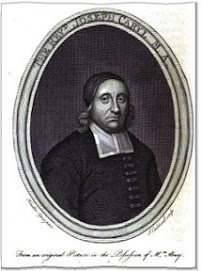
Joseph Caryl
Thomas Case
Daniel Cawdry
Stephen Charnock
Samuel Clarke (annotator)
Samuel Clarke (minister)
John Collinges
William Cooper (Puritan)
Zachary Crofton
Samuel Crossman

D
William Dell
Thomas Doolittle
Daniel Dyke

F
Giles Firmin
John Flavel
Thomas Ford (minister)
Richard Frankland (tutor)

G
Richard Gilpin
Thomas Gouge
William Greenhill
Obadiah Grew

H
Thomas Hall (minister)
Timothy Hall (bishop)
Samuel Hammond (minister)
Philip Henry (clergyman)
Oliver Heywood (minister)
Joseph Hill (lexicographer)
Leonard Hoar
Thomas Horton (Gresham College)
Charles Hotham (rector)
John Howe (Puritan)
John Humfrey

J
Arthur Jackson (minister)
James Janeway
William Jenkyn
Thomas Jollie

L
Henry Langley
Nicholas Lockyer

M
William Manning (Unitarian)
Thomas Manton
Walter Marshall (Puritan)
Adam Martindale
Edmund Staunton
Richard Mayo (minister)
Matthew Mead (minister)
Charles Morton (educator)

N
Henry Newcome
Matthew Newcomen

O
John Oxenbridge

P
William Pell (minister)

R
Edward Reyner
Thomas Rosewell
John Rowe (minister)

S
Lazarus Seaman
John Shawe
William Sherwin (minister)
William Spurstowe
Nathaniel Stephens (clergyman)

T
Francis Tallents

V
Ralph Venning
Nathaniel Vincent
Thomas Vincent

W
Thomas Watson (Puritan)
Bartholomew Westley
John Westley
Henry Wilkinson (canon)
Henry Wilkinson (dean)
Benjamin Woodbridge
Hezekiah Woodward

The Savoy Conference

(From Wikipedia)

The Savoy Conference of 1661 was a significant liturgical discussion that took place, after the Restoration of Charles II, in a supposed attempt to effect a reconciliation within the Church of England.
It was convened by Gilbert Sheldon, in his lodgings at the Savoy Hospital in London (where the Savoy Hotel now is) and was attended by commissioners: 12 Anglican bishops and 12 representative ministers of the Puritan and Presbyterian factions. Each side also had nine deputies (called assistants or coadjutors). The nominal chairman was Accepted Frewen, the Archbishop of York. The object was to revise the Book of Common Prayer. Richard Baxter for the Presbyterian side presented a new liturgy, but this was not accepted. In 1662 the Act of Uniformity followed and the Great Ejection.

Commissioners
The nominated commissioners and deputies were as follows:

Accepted Frewen, Archbishop of York
Gilbert Sheldon, Bishop of London
John Cosin, Bishop of Durham
John Warner, Bishop of Rochester
Henry King, Bishop of Chichester
Humphrey Henchman, Bishop of Salisbury
George Morley, Bishop of Worcester
Robert Sanderson, Bishop of Lincoln
Benjamin Laney, Bishop of Peterborough
Brian Walton, Bishop of Chester
Richard Sterne, Bishop of Carlisle
John Gauden, Bishop of Exeter

For the presbyterians (eventually ejectees marked *):
Edward Reynolds, Bishop of Norwich
Anthony Tuckney*
John Conant (Reynolds' son-in-law)
William Spurstow*
John Wallis
Thomas Manton*
Edmund Calamy*
Richard Baxter *
Arthur Jackson*
Thomas Case*
Samuel Clarke*
Matthew Newcomen*

Deputies
On the episcopal side:
John Earle, Dean of Westminster
Peter Heylin Sub-dean of Westminster.
John Hacket
John Barwick
Peter Gunning
John Pearson
Thomas Pierce
Anthony Sparrow
Herbert Thorndike

On the presbyterian side:
Thomas Horton (ejected but then conformed) 
Thomas Jacomb*
William Bates*
John Rawlinson*
William Cooper*
John Lightfoot
John Collinges*
Benjamin Woodbridge (ejected but then conformed and then became a nonconformist again)

There was to have been one more deputy on the presbyterian side, the former physician Roger Drake*. A clerical error caused his name to appear as "William Drake" in the official document, and he did not actually attend.